Far to the north, where the wind cleanses the air and the light dances across the tundra, the drum is created and carried forth as more than just a musical instrument. In the Indigenous traditions around the Arctic – from the Sami, by way of Siberian shamans to the Inuit and Chukchi – the consecration of the drum is carried on as both myth and practice. To consecrate the drum is to awaken its spirit and its place in the community, and to bind together the powers of the human being and of nature.
The drum's birth
It all begins with the selection of the materials. In Siberia the shaman senses a particular respect as he
"hunts for the soul of the drum, the animal from which the hide is to come."
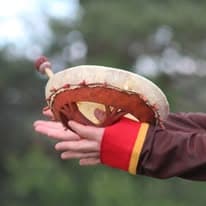
The frame is often bent from birch; its supple strength connects upward to the sky and deeper down into the earth. The hide is often taken from reindeer, goat or another sacred animal, and it is said that the animal's spirit will make its journey into the drum. The body of the drum remains "empty" for now – it waits to be awakened.
Faint traces and powerful symbolism
In Sami tradition the knowledge of consecration is more elusive, preserved between the lines of old court records and accounts written by outsiders. Here we find fragments of fact: the drum was often made by the noaide himself or by close family, sometimes decorated with symbols for the world, the gods and the powers. The drum could "pass down through inheritance," and ritual acts such as sacrifice or fasting could mark its transfer – but genuine, detailed descriptions of a formal consecration ritual are rare in the oldest sources.
It is known, however, that the drum was not simply taken into use. It was presented to the spirits and supplied with offerings: blood, fat, tobacco. Perhaps the noaide let the drum hover over the fire, perhaps he sang old joiks to lure the "life spirit" into wood and hide. The drum was to be "awakened" and made ready for its work as a bridge to the spirit world.
The great giving of life
Among Siberian peoples such as the Evenki, Altaians and Chukchi, the consecration of the drum is a deep and detailed ceremony. Here kin and village gather; the materials have been chosen with care. The shaman-to-be may symbolically "hunt" for the animal's soul and bring it into the drum through story, song or dance.
The drum is purified over fire – often rotated nine times sunwise over the embers, to bind itself to the cycle of the universe and to the life-giving power of the Sun. Milk, vodka and blood are offered, and the drum is fed to make it a friend of the spirits.
The drum is then decorated with symbols for the three layers of the world, bells and bands that give it voice. Finally it is taken into the community: all touch or play the drum, sing and dance, so that not only the shaman, but the whole clan, is greeted in together with the sacred implement. Only then is the drum ready for its first spiritual journey.
The Inuit and common features in the north
Among the Inuit and several Arctic peoples one finds similar, but often simpler, traditions. The drum is consecrated with dances and songs, gratitude to the animal's spirit, perhaps a symbolic smudging or a ceremony in which the whole community touches the drum. The consecration is always about passing from the ordinary to the sacred – that the drum steps in as a living being between human and spirit world.
Common features of drum consecration in northern traditions
🔸 Respect for the materials
– The wood and the animal hide are chosen with care and regarded as living and sacred.
– Animals and trees have spirits that must be acknowledged or formally called into the drum.
🔸 Animation of the drum
– The drum's "spirit" is awakened or invited in.
– In some traditions this happens through a symbolic hunt for the animal's soul.
🔸 Ritual purification or sanctification
– The drum is purified or "born" with the help of fire, incense or blood.
– In Siberian traditions the drum is rotated over fire (often 3, 7 or 9 times).
🔸 Offerings to the drum's spirit
– Food, milk, blood, fat, metal objects, tobacco or liquor are offered to appease or attract the spirits.
🔸 Decoration with symbols
– After the consecration the drum is painted or adorned with symbols (for the levels of the world, power animals, the sun, spirits, etc.).
– Colors, bands and metal ornaments (such as bells) are added to give the drum sound, power and direction.
🔸 Collective participation or communal marking
– The consecration does not take place alone, but in community: with dance, song, touch or a complete ceremony.
– It marks that the drum serves not only the shaman, but the whole clan/community.
🔸 The drum's first use/spirit journey
– The newly consecrated shaman uses the drum for the first journey to the spirit world.
– The drum is finally connected to spirit helpers, nature forces and the structure of the world.
🔸 The drum as a living being
– The drum is seen as more than a tool – it is a fellow traveler, a spiritual companion and protector.
– It is often referred to with a personal pronoun ("he/she") and given a kind of "name/will."
These common features recur, to varying degrees, in Sami, Siberian, Inuit, Finnish and – probably – Norse shamanic tradition, even though the degree of preserved detail varies greatly.
A proposal for a modern consecration ceremony for a shamanic drum
This ritual combines essential features from Sami, Siberian, Finnish, Norse and Arctic tradition to mark the drum's birth as a spiritual implement today. The ritual can be adapted individually or performed in community.
- Preparation and consecration of the space
Choose a quiet place, preferably in nature (or a spiritually consecrated indoor area).
Place the drum, the drumstick and any offerings (milk, tobacco, herbs, textile bands, a small piece of food or liquor).
Draw a circle on the ground or floor as a sacred space – use stones, twigs or flowers if you wish.
Light a fire or a candle to represent the cleansing power of fire.
- Calling the directions and the spirit world
Stand in the middle of the circle with the drum.
Turn toward the four cardinal directions one after another: north, east, south, west.
For each direction:
Raise the drum and speak a short prayer or intention.
Give thanks to the forces of nature and ask for protection and blessing for the drum.
- Purification and "animation" of the drum
Hold the drum over the fire or sway it over the candle/incense, and say:
"May the purity of fire cleanse, awaken and give power to you."
Drip a little milk, pour a little tobacco or the chosen offering onto the ground as thanks to the spirit of the animal and the tree that gave material to the drum.
Say:
"I thank you, reindeer/goat/tree, for your gift. May your spirit dwell in this drum."
- Decoration and personal intention
Tie a band, a tassel or a symbol to the drum that expresses your worldview, your protector, or a direction you wish to strengthen.
Paint or hang bells on it if desired.
Sing or joik your own song or the drum's song; let sounds from the heart stream out to the drum.
- Collective participation (optional)
Invite friends, family or a community.
Let all who wish to touch the drum and welcome it sing, dance or send their wishes and blessings into the drum.
Let the drum "pass" around, so that it becomes part of the community.
- First use and spirit journey
When you feel the drum is ready, sit in stillness.
Strike the drum gently; close your eyes and focus on feeling its pulse – imagine that you are traveling to the spirit world together with it.
Ask that the right helpers, spirits and nature forces accompany you and the drum on future journeys.
- Closing and thanks
Go once more through the four directions, give thanks for protection and presence.
Blow out the candle/fire and say:
"The drum is born – from now on we are traveling companions."
References
Andersen, P. A. (2020). Samiske trommer og kulturell revitalisering: En studie av Paul-Ánde-trommens tilbakekomst. Master's thesis, UiT The Arctic University of Norway.
https://munin.uit.no/handle/10037/19163
Bäckman, L., & Hultkrantz, Å. (1978). Studies in Lapp Shamanism. Stockholm: Almqvist & Wiksell.
Christoffersson, T. (2022). Bruken av tromme i sjamanismen og dens symbolske betydning. Tidsskrift for Religion og Samfunn, 14(2), 89–102.
Gjessing, G. (1954). Runebommer: Et bidrag til samenes religion og historie. Oslo: Instituttet for sammenlignende kulturforskning.
Hagen, R. (2005). Sámi Religion – Historical Continuity and Change. In B. Bertelsen, J. E. Fossum & C. Moe (Eds.), Sami Culture in a New Era: The Norwegian Sami Experience (pp. 130–148). Davvi Girji.
Helander-Renvall, E. (2010). Animism, personhood and the nature of reality: Sami perspectives. Polar Record, 46(1), 44–56. https://doi.org/10.1017/S0032247409990042
Kolberg, A. (2020). Norsk nysjamanisme i media: En fremstilling av det moderne sjamanistiske landskapet i Norge. Master's thesis, University of Oslo.
https://www.duo.uio.no/handle/10852/81120
Manker, E. (1950). Die lappische Zaubertrommel. Eine ethnologische Monographie. Erster Teil: Die Trommel als Denkmal materieller Kultur. Stockholm: Nordiska Museet.
Máilmmi giellačálanráđđi. (2022). Sjamantromme (encyclopedia article). Store norske leksikon.
Niemi, E. (1997). Kvensk kultur og historie i Nord-Norge. Tromsø: Universitetsforlaget.
Rydving, H. (1993). The End of Drum-Time: Religious Change among the Lule Saami, 1670s–1740s. Uppsala: Uppsala University.
Steinsland, G. (2005). Norrøn religion: Myter, riter, samfunn. Oslo: Pax forlag.
Thuen, T. (2002). Religion i veiviseren – Det gamle samiske verdensbildet i møte med kristendommen. In T. Thuen & H. Eidheim (Eds.), Religiøs pluralisme i Sápmi (pp. 55–76). Institute for Social Research, University of Tromsø.
Vestbø, S. (2021). Hva er en trommereise? Article. Retrieved from