Andvare is a complex figure in Norse mythology whose story bears the marks of both material and spiritual conflicts. His role as guardian of a cursed gold hoard and his ability to undergo animal transformations leave room for a deeper analysis through a shamanic perspective.
Andvare's mythological framework
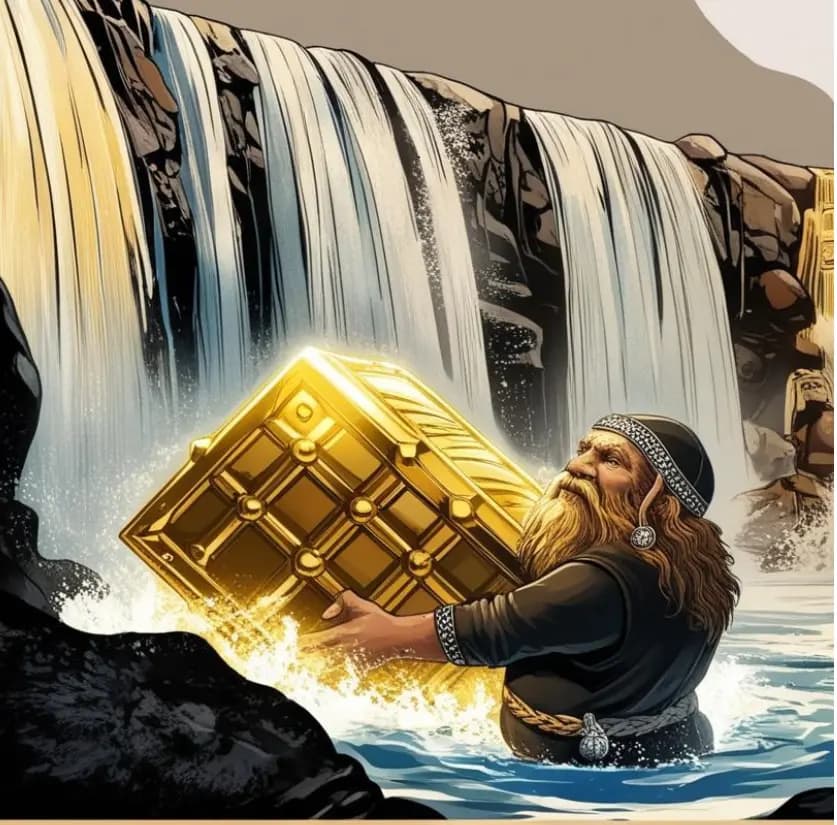
According to the Volsunga Saga and Snorri's Edda, Andvare is a dwarf who lives beneath the Andvare Falls, where he guards a gold hoard including the magical ring Andvaranaut. With the help of Ran's net, Loki catches him in the shape of a pike and forces him to surrender all his riches. Andvare responds by laying a curse upon the ring, which brings ruin to all its owners – an act that sets in motion the tragedies described in the Volsunga Saga.
Etymological roots
The name Andvari (Old Norse "the cautious one") suggests a character marked by wariness and the guarding of treasures. This contrasts with his fate as a victim of Loki's plunder, which underscores the theme of fate controlled by external forces.
Shamanic analysis of Andvare's transformations
Andvare's ability to transform himself into a pike can be read as a shamanic practice
Animal shapeshifting and spiritual portals
In Siberian shamanism, animal transformation is a method for navigating between worlds. Andvare's pike form can be interpreted as:
A way to escape physical threats (Loki's hunt)
A technique for communicating with the spirits of the water
A physical manifestation of his spiritual essence
The source points out that the Vanir (such as Freyja) were connected to seiðr magic, in which animal helper spirits played a central role. Andvare's transformation may thus reflect a dwarf version of this practice.
The cosmology of the cursed ring
The curse of Andvaranaut analyzed through a shamanic lens:
The dual nature of magical objects
The ring functions as both:
A measure of value - created by the dwarves' subterranean metallurgy
A weaver of fate - bearing influence upon the threads of life
This accords with Tolley's observations that Norse magic often combined practical and spiritual functions.
The dynamics of the curse
Andvare's decision to bewitch the ring can be seen as:
A shamanic "spiritual guard post" act
A ritualized defense against the profanation of sacred knowledge
A reflection of the Norse belief that metalwork contained creative life force (megin)
The structure of the ritual in the myth
Loki's capture of Andvare can be seen as a shamanic initiation rite
Acquisition of Ran's net (a spirit tool)
Descent into the underworld of the falls
A struggle of power with the dwarf's spirit
Acquisition of a cursed object of power
Bringing the treasure back to the world of the gods
This structure recalls shamans' journeys to the underworld to retrieve or control spiritual resources.
Source references
The Volsunga Saga – Primary source for Andvare's myth
Tolley, Clive (2009) – Shamanic analysis of Norse magic
Simek, Rudolf (1993) – Dictionary of Northern Mythology
The Prose Edda (Snorri Sturluson) – The mention of Andvare
Eliade, Mircea (1951) – Shamanism: Archaic Techniques of Ecstasy
Rønnebech, Erik F. (n.d.) – Lexicon of Norse mythology
Hutton, Ronald (2011) – Shamanic interpretation of seiðr
Gesta Danorum (Saxo Grammaticus) – Alternative traditions
Hammer, Jill (2007) – The role of the völva in Norse spirituality
van Hamel, A.G. (1932) – Ritual structures in eddic poetry