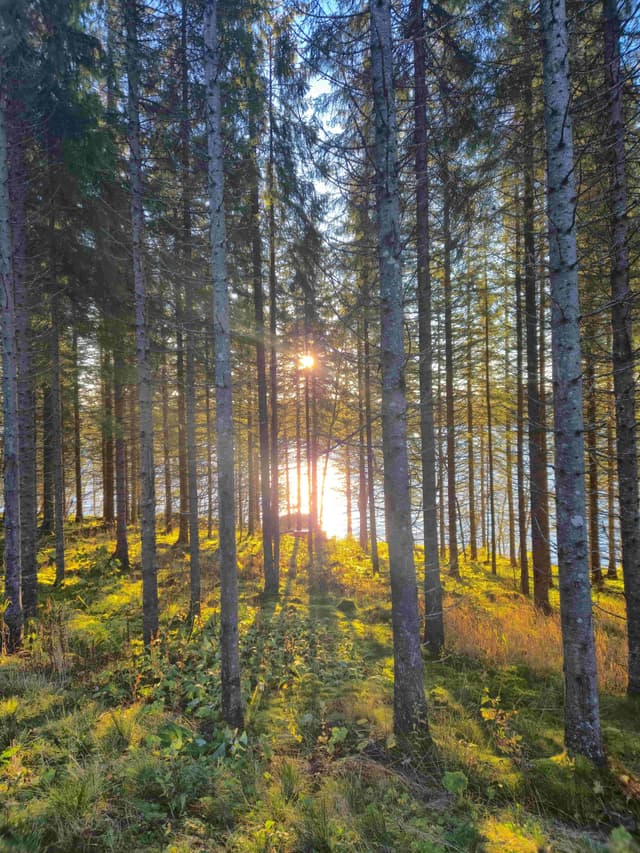
Deep within the silent forests along the border between Norway and Sweden lies a piece of cultural heritage that almost vanished into oblivion. There, in Finnskogen, lived and still live the descendants of the Finnish immigrants who in the 1600s settled in what were then desolate forest regions. They brought with them their traditions, their language – and not least their incantations.
These were not just words. They were words with power. Words meant to stop the blood in an open wound, drive off an angry dog, lift away a boil, or protect against evil from humans, animals and beings of the underworld alike. They were words that could almost be tasted – coarse, poetic, powerful – the words of people who lived close to nature and depended on understanding and negotiating with it.
The legacy of Kaisa Vilhuinen
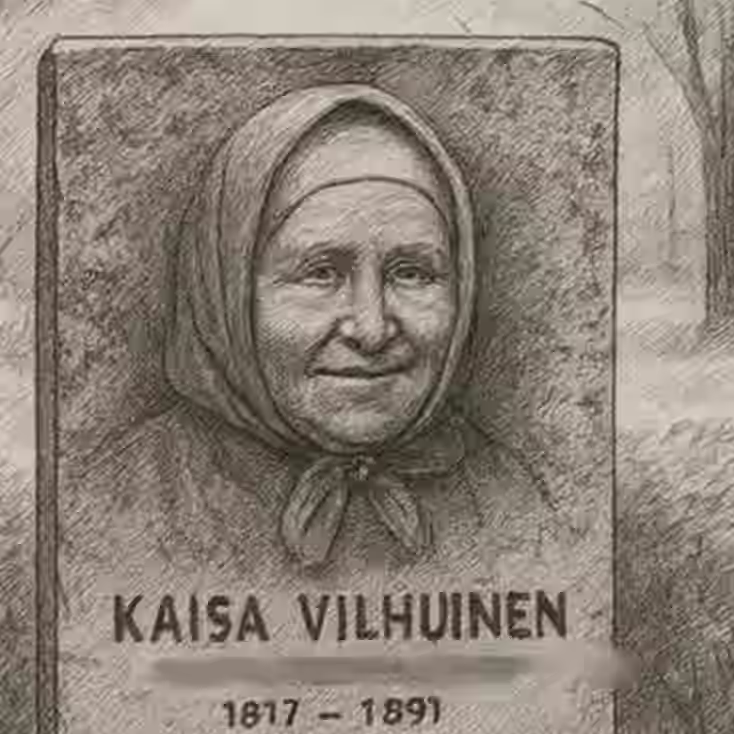
Many of these incantations were preserved thanks to Kaisa Vilhuinen (1855–1941), an elderly woman who grew up in Finnskogen and who still spoke Finnish as the immigrants had done generations before.
In the 1920s, linguists such as Lauri Kettunen and Väinö Salminen came to Finnskogen with Edison phonographs to document both the language and the traditions. At a time when this world was on the verge of disappearing, they captured Kaisa's voice on fragile wax cylinders. Their recordings – stiff with technological limitations, but full of life – hold ancient words that had lived for hundreds, perhaps thousands, of years.
In 2007 the musician Ove Berg Russanen chose to breathe new life into this material. With instruments such as the kantele – Finland's national stringed instrument – he created music that both preserves and conveys. The result was the album Incantations of the Forest Finns, a unique blend of historical recordings, newly composed music and recitation.
Words that could heal – and harm
The Forest Finnish incantations were used for many purposes. Some were gentle, like prayers against illness. Others were aggressive and full of images we might today find brutal. But in the world in which they arose, this was serious – literally a struggle of life and death.
Let us walk through some examples:
- Cock, rise up! – against impotence
A mischievous incantation, full of erotic imagery, in which a rooster (cock) is urged to rise up. Kaisa once ended the recitation by saying:
"Then the men really woke up."
- Rollota, Rollota – the smoke out
In the smoke houses, dwellings without a chimney, the smoke had to find its way out through a hole in the roof. When it would not, one could "talk it out" with this rhythmic formula. Since then it has even been used as support for those who wanted to quit smoking.
- Blood-stemming – stopping bleeding
With biblical imagery – Moses stopping the river Jordan – the blood is commanded to stand still like a wall or a fence.
- Against wasp stings
Here the wasp is spoken of as a little bird that can sting bark and wood, but not the human being. The accounts that such words actually helped still live on.
- Against boils
One of the most drastic: the boil is commanded into the genitals, into waterfalls and finally down into hell. The language is coarse, but carries the strength of a magic that hid nothing.
- Against adder bites
The words send the illness into the depths of the earth – or into the serpent's own realm in the underworld.
- Against aggressive dogs
The dogs are commanded to bark at themselves and to draw in their claws and teeth. For women it was enough to lift the hem of their skirt.
- Creating a milk-hare (Para)
One of the most legendary rituals. One makes a doll out of yarn, hide and a pin, whips life into it over nine Thursday nights – and sends it out to steal milk from the neighbour's cows.
Between shamanism and Christianity
The incantations stem from Finno-Ugric shamanism, but also bear the mark of Christian influence after the Reformation. Here we find the combination of invoking the Holy Trinity and commanding a demonic force straight down into hell.
The symbol of this spiritual synthesis is also found in the music: the playing of the kantele. In olden times this was the shaman's tool, just as the Sami runic drum was. The five-stringed kantele had strings of animal gut or horsehair, and its sound is soft and hypnotic – perfect as a backdrop for the monotonous rhythms of the incantations.
Magical boundaries and protection against evil
In addition to the words, the Forest Finns used magical symbols.
Pentagrams and crosses carved into barn doors, outbuildings and saunas marked an invisible boundary against dark forces: "this far, but no further." At the Vesterhaug farm in Brandval Finnskog, one such barn door was preserved and brought to the Norwegian Forest Finn Museum.
From wax cylinder to streaming
That we can hear Kaisa's voice today is a small miracle in itself. The wax cylinders from 1905 and 1926 were preserved, cleaned and digitised. The album "Tirun Lirun" makes them available to everyone, while Ove Berg Russanen's new recording ties the thread to our own time.
Forest Finnish incantations are a part of our Nordic cultural heritage that lets us hear the echo of voices from the past. They are living testimonies of how people through the centuries have used language, music and symbols to influence their reality – to protect, to heal, or to avenge.
That we can still hear them, and even feel their rhythm and power, is owed to courageous bearers of tradition – such as Kaisa Vilhuinen – and to modern conveyers such as Ove Berg Russanen.
Sources
Incantations of the Forest Finns, Ove Berg Russanen, Nordic Sound, 2007
Recordings and translations of Kaisa Vilhuinen, Lauri Kettunen, Väinö Salminen (1905, 1926)
Tirun Lirun – traditional recordings from Finnskogen
Research and commentary by Timo Leisiö and Sinikka Langeland
Norwegian Forest Finn Museum – documentation and artefacts
Olaf Lindtorp: Fra Finnskogene i Solør og Värmland (1940s, reissued 2017)
Oral accounts from descendants in Finnskogen