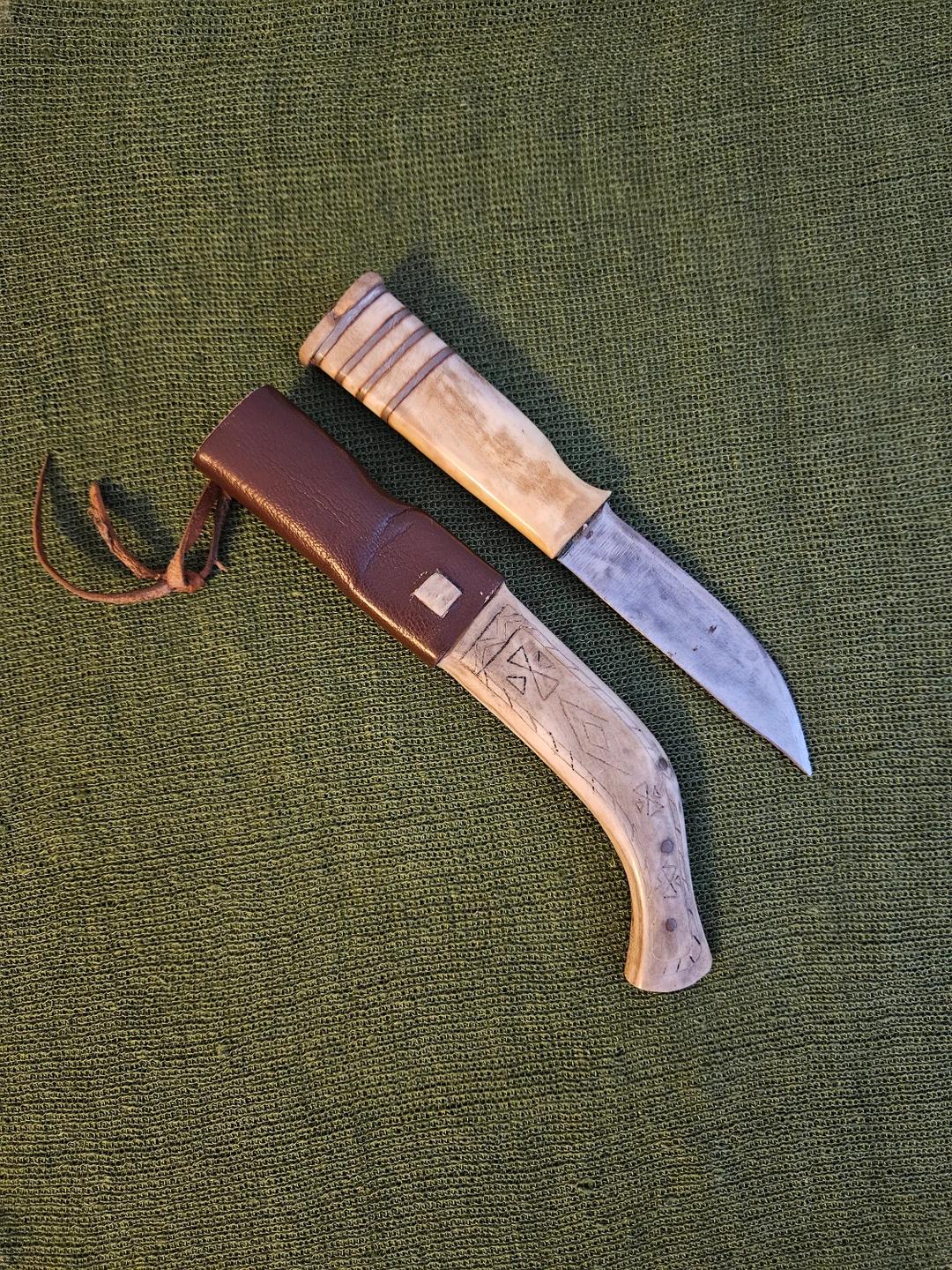
The ceremonial knife plays a central role within shamanic practice, particularly in Sami and Norse tradition. In Norway, Sjamanistisk Forbund has recognised it as a sacred tool, used specifically in ceremonies such as knife healing. This article explores the knife's significance, use, and legal status in a modern Norwegian context.
The knife's significance and use in Sami tradition
In Sami culture, two types of knife are traditionally used:
Buiku, puukko, or unna niibaš ("small knife")
Stuorra niibi ("large knife")
The large knife, often called the Sami knife or Finnish knife, has a long, broad, and powerful blade of between 20 and 45 cm. Beyond its practical use in everyday life, this knife takes on a deeper, spiritual significance in a shamanic context. In shamanic practice, the ceremonial knife is regarded as a sacred instrument for channelling energy and performing sacred acts during ceremonies. It is not used as a weapon, but as a ritual implement with deep roots in both Sami and Norse traditions.
Ceremonial use and healing
In Sami shamanism, or noaidevuohta, the knife serves as a tool for the noaidi (shaman) to:
Channel energy
Perform symbolic cuts to remove negative energies
Mark sacred areas
Assist in drum journeys and other ritual practices
In a healing context, the knife can symbolically "cut away" illness or negative energies from a person, without physical contact. This illustrates how the knife transcends its physical form and becomes a powerful spiritual tool.
Legal aspects and the knife law
The use of the ceremonial knife naturally raises questions about the legality of carrying a knife in a public place. In Norway, this is regulated by Section 189 of the Penal Code, which generally prohibits carrying a knife in a public place. The law does, however, allow for exceptions when the knife is carried in connection with work, outdoor activities, or other legitimate purposes. The knife law has undergone some changes since 2012, but the core of the legislation remains largely unchanged. The main points of today's knife law are:
A general prohibition against carrying a knife in a public place.
An exception for knives used in connection with work, outdoor activities, or other legitimate purposes.
A total ban on certain types of knives such as switchblades and stilettos.
Sjamanistisk Forbund's legal assessment
Sjamanistisk Forbund has had a legal assessment carried out on the use of the ceremonial knife in connection with their ceremonies. This assessment concludes that carrying a ceremonial knife during shamanic ceremonies falls under "legitimate purposes" in the sense of the law. This means that members of Sjamanistisk Forbund may carry a ceremonial knife in connection with the performance of religious ceremonies without breaking the law.
Guidelines for use
It is important to note that even though the use of the ceremonial knife is permitted in a religious context, it must still be handled with respect and care. For users of the ceremonial knife in shamanic practice, it is important to be aware of the following:
Religious or cultural use may potentially fall under "legitimate purpose" in the sense of the law.
It is recommended to seek legal guidance for specific use in public settings.
Private use in closed ceremonies is generally not affected by the prohibition against carrying a knife in public.
The shamanic community depends on the goodwill of law enforcement, so comply with any orders or ensure good communication with them. Let the association handle a matter afterwards instead. Do not seek confrontation.
The ceremonial knife remains an important element in Sami and Norse shamanic practice, with deep cultural and spiritual significance. Through legal recognition and careful regulation, Sjamanistisk Forbund has succeeded in preserving this important part of its religious practice while complying with Norwegian law. This shows how traditional religious practices can be adapted and integrated into modern society, as long as it is done with respect for both the tradition and applicable laws. The continued use of the ceremonial knife in a modern context illustrates how ancient traditions find their place in today's society, balanced between cultural preservation and legal compliance.
Membership of Sjamanistisk Forbund is free