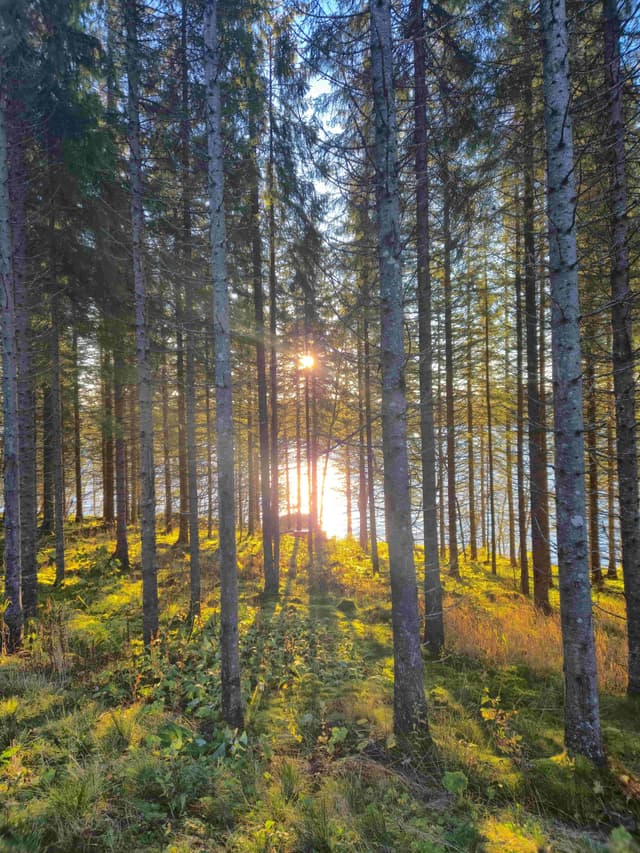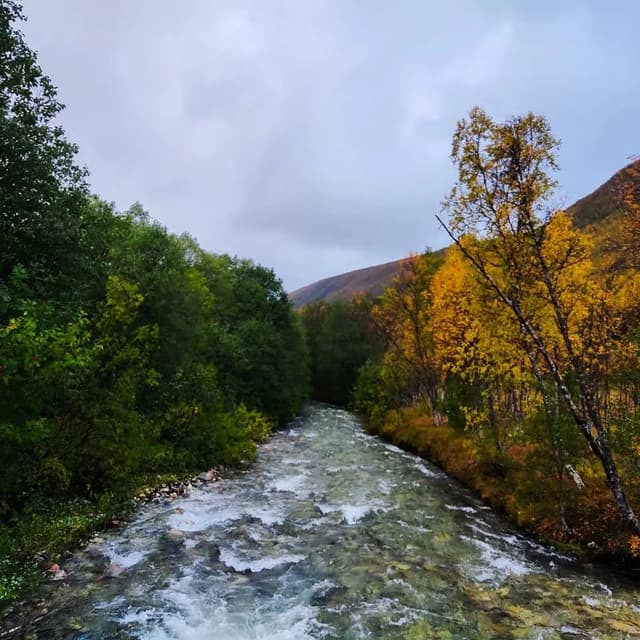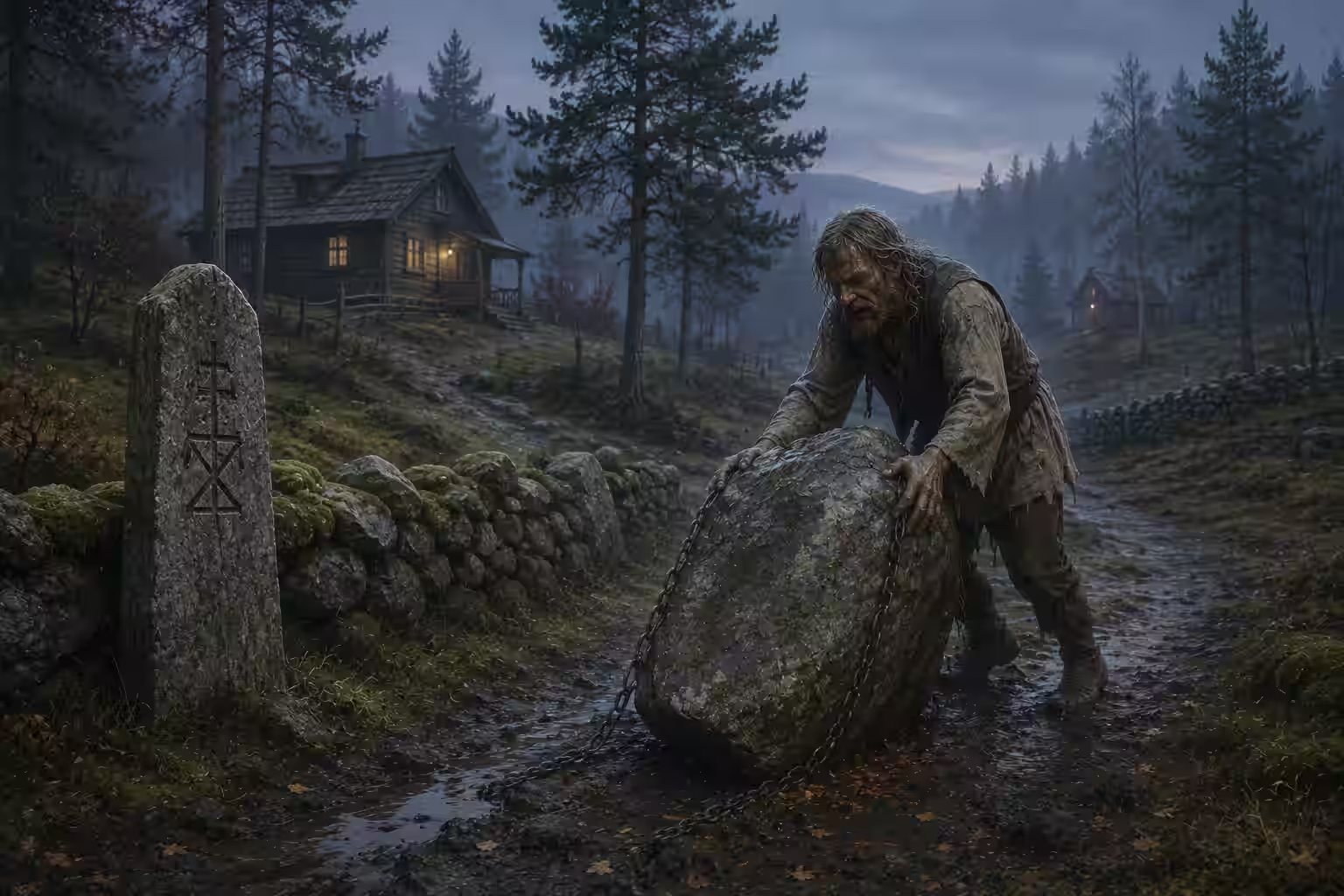
Imagine you are out walking on a dark autumn evening, deep in the wooded boundary between two old farms. It has been raining, there is a smell of wet earth and decay, and somewhere out there among the pines you hear it: a scream. Not a roe deer, not the yelping howl of a fox, but something heavier, more desperate, like a man weeping as he struggles with something he will never manage. Had you lived in the Norwegian countryside a few hundred years ago, you would not have run home and dismissed it as wind in the trees. You would have known exactly what it was. You had just encountered a deildegast, and you had every reason to hurry to your neighbours and pass the news along.
The deildegast is one of the most quietly unpleasant creatures in Norwegian folklore, and at the same time one of the most human. Where the hulder tempts with her beauty and the nøkken lures with his fiddle, the deildegast is quite simply a revenant born of a wholly ordinary, tedious, shallow sin: he moved a boundary stone. He was, in other words, a land fraudster. And for that he would pay for all eternity.
A name with heavy baggage
The word itself carries the punishment within it. "Deild" is Old Norse for boundary marker or dividing mark, a stone placed to mark where your property ends and the neighbouring farm's begins. "Gast" is at best a distant relation of the English word "ghost", but in Norwegian folklore it meant something far more tangible and unpleasant than a transparent sheet floating through corridors (Wikipedia). A gast had a body. It could scream, it could struggle, it could even, according to some legends, transform into a bird. Put together, "deildegast" becomes something as prosaic and at the same time as terrifying as "the boundary-stone ghost", a term so concrete that one might think it had been coined by a land consolidation court rather than by the imagination of folk poetry.
And that is precisely the point. The deildegast is not a creature from some distant mythological past populated by giants and valkyries. He is one of us, only dead, and burdened with a very specific task he will never complete.
The sin that was worse than murder
Here is what truly sets the deildegast apart from other Norwegian revenants: his crime was not murder, not indecency, not even anything particularly dramatic. He simply moved a stone a few metres. Perhaps one night, perhaps little by little over several years, so that no one noticed until it was too late. But in peasant society this was among the very worst things a person could be guilty of, worse than many forms of violence (litteraturogmedieleksikon.no). Violence committed in the heat of the moment could at least be understood, and grudgingly forgiven; anger is human. But moving a boundary stone was cold, calculated greed. It was to steal your neighbour's livelihood, and not only his, but that of his children, his grandchildren, and every unborn generation who would live off that land after him. It was, in other words, a crime against eternity itself. And a crime against eternity deserves a punishment that lasts exactly as long.
One might think that the farm's forebears, those who had cleared the stones, cultivated the land and drawn the original boundaries with sweat and toil, also had a hand in this. Moving the deild was not only an offence against living neighbours, but an insult to everyone who had come before.
A Sisyphus in leather breeches
So what happened to the land thief once he finally gave up the ghost? He found no peace in the grave. Instead he was condemned to walk again at the boundary stone he had moved, night after night, trying to carry it back to where it belonged (Norwegian Wikipedia). That sounds manageable enough really, a stone, a trip, and it's done. The trouble is that the deildegast never, ever succeeds.
In some legends the stone simply slipped from his grasp at the decisive moment and rolled back to where it had come from, often down into a streambed or to the bottom of a tarn, just as the goal came within sight (litteraturogmedieleksikon.no). In other versions the stone grew heavier and heavier with every metre he drew nearer to the correct spot, as though the ground itself refused to let him complete his penance. And to make matters even more unpleasant: the stone was often glowing red hot. According to folk belief, this happened because, when a new boundary stone was set, a fire was lit in the hole where the stone was to stand, a small image of the flames of hell, bound fast beneath the stone with an incantation. If the stone was disturbed unlawfully, the flames were released once more (litteraturogmedieleksikon.no). So one did not simply carry a heavy stone in the dark, one carried a red-hot one, with bare hands, for all eternity, without pause and without result.
It is impossible not to think of Sisyphus here, and folklorists have indeed pointed this out: the deildegast is regarded as a Nordic variant of the Greek myth of the man who eternally rolls his stone up a mountain, only to see it roll down again just before reaching the top (Norwegian Wikipedia; Nynorsk Wikipedia). Only here the punishment is even more unsettling, because it takes place in your own back woods, with sounds you can hear from the kitchen window. Camus wrote of Sisyphus as an image of the absurd, the meaningless repetition without redemption. Norwegian farmers needed no French existentialism to understand that very feeling; they had the deildegast screaming at the edge of the forest to illustrate it, free of charge, every autumn.
Hearing the gast scream
The descriptions of the encounter itself are among folklore's most atmospheric. One heard him before one saw him, if one saw him at all: a howl, a wailing, a groan carried across bog and heather in the autumn dark. In Setesdal and Åmli he was called the skogagast (forest gast), elsewhere heigast (moorland gast), as though the very name were tailored to whichever type of outlying land he haunted (Nynorsk Wikipedia). In the early 1800s, two girls from Flatdal in Telemark are said to have been so terrified by the sight of a deildegast struggling with a stone in the bog, wrapped in blue smoke, that they had to be carried home by others (Norwegian Wikipedia). The blue glow was no coincidence, it was the same colour folk belief attributed to the underground beings, a reminder that the deildegast had moved from being an ordinary human being to becoming something belonging to an entirely different, not wholly human category of being.
In human form the deildegast looked exactly as he had in life, save for one small but telling detail: his clothes. Since many of them had been dead for generations, they still went about dressed in the fashion of the time when they had lived, which in practice meant that a farmer might meet a revenant in a curiously old-fashioned cut of leather breeches and form an opinion of just how long the sin had haunted the forest (English Wikipedia). So one could, if one were cold and analytical enough in the midst of one's terror, actually date the ghost by his wardrobe.
The deildegast could also shift shape into an owl that hooted mournfully in the night. If a hunter shot this owl, misfortune would follow him for the rest of his life (Norwegian Wikipedia), as though nature itself gave warning against interfering too roughly with something already doomed to last until Judgement Day.
Draumkvedet
The deildegast's oldest known trace in writing is found not in some tedious record, but in one of Old Norse literature's most gripping visionary poems: Draumkvedet, composed towards the end of the Middle Ages. There the sin is described thus, in a verse that still raises the hairs on one's neck:
"So kom eg meg åt manne dei / dei bar på gloande jord. / Gu' nåe dei synduge såline / som flytte delder i skog."
("So I came upon those people there / who bore glowing earth. / God have mercy on the sinful souls / who moved boundaries in the forest.") (Nynorsk Wikipedia)
Note how precisely the image is already fixed: glowing earth, sinful souls, an act carried out in the shelter of the forest. Everything the later folk belief built upon, the red-hot stone, the shameful, secret crime, is already there, painted in a few strokes in a vision of hell and purgatory. The belief itself is likely older than the poem, but Draumkvedet gives us the first tangible evidence that the deildegast already held a fixed place in the Norwegian folk soul's conception of justice and punishment (English Wikipedia).
Four hundred years later, the deildegast found a new interpreter in Arne Garborg, who in the poem "Dømd" ("Condemned") from Haugtussa portrayed a land thief shuffling in despair along the riverbank:
"Tusla og stræva forutan ro; / sleit og lyfte, men garden stod. / Lyfte og sleit utan ro og rast; / men steinane låg som i muren fast. / Då skreik han og grét av barmen trong, / skreik og grét til det vart som song." (Norwegian Wikipedia)
That Garborg, one of Norwegian literature's sharpest stylists, found it worthwhile to write about precisely this creature says something about how powerful an image of guilt and eternal punishment the deildegast represented, powerful enough to carry an entire poem, not merely a couple of lines in an old vision.
The neighbour law no lawyer could have written
It is tempting to think of the deildegast as a simple horror tale, but it did a piece of real social work that an entire land consolidation court might envy. Legends of this type functioned above all as a preserver of norms, that is, as a deterrent (litteraturogmedieleksikon.no; English Wikipedia). In a society without land registers, without GPS coordinates, without a notary public on every headland, the boundary stones were the very foundation of peace between farms. If one moved them undetected, one could gain land in this life, but the price was a threat so grave that most people thought twice.
The legend also did something else, something a little more bitter: it was a comfort for the weak. Many of the stories concern not ordinary land thieves, but officials and priests, people with so much power in peasant society that no one dared take them to court while they lived (litteraturogmedieleksikon.no). What does one do when the priest moves the boundary between the vicarage and your land, and you have neither the money, the standing, nor the courage to challenge him? One waits. One waits until he lies on his deathbed and finally confesses in terror of what is to come, but the village people, according to the legends, do not forgive him regardless, thereby sealing his fate as an eternal deildegast. It is a form of justice delivered in arrears, admittedly, but justice all the same, and told with a certain gleeful satisfaction over the coffee cup at the kitchen table.
Even more dramatic is the legend from Agder about a farmer who claimed to have seen an entire court of division walking again at the boundary stone, as though not only the individual land thief, but the whole legal apparatus that had approved the injustice, was condemned to gather there in eternal shame (litteraturogmedieleksikon.no). That is, when one thinks about it, a surprisingly sophisticated form of institutional criticism to wrap up in a ghost story. One was not only to fear the greedy neighbour; one was also to keep an eye on those who sat in judgment over his land.
Why the deildegast still haunts us
Today, with digital maps and satellite-measured property boundaries, it is easy to dismiss the deildegast as a quaint, slightly ridiculous curiosity from an age when people believed boundary stones had metaphysical sentinels. But look more closely, and you find a legend that strikes at something deeply universal: the fear of being cheated by one's neighbour, powerlessness against those who hold more power than you, and the notion that justice may come late, but it does come, if not in this world, then in the next, with a glowing stone and an eternal, unpleasant task.
The deildegast is, in short, the Norwegian people's answer to the question of what becomes of greed when it dies. The answer is: it remains standing and screaming in the forest, eternally and alone, with a stone it will never manage to lift into place. So the next time you pass an old, moss-covered boundary stone in the forest, it might be worth giving it a respectful nod. You never know who, somewhere in the dark beyond the reach of your torch, is still desperately trying to move it back.
Sources:
• Deildegast – Wikipedia (Bokmål)
• Deildegast – Wikipedia (Nynorsk)
• Deildegast – Wikipedia (English)
• Sagn – Litteratur- og medieleksikon
• Spøkelse – Wikipedia