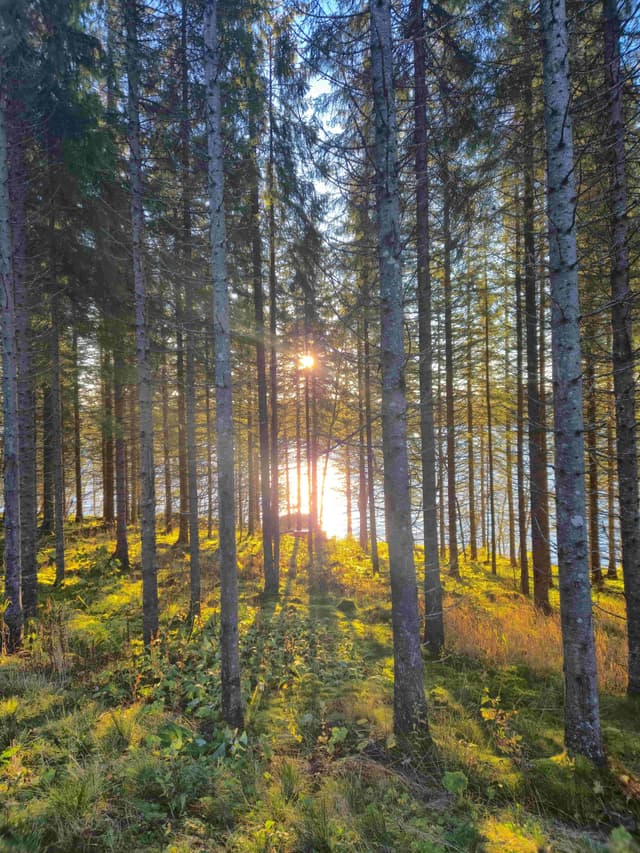
Imagine a winter's night over Sápmi, some hundreds of years ago. The snow crunches beneath the skis, the fire in the lávvu has burned down to embers, and over the tundra stretches a sky so clear that one can count the stars until sleep comes. This is not merely a dark ceiling full of points of light, but a living landscape populated by hunters, reindeer, dogs and an old woman who skis after an animal she can never catch. The sky tells a story that has lasted so long that no one can recall its beginning, and no one expects an end.
For the Sámi, the starry sky was never merely astronomy. It was calendar, compass, weather forecast and mythology, woven together into a single system in which hunting, reindeer husbandry and life on earth were mirrored in the lights overhead. As the astrophysicist Jelena Sergejeva writes, it is no coincidence that most Sámi constellations depict animals, hunting implements, hunters and fishermen: the hunt was the very means of survival, and so the sky was interpreted through the logic of the hunt (Sergejeva, University of Oslo).
The Reindeer That Is Never Caught
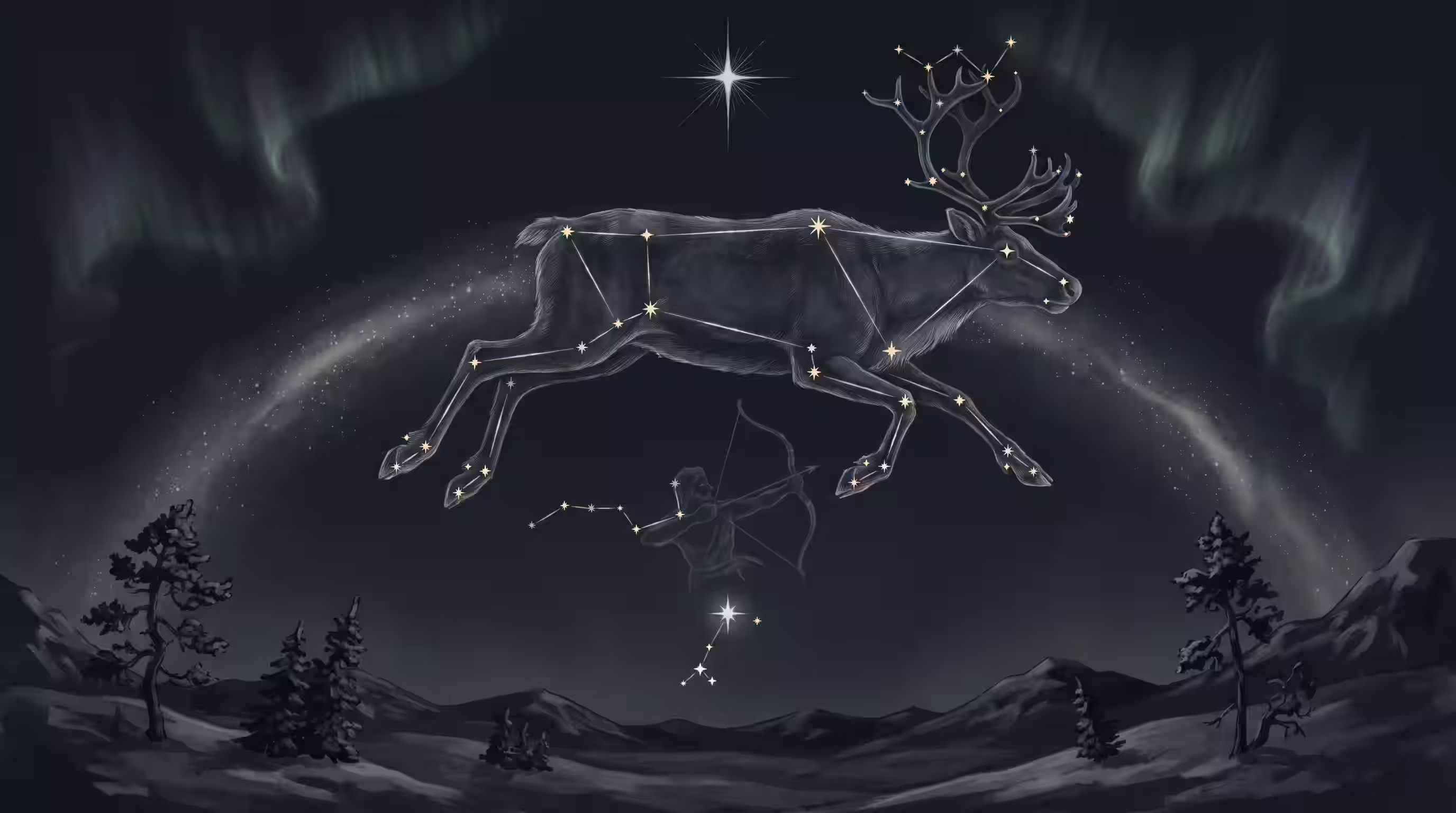
At the centre of this celestial narrative stands a great constellation the Sámi called Sarvvis: the cosmic reindeer bull, or, in South Sámi and East Sámi tradition, the elk. Its antlers are found in Cassiopeia, while its body stretches through Perseus and Auriga, the charioteer (Sergejeva). Every night this animal is pursued by an entire team of hunters who rise above the horizon one by one, as though gathering for a hunt that never ends.
First to rise is Fávdna: the star we call Arcturus, the most tireless of the hunters, always with bow drawn and arrow ready. His bow, Fávnnadávgi, is none other than the handle of the constellation we call the Plough, and it always points towards Sarvvis (Sergejeva; Talking Stories, University of Oregon). Behind him come the Gállábártnit, three brothers known for their skill with a bow and for inventing skis: in the Greek sky we recognise them as Orion's Belt. They carry with them a knife, a spear and a pot, implements they will need once the reindeer finally falls (Sergejeva). Their father, Gállá, is none other than Sirius, the brightest star in the sky, and he has come out simply to see how his sons are faring.
Then there is Boares Áhkku, the old woman, also known as Boares galgu or Gievdneguoddi, the pot-carrier. She skis after Sarvvis together with her dogs, calling out encouragingly: 'Chase on, chase on! The fat rump is your reward if you catch him!' She and her dogs are none other than the Pleiades, which the Sámi saw as a flock of frightened reindeer calves, tightly clustered 'just as frightened reindeer flock together' (Talking Stories). There are also Čuoigit, the two skiers (Castor and Pollux in Gemini), who try to drive Sarvvis towards Fávdna, so that he might finally come within range.
The North Star That Guards the World
But watching over this entire hunting scene is a star that never moves: Boahji, the North Star. The name means 'nail': the nail that holds the vault of heaven in place, also called Boahjenávli, the north nail, in Kautokeino, Karasjok and Karesuando (Sergejeva). In Sámi belief, the sky arches over the earth like an upturned pot, and the central point (the top of the world pillar bearing it all) is precisely Boahji (Karhuntassu).
Boahji is himself a hunter, with his own bow visible in the constellation Ursa Minor. He is so high up that he rarely comes within range of Sarvvis, but keeps a watchful eye on the reindeer. Should he hit his mark, the sky would fall, the stars would plunge down, the sun and moon would be extinguished, and all life would come to an end (Sergejeva; Beneath Northern Lights). The fate of the entire universe rests on the hunt never being completed.
Night after night the hunters give up, one by one: first Gállá, the old father who only came to watch, and last of all Fávdna himself, who lowers his bow once more. Sarvvis slips away, just as he always has, and continues grazing until the hunt begins anew the next evening.
A Sky Without End
It is tempting to read this eternal hunt as a tale of doom, of a world that might perish if the reindeer dies. But that would be to misunderstand the Sámi conception of time. For the old Sámi, time was not a straight line towards a day of judgement, as the Christian narrative assumes. Time was cyclical, without beginning and without end (Sergejeva). The hunt continues from year to year, from millennium to millennium, and the starry beast always slips safely past. No hunter ever comes any closer. The order of the universe remains unchanged: a comfort shaped not as a promise of salvation, but as a pattern one can rely on, night after night.
A similar myth found its way to Sápmi from peoples further east. Among the Khanty people of Siberia, it is told how the son of the sky god Torum created an elk with three pairs of legs. The son caught up with the elk on skis and cut off the hindmost pair of legs, and his ski track became the Milky Way, which the Sámi called Lodderáidalas, the Bird Path, the celestial route birds follow when they migrate south and find their way home again (Sergejeva). On the Kola Peninsula the story is told differently: there the thunder god Tiermes hunts the cosmic reindeer bull with his dogs, with the rainbow as his bow and lightning as his arrows. Should Tiermes plunge his knife into the animal's heart, the stars would fall and the rivers would flow backwards (Sergejeva).
Clock, Calendar and Compass
The starry sky was also a practical instrument for telling time, weather and direction. Dávggát, the Plough, is visible all night and has been used as a clock since time immemorial; the Inari Sámi described how it stood in the east at midnight in January, in the south-east later in the night, and in the north-west towards morning (Sergejeva). The Finnish writer Samuli Paulaharju wrote in 1925 that Sámi reindeer herders are 'truly wise': they have a name for every star, and if a star were to vanish, they would notice the loss at once.
The Milky Way, the Bird Path, was used to predict how much snow the winter would bring (Talking Stories, University of Oregon). A cloudless sky on New Year's Eve foretold a good berry season, an overcast sky cold summers. The northern lights, guovssahasat, were read with respect: low aurora foretold cold, an aurora from the south-west foretold a south-westerly wind. But provoking it to burn more fiercely, by whistling or joiking at it, was risky: an agitated aurora could plunge down and harm whoever had lured it forth (Talking Stories; Karhuntassu).
Beaivi, Mánnu and the Holes in the Sky
Above the starry sky enthroned two celestial bodies in a class of their own: the sun and the moon. The sun deity Beaivi ('sun' or 'day') and her daughter Beaivvi nieida, the sun girl, were worshipped with offerings to secure good fortune in reindeer husbandry and to heal sickness (Karhuntassu). The moon, Mánnu, had a more fearsome reputation, often called Mánnu-stállu. December, juovlamánnu, was an unsettled time, when all noise was forbidden once the moon had risen. In February, however, when the polar night released its grip, the opposite custom applied: then people would call out to summon the moon forth (Karhuntassu).
Even Venus had its place, under the name Guovssonásti. When it sank below the horizon, forest trolls and other evil beings had free rein, a dominion that ceased once Venus reappeared (Karhuntassu). The stars themselves were imagined as holes in the vault of heaven, cracks into another reality, called in East Sámi languages duot ilbmi, 'the other air' (Karhuntassu).
The Drum That Carried the Sky
Deeper still within Sámi cosmology we find the gievvrie, the shaman's drum, on which images of animals, humans and travelling souls are painted closely around a central cross. The ethnoastronomer Bo Sommarström devoted much of his scholarly life to investigating whether the placement of these figures might have been influenced by the starry sky. By dividing the drumskin into four quadrants, like a horizon divided by the cardinal directions, he found a surprising number of correspondences between the placement of the figures and the positions of well-known constellations such as the Milky Way, Pegasus and Orion (Sommarström, "The Saami Shaman's Drum and the Star Horizons").
He calculated precisely which constellations were visible to the South Sámi at 65 degrees north latitude, and found that the constellations hardest to see from this sky, such as Scorpio, were also the most weakly represented on the drumskins (Sommarström). This suggests that the drum was a carefully calibrated map of the sky the Sámi could actually observe. Sommarström described the drum as a 'psycho-cosmogram' in which the sun's height, the calendar, the seasons and the cardinal directions met in a single image, not unlike the astrolabes of the Sámi's European neighbours (Sommarström, "Ethnoastronomical Perspectives on Saami Religion"). Looking up from below through the semi-transparent drumskin, the shaman could read the constellations mirror-reversed, much as other European peoples read their horoscopes, yet the drum reproduced nature's own anticlockwise direction as the stars rotate around Boahji through the course of the day (Sommarström, "Ethnoastronomical Perspectives").
A Living Legacy
The spirits of the dead also had their place in this worldview. At the turn of the previous century, the Norwegian folklorist Just Qvigstad and the Sámi author Johan Turi gathered accounts of spirits that most people could not see, but which noaideslágáš (those skilled in the shaman's arts) could see, hear and control (DuBois, "The Usually Invisible, Occasionally Visible, Spirits of the Dead"). These accounts, blending indigenous tradition with Christian elements from neighbouring peoples, remind us that Sámi cosmology was never a closed system. It lived and changed, just as the constellations themselves continued to wander across the sky from generation to generation.
Today, standing out on the tundra under a clear winter's night, the stars are still the same lights the ancestors saw. Fávdna still draws his bow. Boares Áhkku still calls out to her dogs. And high above it all, unmoving, Boahji holds the sky in place: a reminder that some stories do not need an ending to be true. They need only to be told onward, night after night, as the Sámi have done since time immemorial.
Sources:
• Sergejeva, Jelena. "Nokre samiske stjernebilete: Eit jaktfolks forestellingar om stjernehimmelen." Institute of Theoretical Astrophysics, University of Oslo, 2011. https://www.mn.uio.no/astro/tjenester/publikum/almanakken/innhold/tema2001.html
• Sommarström, Bo. "The Saami Shaman's Drum and the Star Horizons." https://core.ac.uk/download/493101360.pdf
• Sommarström, Bo. "Ethnoastronomical Perspectives on Saami Religion." Scripta Instituti Donneriani Aboensis, 12 (1987): 211–250. https://journal.fi/scripta/article/view/67164
• "Saami Astronomy." Talking Stories, University of Oregon. https://talkingstories.uoregon.edu/2022/02/25/saami-astronomy/
• "The Sun and the Moon as the Most Important Celestial Bodies." Karhuntassu – Sámi Culture and Mythology. https://www.karhuntassu.fi/en/front-page/history/sami-culture-and-mythology/the-sun-and-the-moon-as-the-most-important-celestial-bodies/
• DuBois, Thomas A. "The Usually Invisible, Occasionally Visible, Spirits of the Dead in Early Twentieth-Century Sámi Folklore." Humanities 12, no. 5 (2023): 94. DOI: 10.3390/h12050094. https://ouci.dntb.gov.ua/en/works/45JbW33l/