The calendar the Vikings used was a calendar that reflected the nature they lived in and the working year. The year was divided into two equally long periods - summer and winter. A man's age was reckoned in the number of winters he had lived. This may indicate that "new year" was when summer began, even though they did not celebrate new year the way we do today.
The year was divided into lunar phases - from new moon to new moon, or from full moon to full moon. The counting of days was probably not exact, especially in the summer months when the nights are as bright as they can be this far north, because it can be difficult to spot the moon.
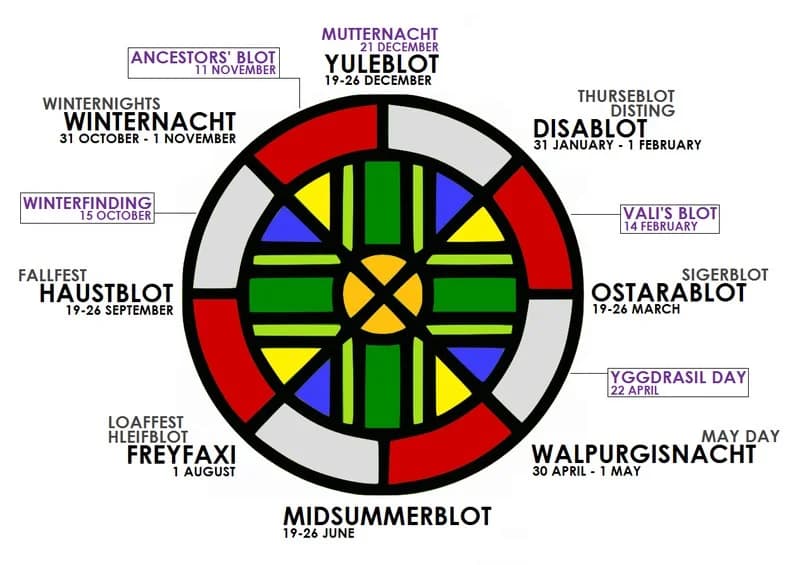
The calendar you see here shows the division of the year in the old Icelandic calendar in relation to the Gregorian calendar that we use today.
The year is divided into two equally long parts - summer and winter, and the darkest period of the year is called skammdegi (the dark days), while the lightest period of the year is called nóttleysa (nightlessness).
The winter months are gormánuður, ýlir, mörsugur, þorri, góa and einmánuður
The summer months are harpa, skerpla, sólmánuður, heyannir, tvímánuður and haustmánuður.
Gormánuður (Slaughter month) - From 14 October to 13 November. Gormánuður, the first winter month, is the beginning of the Old Norse winter half-year. 14 October is the first day of winter; on the primstav (rune calendar staff) the day is most often marked with a mitten, and on this day the year's first sacrificial feast - the winter blót - is to be held. This blót was dedicated to the fertility god Frøy (Gro Steinsland, Eros og død i norrøne myter). By then the autumn harvest was in the barn. According to Víga-Glúms saga, a díseblót was held at vetrnætr (winter nights) - the period around 14 October. People then welcomed winter and made a blót for a good year.
Ýlir (Yule month) - From 14 November to 13 December. Ýlir is the second winter month. The Viking-age winter solstice fell during it. The Swedish historian of religion H. Calander holds that the Yule period corresponds to ýlir, and that the name of the festival derives from the name of the month. Ýlir is also identical with one of Odin's many names, Jólnir, which has likewise been linked to Yule. This is well known from Old Norse legends, where it is said that Odin travelled about around Yule time (KLNM XII 1967,506).
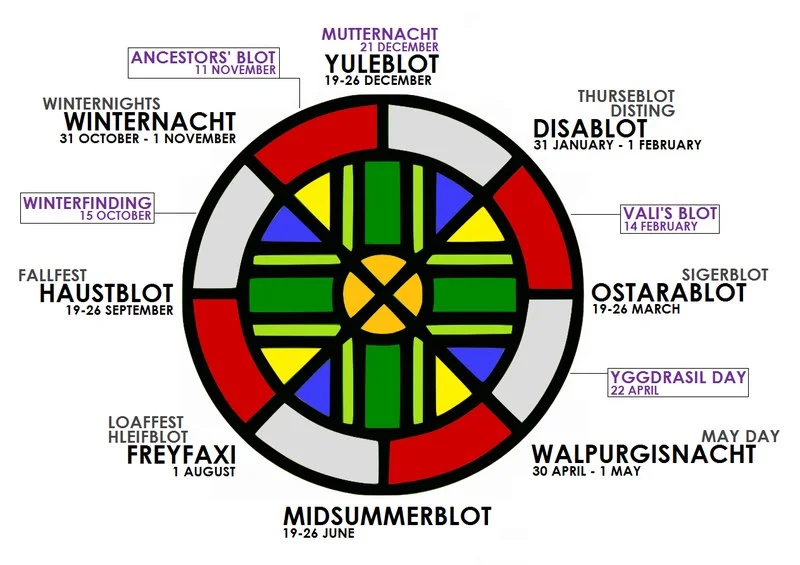
Scholarship has not managed to arrive at a unified view regarding the timing of the heathen jóla. In several sources there is much to suggest that the Yule celebration varied in length and timing, or lasted all the way up to hoggunótt (12 January). For this reason, some of what is written here may perhaps also be identified with the mörsugur month. (Cf. norrøn ordbok, Det Norske Samlag = jólmánaðr - the month from mid-December to mid-January.)
We do not know very much about the Yule celebration in Old Norse times, but there is good reason to believe that Yule in heathen times was based, at least in part, on the idea of sacrifice and the fertility of the crops. Working the soil was regarded as a sacred act, and various notions of magic attached themselves both to the growth process and to the harvest, and the growing power itself was conceived of as a vette (nature spirit). It is thought that a fertility feast was part of what became our Yule celebration; among other things, the custom of setting out the Yule sheaf may be a remnant of old fertility magic. According to folk belief, Yule was a feast connected to the cultivation of the earth.
Yule was probably celebrated when the animals for slaughter were at their fattest, when the grain had been threshed and all the autumn chores were finished. This timing has nothing to do with "midwinter". Although the timing may have varied somewhat in different parts of the Nordic region, the Yule celebration fell within the West Norse calendar's second winter month - ýlir.
By then people had harvested what they had sown in spring, and storehouses and chests were full of food meant to last through the winter. At this feast the Yule ale was blessed to árs ok friðar - that is, a toast to growth, harvest, a good year and peace in the broadest sense.
This heathen ritual ale-drinking lived on into Christian times, as we can read in the Christian law of the older Gulating Law and the corresponding ordinance in the older Frostating Law, where the laws show us that several feasts were involved and that the Yule celebration began at an earlier point than today.
In Gulating's Christian law (ch. 6) there is an ordinance for an ölgerð (ale brewing), which is mentioned as samburðar öl. At least three farmers were to share in this communal drinking, unless a farmer lived especially far off the beaten track. In that case he was, for his own part, to brew as much ale as if he were part of a group. This ale was to be made by 1 November.
In ch. 7 there is an ordinance for another ale brewing, the farmer and his wife together. According to the law, this ale was to be blessed on Yule night. Strict penalties were laid down for those who did not follow the ordinance according to the laws.
By the wording of the laws, there must be two different ale brewings: the first for a communal drinking party, a kind of harvest thanksgiving feast, while the latter concerns the enjoyment and blessing of the mandated drink within a smaller community, that which the home represented. One was to drink for a good year and peace, and to the memory of the gods. The ale bowl passed around the family circle, and the sacred bonds with the powers were confirmed and renewed.
There is much to suggest that the blót known as the alveblót (elf-blót) was identical with the pre-Christian Yule. The alveblót seems to have been held in late autumn. The beings called elves (álfar) seem to have constituted a collective of fertility powers. They were close to the god Frøy (Folke Ström).
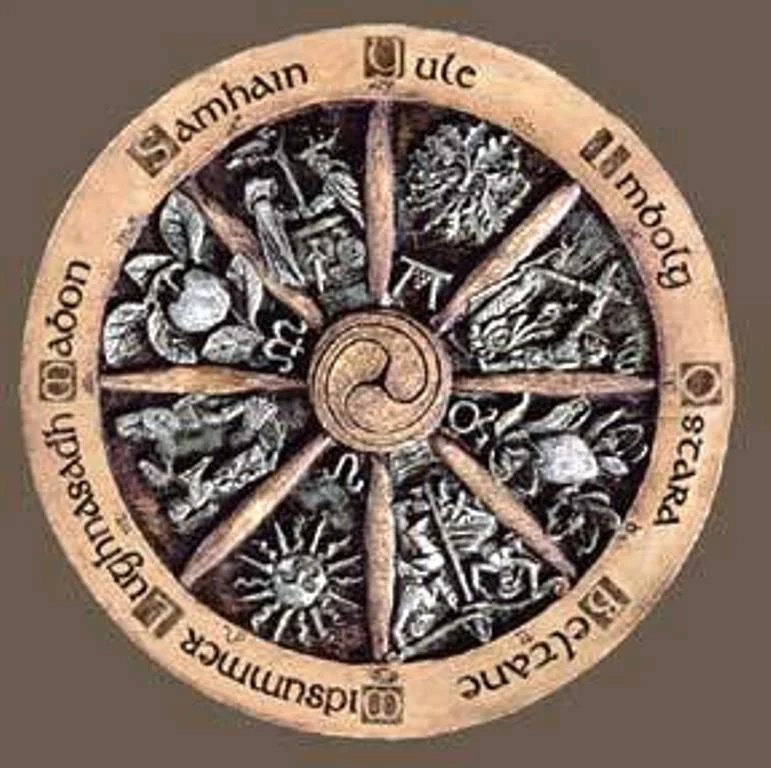
The alveblót is a private blót - perhaps the one referred to in the ordinance for the ale brewing in Ch. 7 of the Gulating Law - which was held within the family. It is this blót that King Olav Haraldsson's court poet, Sighvat the skald, composed verse about regarding his troubles around Yule time in Götland. Because the families were celebrating the alveblót, he could find no lodging anywhere for the night. Sighvat recited: "Do not come in, you wretch!, the housewife said to me. Here we are heathens all, the wrath of Odin we fear. - Out, said the loathsome woman, who chased me to the woods like the wolf, said that inside the house, they were holding an alveblót."-
The heathen Yule celebration was thus just as much a closed family feast then as it is today. As one might expect, since this concerns a single, closed private cult festival, the information in the sources is exceedingly sparse.
In the praise poem Haraldskvedet, composed by Harald Fairhair's court poet Torbjørn Hornkløve to Harald Fairhair around the year 900, there is talk of drinking Yule: "The king will drink Yule out on the sea, ... and take up Frøy's game!..."
In the saga of Håkon the Good there is an account in which Trøndelag farmers force the Christian king Håkon Adelsteinsfostre (= Håkon the Good) to take part in the Yule feast. There Håkon the Good makes a blót, drinks to the memory of the gods and eats horse liver, ..."Drakk hann þá öll minni krossalaust, þau er bændr skenktu honum" (He then drank all the toasts crossless (without making the sign of the cross), the ale that the farmers poured for him).
Giving Yule gifts is an old heathen custom in Norway, but it was not the children who were lavished with gifts. It was the great men who gave Yule gifts, perhaps to create new alliances and confirm old ones. Great men also gave Yule gifts to their subjects. According to Snorri, Eirik Jarl, at the beginning of the 11th century, followed the custom of the great men and gave his people their jólagjöf (Yule gift) on the eighth day of Yule, and they had much merriment over the ale-drinking. Likewise, one can read in several sagas that the king gave Yule gifts, most often in the form of a costly cloak to the respective hero of the saga.
In Víga-Glúms saga we also read that the Yule feast was held in the manner of great men and that men were sent off with gifts when they were to depart. Several sagas tell that at great banquets such as funeral ale, weddings, the Yule banquet of chieftains and the like, it was the custom to drink bragarfull, a toast at which one made a vow (Jomsvikingesaga, Helgakviða Hjörvarðsonar and others). The word is derived from bragr and has no connection to the god Brage; thus this is a hero's toast.
An old Yule custom in Norway is to dress the chair; it dates from the time when the high seat chair had carved images of gods, or when a wooden image, a household god, was placed in the master of the house's seat. From the saga age we know of such chairs, among them the one the troll-woman Gríma had, with an image of Thor on the chair back. In Olav Tryggvason's saga there is an account of prophecy from the high seat chair on Yule eve. King Vladimir in Gardarike had an old, frail mother who was heathen, far-seeing and skilled in magic. On Yule eve she was carried in and seated in the king's high seat to prophesy about what she knew of the future (I. Reichborn Kjennerud).
Several of our oldest Yule customs date as far back as the nomadic hunting culture, where an animal was offered to the sun to honour its turning at the winter solstice. From the earliest farming culture comes the notion of the Yule goat, a vette that lived in the field and fled to the woods when the field was cut, but drew closer to the house each day and stood by the door on Yule eve. Yule goats made of straw are still with us. Today's Yule customs thus span a period of 3000 years. (Hans Rotmo).
Some believe the origin of the custom of the Yule goat (julebukk) is heathen. A goat was slaughtered for Yule to ensure a good year. Later the word was used for a person who went about during Yule wearing a goat mask and dressed in a shaggy hide.
The old Norwegian female vette lussi, mother of the underground beings, was a real threat and punished those who did not do their work in time, such as the Yule preparations. Lussi's long night was 13 December (Hans Rotmo). Lussi must not be confused with the Christian saint Lucia.
The old Norsemen imagined that the first farmer on the farm lived forever, and they brought gifts to him where he was buried in his mound; later this mound farmer was called the tuftekall, or the tusse, and even later the nisse (Hans Rotmo).
The Church moved the celebration of Yule to the third winter month. Yule is a prime example of how the Church took over heathen customs and traditions and gave them a Christian wrapping. The Church quickly saw that it was difficult to eradicate the old traditions that were so firmly anchored in people's lives, custom and practice - not only in the Nordic region, but throughout the rest of pre-Christian Europe. It was easier to Christianise the traditions.
The Church, for example, agreed to the condition Emperor Constantine set for the privileges he granted the Church when, in 323, he made it the state religion (probably for purely political-strategic reasons): that they honour the making of the Sol Invictus day into a feast day also under the Church's regime, as well as moving the week's day of rest from Saturday to the sun's day: Sunday. In the mid-300s, therefore, 25 December was made the great feast day for the birth of Jesus by the Church in Rome, but we do not know when Jesus was born, and once again the Church took over a pre-Christian feast day.
When the Church moved the Old Norse Yule forward, it kept the idea of celebrating new life. But now it was Christ's birth that symbolised this. The celebration continued as a family feast, but now the ale was to be blessed to Christ and the Virgin Mary. The Church made some attempts to have the name Jul (Yule) changed to "Kristmesse", but they did not succeed.
When the Church moved the Old Norse Yule forward, it kept the idea of celebrating new life. But now it was Christ's birth that symbolised this. The celebration continued as a family feast, but now the ale was to be blessed to Christ and the Virgin Mary. The Church made some attempts to have the name Jul (Yule) changed to "Kristmesse", but they did not succeed. The old name probably had roots too strong among our ancestors, but elsewhere they managed it, as for example in English-speaking countries where Yule is called "Christmass". The heathen origin of the Yule celebration is the reason why Jehovah's Witnesses do not celebrate Yule.
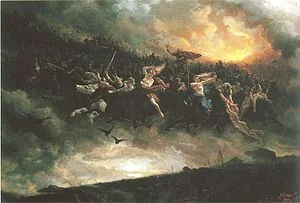
In the darkest time of winter, people believed that the dead returned to their old dwelling places.
These people came together in what was called the Oskorei (also called Åsgårdsrei). The word means the dangerous host. People imagined that it was a band of the dead who rode about on frozen, black horses - especially around Yule time - and carried off people or foretold strife. The Reia could ravage the houses, eat all the Yule food and drink the Yule ale. The Oskorei is also well known from more recent tradition, but it has nothing to do with the Yule celebration itself, only that, according to belief, it came in the darkest period of the year, the season that has always provided natural fertile ground for the horror imaginings of folk fantasy.
It is said that Sigurd Svein (Sigurd Fåvnesbane) and Guro Rysserova (Gudrun Giukesdotter?) were the leaders, but also that it is Odin. In our neighbouring countries the Oskorei is also called "Den vilda jakten" (The Wild Hunt) and "Odins jakt" (Odin's Hunt). In the Oskorei were those people who had died in an unnatural way.
Johan Sebastian Welhaven (1807-73, Norwegian poet, professor of philosophy) wrote the poem "Asgaardsreien", based on information from folk belief. One of the verses runs as follows:
The Asgaardsrei rides in formation in autumn and winter on harsh nights, but most of all it travels at Yule time; then it holds feast among trolls and giants, then it sweeps low over meadow and path and rushes clamouring past the village - so beware, farmer, keep custom and order; for the Asgaardsrei is soon by the farm!"
Likewise Per Nicolai Arbo (1831 - 1892), a Norwegian painter who painted works with mythological and Viking-age motifs, painted the Oskorei as he imagined it. The painting is on display at the National Gallery in Oslo.
But many of the dead who "walked again" were peaceful. They were most often the ancestors who were buried in mounds near the farm and who had died a natural death. The custom of letting a light burn on Yule night, and of leaving food out on the tables, stems from these who "walked again". The beds were left empty so the dead could use them, and people themselves then lay on the floor, or a bed reserved only for the dead was made up.
Mörsugur - From 14 December to 12 January. Mörsugur is the third winter month. In Norwegian, mörsugur means "suet-sucker", (ister = visceral fat + the verb suge, to suck). The name of the month gives a certain impression that people were in good condition this month, after a couple of months of eating meat. The Viking-age winter solstice (21 December) also fell in the Mörsugur month, but with the source material we have, there are few grounds to suggest that this was used as an occasion to celebrate the return of the sun. Nevertheless, one should not rule out that this may have played a significant role in the Old Norse fertility cult, since the sun too was in many ways reborn, and one depends on it for life to grow. The sun is, in itself, a strong symbol of fertility.
Of the few sources that deal with this, the Greek historian Procopius wrote in the 500s about a tribe far to the north in Thule who were terrified that the sun would not turn at the winter solstice. They sent an envoy up the mountain to observe the sun turn. When the envoy returned with the happy news, a great feast was held in the darkness.
12 January is midwinter day, and then the midwinter blót is to be held. Midwinter night was also called Hoggunótt.
Þorri - From 13 January to 11 February. Þorri is the fourth winter month. According to the saga literature, in the Þorri month a Þorrablot is to be held - a feast for the winter figure Þorri - when toasts were made to the gods. It was the custom that the housewife, on the evening before the Þorri month began, went out of the house and invited Þorri in just as she would any other guest. Other sources say that the farmer was to welcome Þorri with a dance of joy. In folk tradition Þorri is the men's month, and each man can choose his own day in þorri. If the weather was good on that day, he was lucky, but if it was bad weather it was an unlucky omen for him. The wife was to take especially good care of her husband.
In the Þorri month the jötunn Frost takes full control of nature with the good help of his son Snø (Snow) and his four children, Þorri (bare frost), Fønn (snow, snowdrift), Drífa (driving snow) and Mjøll (fine drifting snow, dry new snow). We find þorri again in skaldic poetry all the way up to the 1800s.
Gói (Icelandic = góa, Nynorsk = gjø) - From 12 February to 13 March. Gói is the fifth winter month. Gói is a West Norse winter figure about whom we have little information. In old Icelandic sources Gói is often described as the daughter of Þorri. According to the Icelandic oral tradition a Gói blót was held. It was the farmer who welcomed Gói with a blót. But there is no certain evidence to confirm this. In Icelandic folk tradition Gói is the women's month, and in the Gói month it is the men's turn to take especially good care of their spouse. We find Gói again in skaldic poetry all the way up to the 1800s.
Einmánuður - From 14 March to 13 April. Einmánuður is the sixth winter month. The name of the month simply means one-month. 21 March is the spring equinox, and then it is a good custom to hold a blót to celebrate fertility. Einmánuður is the boys' month, while Harpa is the girls' month, just as Þorri and Gói are dedicated to the man and the woman respectively.
Harpa - From 14 April to 13 May. With the Harpa month, the first summer month, summer begins. Harpa is probably a vette we no longer know of, but she must have been of great importance, since she has been given her own month name. On the first day of summer the third great sacrificial feast is to be held - the summer blót. The summer blót is held for victory in war and luck on expeditions. This blót stood first and foremost under the sign of Odin (Gro Steinsland). Harpa is a woman's name that is still in use in Iceland. Harpa is the girls' month, while Einmánuður is the boys' month, just as Þorri and Gói are dedicated to the man and the woman respectively.
Skerpla - From 14 May to 12 June. Skerpla is the second summer month. Once again we have a woman's name that is difficult to explain, but Skerpla is probably a vette we no longer know of.
Sólmánuður - From 13 June to 12 July. Sólmánuður is the third summer month. In Norwegian, Sólmánuður means sun month and is the lightest period we have in the north. 21 June is the summer solstice.
The name Jonsok (Midsummer) is alive from medieval mass tradition, but both the timing and the most vital customs connected to the day stem from ancient times. It is natural to hold a sun festival in this context. The very fact that the sun turned was in itself a good occasion for cultic and ritual acts.
In detail we do not know how these very old customs were practised, but a likely line of thought is that the sun and the life forces, at such a turning point, were to be helped to win out over a difficult period. According to general folk belief, all things good and bad seem to come to a head at certain important times, such as Yule and Midsummer.
Into this pattern we can place the bonfire. To this day we experience the Midsummer bonfire as a centre, a source of power, and if we strip away all the new things we attach to the bonfire celebration, we come back to a strong belief in the life-giving and protecting power that fire stood for. Next to the sun, fire gave the most warmth and kept troll-folk at bay. Real and symbolic protective belief came together and formed the basis for a combined spring and summer feast. With our climatic conditions, the timing was as convenient as possible, and the working year called for the gathering of larger crowds of people. The time was suited to outdoor life (Olav Bø).
In Icelandic folk belief, this shortest night of the year is filled with magical powers. Elves and vettir come out in the night and feast and dance around the bonfire together with the people. Young women roll themselves naked in the morning dew to become more fertile. This is probably connected to the fact that this day, since ancient times, has also been popular for celebrating weddings. On this night fortunes are also told.
Midsummer eve is a good time to find magical stones, stones that can make a person invisible or protect against diseases. Certain herbs picked on this evening have healing properties, while others have more dramatic powers. Lyfjagras (Pinguicula vulgaris), picked on this evening, is known to cure all diseases. The cows become very sensible and speak human language. Of course, they are completely silent if they know there is a human present. The seals could take human form.
A folk legend tells of a farmer who caught a young seal-woman the night before midsummer. He hides away the sealskin and makes her his wife. Several years later she finds her skin, and just before she put it on again she said: "Mér er um og ó. Ég á sjö börn í sjó og sjö börn á landi" (I am torn. I have seven children in the sea and seven children on land). Then she returned to the sea.
It is also around the solstice that the Icelandic Allþingi (the Althing) gathered in the old days. This heathen celebration was, of course, transferred to Christianity, and is today called Jonsok (24 June).
Heyannir - From 13 July to 14 August. Heyannir is the fourth summer month. The name of the month explains itself. Heyannir means the hay harvest, and is thus the month for drying and gathering in hay. In some places in Scandinavia this month was also called Ormamánuður (snake month).
Tvímánuður - From 15 August to 14 September. Tvímánuður is the fifth summer month. The name of the month means two-month, but it is unclear what lies behind the name. This month was also called Kornskurðarmánuður (grain-cutting month). In this month, then, it is time to harvest the grain.
Haustmánuður - From 15 September to 13 October. Haustmánuður is the sixth summer month. The name haustmánuður means autumn month. 21 September is the autumn equinox.
Other names for the months: In the Snorri Edda the summer months can be referred to as gaukmánuður (cuckoo month), sáðtið (the sowing time), eggtið (egg time), stekktíð (lamb time), sólmánuður (sun month), selmánuður (shieling month), heyannir (the hay harvest), kornskurðarmánuður (grain-cutting month) and haustmánuður (autumn month).
In the Snorri Edda the first winter month is referred to as gormánuður (slaughter month), the second ýlir (Yule month) or frermánuður (the frost month), the third mörsugur (suet-sucker, ister = visceral fat) or hrútmánuður (Hrútur is a ram, ram month). The last three winter months - þorri, góa and einmánuður - are more or less standard in most sources.
In Denmark the corresponding 6 winter months were called Slagtemåned (Slaughter month), Julemåned (Yule month), Glugmåned, Blidemåned, Tordmåned and Fåremåned, and the corresponding 6 summer months were called Vårmåned (Spring month), Skærsommer, Ormemåned (Snake month), Høstmåne (Harvest moon), Fiskemåned (Fish month) and Sædemåned (Sowing month).
According to Olrik and Ellekilde, the Danes in heathen times inserted an extra month in certain years - Sillemåned - so that some years had 13 months instead of 12. "Sille-" in Sillemåned means "late", and has nothing to do with the fish sild (herring). Likewise, Tordmåned is said to mean "manuring month" and therefore has nothing to do with the god Tor (Thor).
[Calendar: System for reckoning time over long periods; the days are grouped into different periods suited to the regulation of civil and religious life. All calendars are based either on the movement of the sun (such as the Julian calendar), the movement of the moon (such as the Islamic calendar), or both (a lunisolar calendar such as the Jewish calendar), so that the length of the calendar year corresponds approximately to the tropical year or to the lunar year (= year). The difficulty that makes calendar systems complicated is that the natural periods - day, month and year - are not simple fractions of one another. (Source: Caplex) Julian calendar: Introduced by Julius Caesar in 46 BC with a solar year of 365 days plus a leap day every 4th year. The Julian year has an average length of 365.25 days and is 0.0078 days longer than the tropical year that the seasons follow. Over 128 years the difference adds up to a whole day. (Source: Caplex) Gregorian calendar: The Gregorian calendar, which is an improvement on the Julian calendar, was introduced by Pope Gregory XIII in 1582, and is now used over most of the world. (Source: Caplex) Solar calendar: Any calendar, such as the Gregorian, that is based entirely on the apparent movement of the sun. (Source: Caplex) Lunar calendar: Any calendar, such as the Islamic, that is based entirely on the apparent movement of the moon. Lunisolar calendar: Any calendar, such as the Jewish, that is based entirely on the apparent movement of the moon and the sun.]
After the Christianisation of the country, the Church introduced the Julian calendar, but this was later replaced by the Gregorian calendar. In Iceland the Old Norse calendar was, in a transitional phase after the Christianisation, used in parallel with the Julian calendar all the way up to about the year 1200. This may be due to the fact that several of the Icelandic laws of that time were directly tied to the old Icelandic calendar.
The Roman 7-day week was adopted into the almanac, so that the year consisted of 52 weeks and 12 months of 30 days plus 4 days per year. This amounts to only 364 days, and therefore they had to add an extra week every 5th or 6th year in the summer to compensate for the miscalculation. This extra week was added by a resolution at the thing (assembly), and it was called sumarauki ("summer addition", auke = increase, i.e. an extra summer week).
In Laksdøla saga one can read the following: "Osk was the name of Torstein Raud's fourth daughter. She was the mother of Torstein Surt the wise, who came up with the summer addition." This should then have happened around the middle of the 900s.
In the sagas we often encounter the time reckoning of X number of weeks before the end or beginning of summer or winter. One must then calculate, according to the calendar presented here, to arrive at the correct time of year. But the summer addition, or the lack of it, naturally creates problems for exact calculations. Good luck!
The subject is continuously under construction by Jón Júlíus Filippusson and me!
THE DAYS OF THE WEEK: The Roman 7-day week was ordered, by a written decree, to be introduced in Roman territories by Emperor Constantine in the year 321 AD. This division of the week was adopted in heathen times by the Germanic peoples
(Research and text composition were done in collaboration with Jón Júlíus Filippusson.)