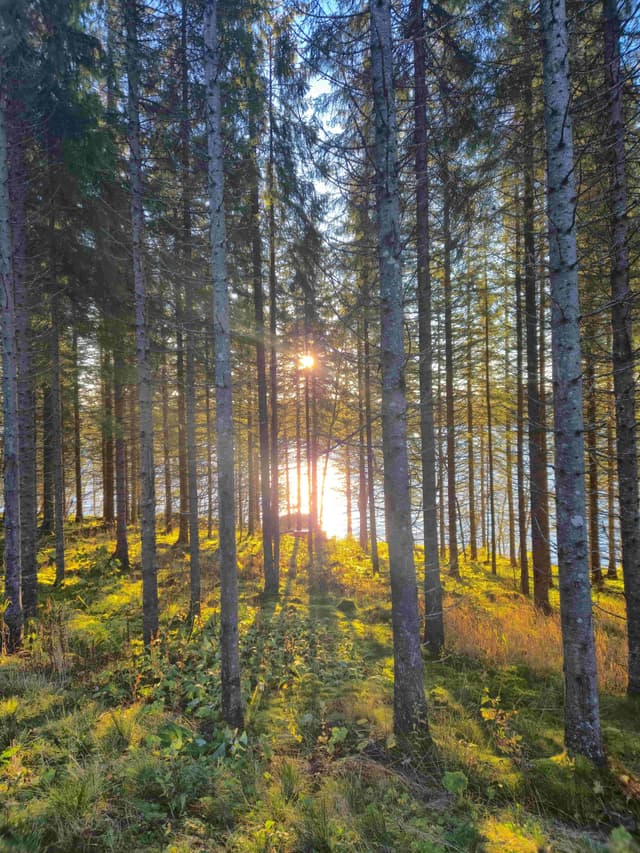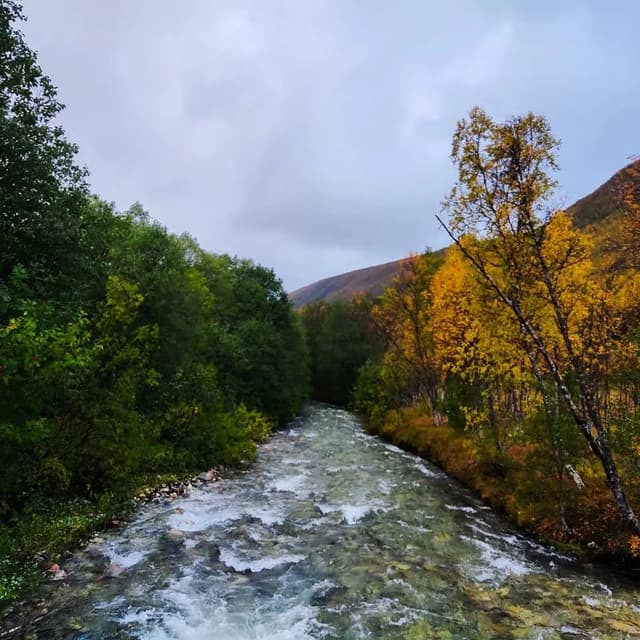
I have stood by water in fog, early, before anyone else is awake, and felt how thin the boundary between worlds really is. Not thick, as we like to believe. Just thin enough that one forgets it is there, until one morning one stands in that half-awake state: half here, half somewhere else, which shamans for thousands of years have used as a gateway to where they needed to go.
People tend to think of shamanism as something far away. Siberia. The Amazon. Places we have never been. But the Nordic hemisphere has its own tradition, buried in the sagas, in the Eddic poems, in stories people told long before anyone wrote them down. And what strikes me again and again: there is not much distance between a Sami noaidi's drum and a Norse völva's staff. Or between a Siberian shaman's spirit journey and Odin, hanging nine nights in a tree.
A journey that is not a metaphor
Let me start with a story fewer people know. It is about a man named Erik.
Erik was the son of a Norwegian petty king, and one Christmas Eve he made a vow: he would find Ódáinsakur, the Field of the Undying. The place where sorrow, sickness, old age and death simply did not exist. Not in heaven, but down below. Underground, or at least somewhere one had to pass through the underworld to reach.
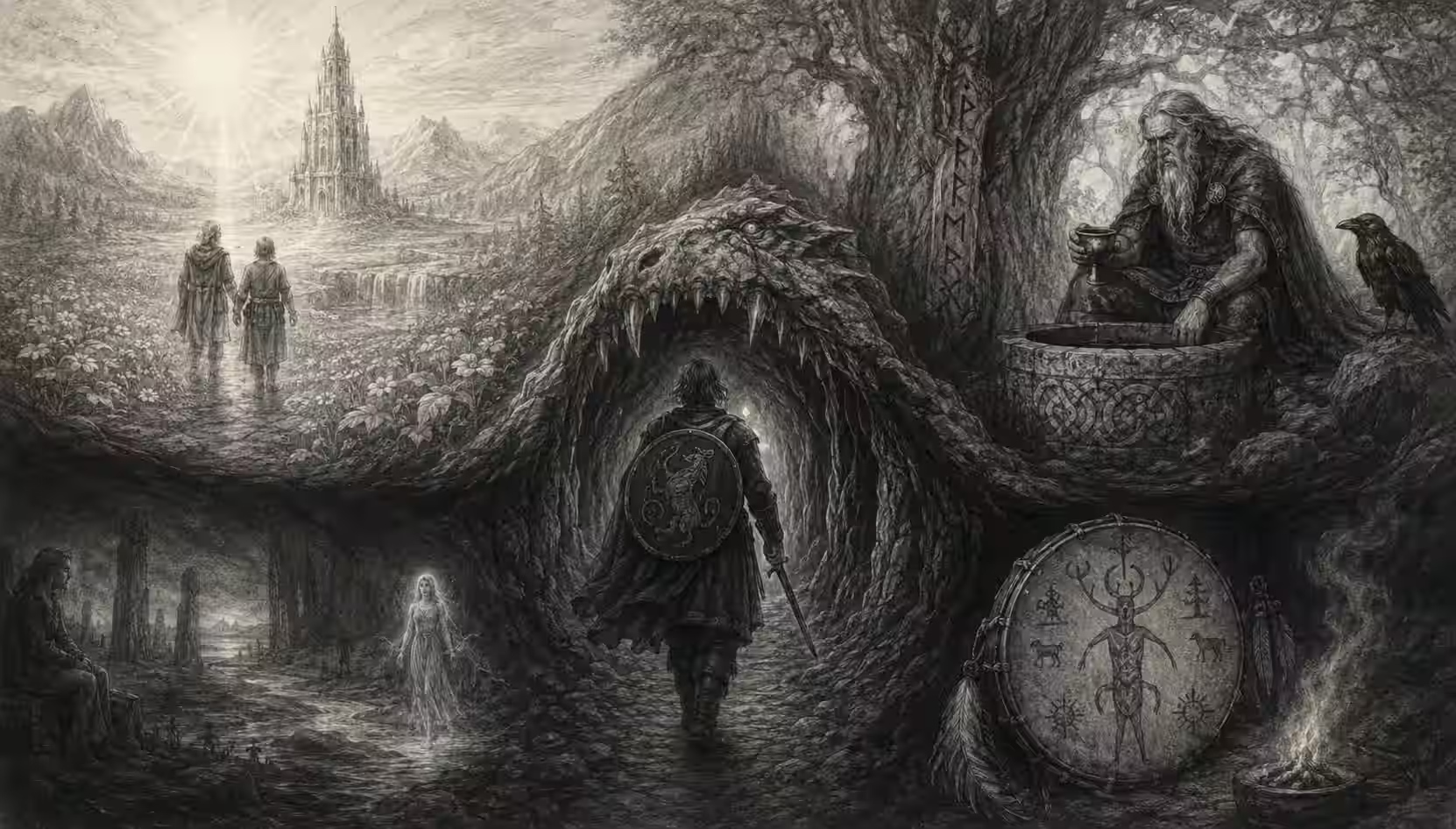
Together with a Danish namesake, he set off. Through Miklagard, through Syria, through an India that in the saga seems more like a dream than a place on the map, until they came to a dark land where the stars stood out in the middle of broad daylight. There, beyond a dense forest, they found a river with a stone bridge over it, and on the bridge lay a dragon with its jaws wide open.
The Danish friend wanted to turn back. Erik did the opposite. He grabbed one of his men with one hand, his sword in the other, and ran straight towards the dragon's maw.
They were swallowed.
And on the other side, nothing bad happened. The smoke lifted, and there lay a sun-filled plain full of flowers, rivers of honey, air that never turned dark, no shadows anywhere. In the midst of it all, a tower that hovered without foundation, with a ladder up to a room full of velvet and gold and food unlike anything they had ever tasted. They thought they had come to Ódáinsakur itself. They had not, quite: an angel later explained that this was only the forecourt, that Paradise proper lay even further in, reserved for the souls of the dead. But they were allowed to rest there for six days before being sent home to tell what they had seen (Eiríks saga víðförla, related by Viktor Rydberg in Investigations into Germanic Mythology).
I remember reading this story for the first time and thinking: this is not just a fairy tale. Now, I should be honest with you: what I say next is my own reading, not something Rydberg himself writes. He is concerned with tracing names and genealogies back to the origins of mythology, not with comparing this to shamanic practice. But the structure of the story is one I recognise from many drum journeys I have led or been on myself, and the similarity is too clear for me to leave it be. One leaves the familiar behind. One meets something meant to frighten one away: a dragon, a guardian, a darkness. One goes through it rather than around it. And on the other side lies what healers all over the world call the lower world: a place without time, without sickness, where one meets helpers one did not know existed.
Gudmund and the one who knew everything
There are several sagas that tell similar stories, and they point towards a figure who reappears again and again under different names: Gudmund, king of the Glittering Plains. He lived, according to the sagas, north of Hålogaland, by Gandvik, and he and his people grew so old that they lived through generations without dying. After his death he was worshipped as a god.
Here it gets interesting, because Rydberg does something I find rather elegant in his analysis: he argues that this medieval Gudmund is really a Christianised, narratively rewritten version of a far older figure: Mimir. The well. The guardian of wisdom.
And this is where Norse mythology truly begins to speak the language of shamanism.
Mimir sits by one of the roots of Yggdrasil, the world tree, and guards a well so full of wisdom that Odin (Allfather himself, chieftain of the gods) has no power over it whatsoever. He must ask. He must suffer. Rydberg shows, with reference to Hávamál 138 to 140, how Odin only gets to drink from the well as a gift or a loan from Mimir, never as something he can take by force (Hávamál, st. 138–140; Rydberg, ch. IV). Consider that for a moment: the mightiest god in the entire Norse universe, and he must submit to suffering and pleading merely to taste knowledge that lies below, underground, in the lower world.
Again, this is where the text ends and my own interpretation takes over. Rydberg uses Hávamál purely philologically, to trace which well Odin actually drank from and who "Bolthorn's famous son" was. But the principle he points to without saying so aloud is one every shaman recognises in their own body. Wisdom is not given for free. One pays for it: with time, with discomfort, with letting go of something one thought one needed. A noaidi fasted. A Siberian shaman underwent what is technically called an initiation illness, often so severe that those around them believed they would die. Odin hung nine nights in a tree, wounded by his own spear, without food, without drink, to retrieve the runes from the depths. Is this a deliberate parallel on the part of the saga writers, or simply the same human mind arriving at the same solution to the same riddle, again and again, independently of one another? I do not know. But the movement is identical: down, through pain, and back up again with something one did not have before.
The tree that holds it all together
Yggdrasil itself deserves a few more words. Rydberg's point is strictly philological: he traces how various sources describe roots, wells and worlds, and who lives where. But I cannot help seeing the tree as something more than that: the very model for how shamans, independently of one another, have mapped out the cosmos. An axis running vertically, connecting an upper world, a middle world where we live, and a lower world where the dead, giants and forces of an entirely different order reside.
What Rydberg actually writes, with reference to the sources, is that there were two Jotunheims in the Norse worldview: one on the earth's surface, far to the north and east, and one beneath the ground, an underground Jotunheim where Mimir and the norn figures Urd and her sisters guarded their wells at the roots of the tree (Grímnismál 31; Rydberg, Investigations, ch. IV). These two were connected, with a path between them: that much is there, plain to read.
That I read this as the very structure of a shaman's universe is my own thought, not his. But it is hard to shake off once you know what you are looking for: not two worlds separated by a wall, but two worlds connected by a path, a path only a few know how to find, and even fewer dare to follow to the end.
Hermod appears in the same mythology, riding Sleipnir down to the realm of the dead to fetch Balder back. He rode through a dark land, came to the river Gjöll with its gold-covered bridge, and finally reached the very gate of the realm of the dead (Gylfaginning 49). The same river, the same bridge of gold, reappears in the saga of Gorm, where travellers are warned against crossing it. Rydberg uses precisely this recurrence to argue that the sagas have roots in one and the same original myth: that is his point, not mine. But when I read it, I mostly think about how long a story can survive, disguised, as long as its very shape strikes something people recognise in themselves.
On not dying where one is meant to die
What fascinates me most about the Ódáinsakur stories is the very paradox in the name: the Field of the Undying. Not a place for the dead, but a place for living people who escape death. This is not the realm of the dead. It lies beside it, almost wall to wall, but it is something quite different.
This distinction, between the realm of the dead and a place for the living, is something a shaman recognises from their own practice: one travels to the lower world to bring something back, not to stay there. Power, a piece of soul, an answer. Then one goes home. Again: that last part is my interpretation, not Rydberg's point.
What he does write, concretely and with reference to the text, is about a grove in Gudmund's realm, an enclosed place shielded from weakness, old age and death, not for the souls of the dead, but for certain living people with access few others have (Rydberg, ch. IV, §51). And he points out that this exact same grove recurs in the myth of Mimir, under the name Mimir's grove, Hoddmimis holt. There, according to Vafþrúðnismál, two people are to survive the end of the world: Líf and Lífthrasir, fed on morning dew, thereafter the ancestors of a new human race (Vafþrúðnismál 44–45). Rydberg in fact spends most of this section correcting a misunderstanding among other mythologists, who had interpreted this to mean the pair sat up in the tree itself during the conflagration: a reading he considers contrary to the wording of Vafþrúðnismál.
What I take with me from this (and this, then, is mine, not his) is how strange it is that this exact place, tied to the guardian of wisdom, becomes where humanity's future is preserved through catastrophe. The lower world that is not ruin, but origin. Where the seeds simply lie waiting.
What the saga writers actually remembered
One of the things I find most moving about reading these texts is seeing how they survived into Christian times, disguised, adapted, but never quite erased. The saga writer who told of Erik had to turn Ódáinsakur into a forecourt of the Christian Paradise, place it east of India, behind a wall of fire, because the old, pagan idea of a place for living people underground had no room in the church's worldview. Rydberg himself points to this: for the church there was only Hades and hell, accessible through the gates of death, no middle ground for those who still breathe (Rydberg, ch. IV, §50).
But the idea refused to die. It kept resurfacing, saga after saga, because it belonged to something deeper than theology. It belonged to a practice. Someone had actually "been there": in trance, in dream, in a state we today would call a shamanic journey, and had come back with stories too powerful simply to vanish.
This is what I think of when people ask me what Nordic shamanism actually is. It is not a finished package of rules. It is traces. Fragments of a worldview that existed long before church bells, that survived in the sagas because they were too good a story to forget, and that still, if one listens properly, tells us something quite concrete: the worlds are connected, the path between them exists, and the price for walking it is always the same: one must give something away to get something back.
I do not believe Erik found Paradise. I believe he found what shamans have always found when they have dared to walk through the dragon's jaws instead of turning back: a place where time behaves differently, where the usual rules do not apply, and where, if one is fortunate and has the right companion along, one is allowed to come home again with something worth telling.
Source
Viktor Rydberg, Investigations into Germanic Mythology, Volume I (Norwegian: Undersökningar i Germanisk Mytologi), chapter IV, §§44–52, with primary sources from Eiríks saga víðförla, Hervarar saga ok Heiðreks, Helga þáttur Þórissonar, Gylfaginning, Vafþrúðnismál and Hávamál.