The law that proves the practice
There is a profound historical irony in the study of Sámi and Norse religion: the sources that most often tell us most precisely what people actually believed and practised are not the descriptions from believing insiders, but the prohibitions of the men of church and state. When lawmakers in the 1100s explicitly forbid "sitting out by burial mounds to wake the dead", it is not because they wish to document a living practice. They want to eradicate it. But what they unwittingly do is bear witness to the fact that the practice actually took place, to such an extent that it required legal regulation.
This principle, that prohibition is evidence, is not a new insight. Historians of religion and archaeologists have long made use of it, but it deserves to be highlighted as a methodological cornerstone in the study of Norse and Sámi religiosity. In what follows, I will go through some of the most important categories of prohibition and show what they reveal about a religion that the authorities tried to wipe from the face of the earth, but which lived on in people's hearts, on remote moorlands and along stone-laid burial mounds far from the priest's eye.
The prohibition of mound sacrifice and the haugbúi cult
The Old Norse term haug, meaning burial mound, appears again and again in the prohibition clauses of the medieval laws, and this is no coincidence. The burial mound was not primarily a burial site in the Christian sense; it was a cosmological hub, a boundary between the living and the dead, a place where the ancestral spirits, the haugbúar, "those who dwell in the mound", resided and could be contacted.
The older Gulaþing Law, dated to the mid-1000s, explicitly forbids blot to haugar ok hǫrgar, that is, sacrifice to burial mounds and sacred piles of stones. The penalty was fines, further fines, and, in cases of repetition, banishment. The Christian law of Sverrir Sigurðarson extended the prohibition to cover sacrifice to heathen wights in general, but the mound remained a particular concern. Gulaþing's Christian law from the early 1200s, preserved in manuscripts from this period, specifically forbids fræista draugha upp at væikia æda haugbua: "attempting to wake the dead or those who dwell in the burial mounds" (Temenos Journal). The first book of the Borgarting Law likewise forbids "utiseta" (sitting out), linking the practice directly to the burial mounds.
Stefan Brink, professor of Viking studies at the University of Aberdeen, has analysed these legal texts and concludes that they do not merely testify to a random marginal culture: "[From these quotations] we can see that the church deemed it necessary to write down prohibitions against the worship of mounds, that is, within a heathen ancestor cult" (Brink, "Myth and Ritual in Pre-Christian Scandinavian Landscape"). The lawmakers would not have spent time and parchment forbidding something that was a rarity. The prohibition presupposes prevalence.
Alexandra Sanmark has, in her research on ancestor cults in Scandinavia, shown that sitja á haugi, sitting on the burial mound, was an integral part of Norse religious practice connected to both divination and contact with the dead. Such mound-sitting is in the saga literature associated with prophetic gifts and poetic inspiration, and Sanmark shows that the archaeological finds support the literary sources' portrayal (Sanmark, "Living on Ancestors"). It is also worth noting that Norwegian folklore studies from the 1800s document offerings made to burial mounds on farms well into Christian times, testimony that the church never fully succeeded. As a study from the University of Iceland concludes, these traditions "underscore the continued sacred value of the burial mound for the local population, and potentially reflect early conceptions of ancestral spirits that the church failed to eradicate" (Nordic folk legends and grave mounds, Háskóli Íslands).
Utiseta
Perhaps no single Norse religious practice is better documented through the prohibition literature than útiseta, "sitting out". The practice involved a person seeking out a place of power, a burial mound, a mountain peak, a crossroads, or a spring, and spending the night there alone, in silence, in order to receive visions, knowledge of fate (örlög), or contact with gods, spirits, or ancestors.
The Icelandic law book Grágás (Konungsbók) from the 1200s formulates the prohibition with a precision that is valuable precisely because it defines what the practice consisted of: "Ef maðr sitr úti at vekja tröll upp eðr at fremja heiðni, þá er hann útlagr", "If a man sits out to wake trolls [i.e. ancestral spirits/wights] or practise heathenry, he is outlawed" (Nordiska Asa-samfundet). The parallel provisions in the Frostaþing Law and the Gulaþing Law show that the prohibition was consistent throughout the Norwegian legal landscape. The Frostaþing Law counts utiseta among the offences, alongside murder and sorcery, that cannot be redeemed; the penalty is outlawry.
It is crucial to understand what this means in terms of source value. The lawmakers are not referring to an abstract, mythological notion. They are forbidding something that people actually do. The word útiseta is concrete enough to have received a legal definition. As Andreas Kornevall aptly points out in his analysis of Norse ceremonial architecture: "It is paradoxical and unintentional, but the laws against heathen practice from Christian lawmakers are today important academic sources for understanding more of the old heathen culture" (Kornevall).
Snorri Sturluson mentions in Heimskringla that the lawspeaker Þorgeirr Ljósvetningagoði, the man tasked with deciding whether Iceland should be Christianised in the year 1000, actually carried out something resembling utiseta: he spent a whole day and night under his cloak at the assembly site, and emerged with his decision afterwards. The practice was evidently recognised enough that even a legal authority made use of it at a decisive historical moment.
The corresponding Sámi term mirrors a shared Arctic and Subarctic form of religion in which the boundary between the human world and the spirit world was crossed at precisely such lonely places at night.
The Sámi drum
If Norse legislation gives us the source value of prohibition, the history of Sámi mission is an even more dramatic example. Here we are not in the relatively sober world of legal texts, but in a colonial campaign in which the power of the state and the power of the church fused into a systematic attempt at cultural annihilation.
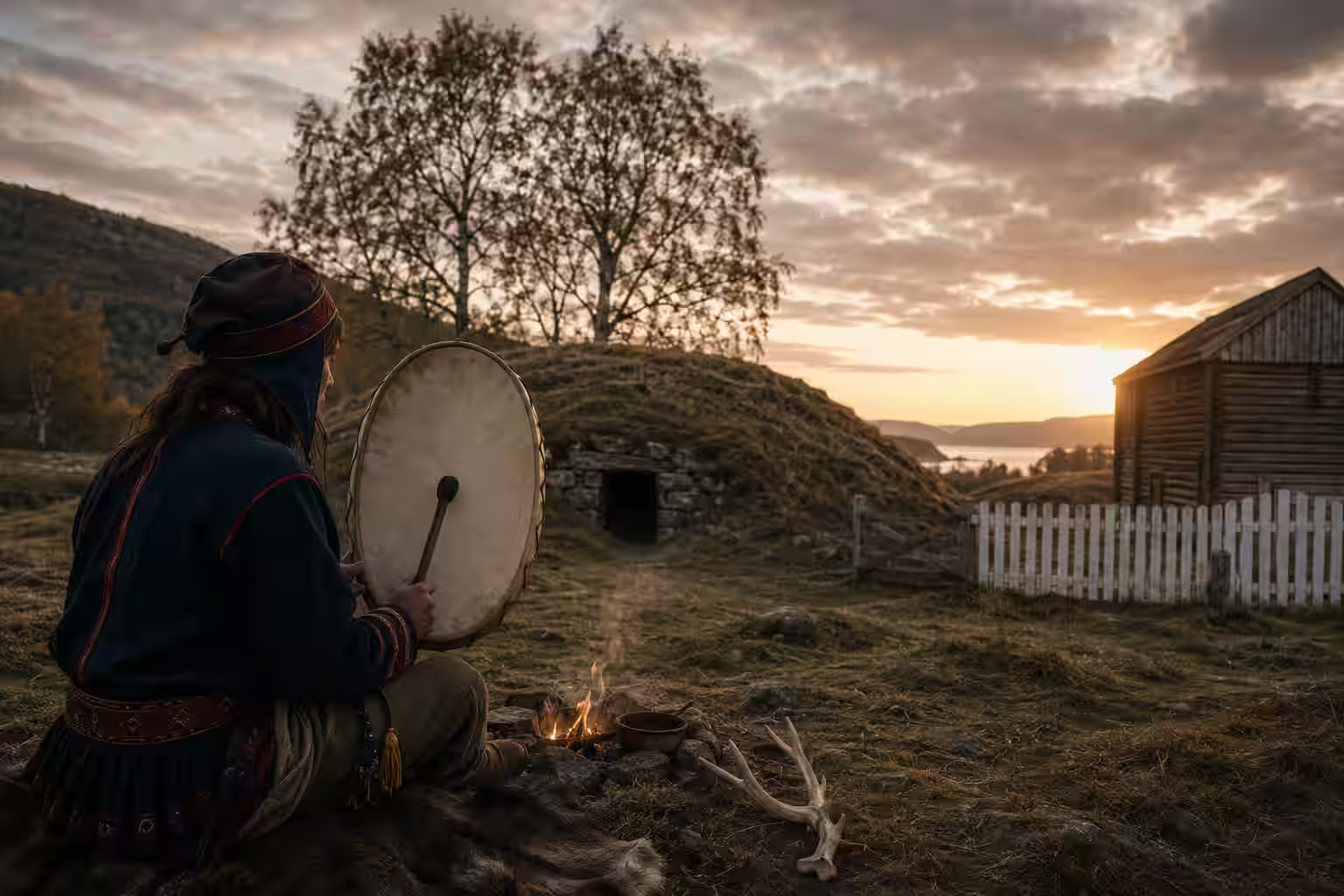
The Sámi frame drum (goavddis or meavrresgárri in various dialects) was not merely a musical instrument. It was the noaidi's map of the cosmos, his navigational tool in the spirit world, his medicine and his meteorology. Painted on the drumskin was the worldview itself: the upper world, the middle world, the underworld, the gods and spirits each in their own domains. Thomas von Westen, the Norwegian missionary who from 1716 led the most intensive Christianisation mission in Sápmi, called the drum "the Sámi bible", and used precisely that description to justify why it had to be destroyed (Wikipedia, Sámi drum).
From the 1600s onward, Sámi sacrificial practices were banned, and possession of drums was criminalised. The consequences were severe. The Sagepub source from the Journal of Material Culture documents: "The use of the drums, which were important sacred objects in the Sámi religious beliefs and ritual practices, was forbidden under threat of severe punishment, even the death penalty. Several Sámi were sentenced to death for using their drums, and at least one person was executed in Sweden for this" (Journals Sagepub). Scholars such as Rydving (1993) note that the death penalty for mere possession of a drum was rare, but that confiscation, torture, and forced renunciation were the rule rather than the exception.
Rune Hagen has documented that more than 175 people in Norway were persecuted for witchcraft in the period 1593–1695, and that the Sámi were strongly overrepresented in these trials precisely because noaidi practice, shamanic journeying, divination, drumming, was interpreted as a diabolical pact within the demonological framework of the clergy (LAITS University of Texas).
What does this tell us about the religion itself? That the drum was central enough that the authorities feared it. Ethnological and folkloristic research has subsequently been able to reconstruct large parts of Sámi cosmology precisely through the surviving drums and through the documents left by the missionaries' own descriptions of what they were trying to destroy. Lars Levi Læstadius' notes, von Westen's reports, Schefferus' Lapponia (1674), all written by people who wished to eradicate this religion, are today primary sources for understanding it.
The joik and the horn hat
The prohibition did not stop at the drum. The joik was equally dangerous in the eyes of the priests, because it was inextricably linked to the practices of the noaidi. The joik is not a song about something or someone; it is a song that is what it calls forth. It is magic in sound form. For this reason, it was regarded as just as culpable as drumming.
The professor at the University of Texas at Austin sums it up thus in his account of Sámi Christianisation: "The joik was as despised by the priests as the drums were, and because of its connection to the pre-Christian Sámi religion, this is also the reason why Sámi joik was banned in schools in Sámi areas well into more recent times" (LAITS). The suppression of the joik in the Norwegian and Swedish school systems is a remarkable example of the fact that the principle of prohibition does not belong only to the Middle Ages; it extends into modern times.
A more exotic, but equally telling, example is the prohibition of the Sámi women's horn hats. Norway's submission to the UN Special Rapporteur on the rights of indigenous peoples documents that the Norwegian authorities and priests forbade the traditional Sámi horn hat because the priests believed the devil was hiding in the "horn" (OHCHR Norway submission). Here we encounter the absurd outer limit of prohibition: even garments were marked as matters of religious policy. But the prohibition testifies to something important, that the horn hat carried a cosmological or spiritual significance that exceeded the merely decorative, and that the priests intuitively understood this, even though they interpreted it through the lens of demonology.
The sieidi stones and the secret sacrificial sites
The Sámi sieidi, a natural stone or wooden post with a distinctive shape that was recognised as the dwelling place of a spirit and became a focal point for sacrificial practice, was another target of the missionaries' wave of destruction. Von Westen and his people confiscated and destroyed sieidi stones systematically. Nevertheless, as the historian of religion Håkan Rydving documents, many places survived in secret:
"Even during the harshest mission activity among the Lule Sámi, several of the sacred sites at the intermediate level continued to be used, but in secret. In addition, new sites for indigenous rituals were established. Anyone who wished to continue sacrificing to the gods of the ancestors had to keep hidden from the authorities who tried to prevent these practices. Indigenous rituals were therefore performed on the mountain ridge, far from the priests, who rarely went there" (LAITS, University of Texas).
This is a pattern we recognise from colonial religious suppression globally: the religion does not withdraw from the world, it withdraws into the mountains and forests, into the private and the nocturnal, into codes and symbolic language that only the initiated understand. Prohibition drives the religion underground, but does not eradicate it.
Methodological reflection: What do the prohibitions tell us?
It is necessary to acknowledge the methodological challenge: the sources of prohibition are filtered through hostile eyes. They do not give us religion as it was experienced from within, but as it was regarded from without by those who feared and hated it. The terminology is distorted, "troll", "devil", "idolatry", and the details that were highlighted tended to be the most dramatic and best suited for criminalisation.
Even so, the prohibitions give us something invaluable: evidence of existence and prevalence. They give us geographical distribution (prohibitions appear from Iceland to Sápmi to Anglo-Saxon England). They give us chronology (the timing of prohibitions correlates with waves of Christianisation, which allows us to reconstruct religious geography over time). And they even give us terminology: the Old Norse and Latin terms in the prohibition texts are often the only surviving designations for practices that were otherwise not recorded in writing.
The contribution of archaeology here is indispensable as a means of verification. When the legal texts forbid mound cults, and the archaeologists then find traces of repeated, post-burial activity in and around the mounds, offerings and food gifts, hearths, footprints of ritual behaviour, the circle is closed. Text and material culture confirm one another mutually.
The forbidden as the sacred
There is a deep irony in the fact that the most powerful testimonies to Norse and Sámi religiosity are carried forth by those who wished the religions annihilated. The bishop who ordered the collection and burning of noaidi drums, the Norwegian lawmaker who ordered outlawry for anyone who sat out by the burial mound at night, they believed they were on the verge of victory. Instead, they produced a body of documentation that has made it possible for historians of religion, ethnologists and archaeologists to reconstruct traditions that would otherwise have been lost in an ocean of silence.
For those who today practise or study these traditions, whether it be Norse seid, Sámi noaidi activity, or other forms of indigenous spirituality in the north, this is an important realisation: ancestral knowledge survived in part because it was persecuted, because the persecution forced the authorities to name and describe what they wished to destroy. What the church forbade lives on as a source. What the colonial power tried to erase was, ironically, preserved in the colonial power's own archives.
Anyone who wishes to understand what the Sámi and the Norse people actually believed and practised, not what they were told to believe afterwards, should begin precisely there: in the long, unintended testimony of the prohibitions to the sacred.
Key academic references
• Brink, Stefan: "Myth and Ritual in Pre-Christian Scandinavian Landscape", University of Aberdeen.
• Rydving, Håkan: The End of Drum-Time: Religious Change Among the Lule Saami, 1670s–1740s (1993).
• Sanmark, Alexandra: "Living on Ancestors: The Soul", in The Viking Way (2004).
• Schefferus, Johannes: Lapponia (Frankfurt, 1674).
• Joy, Francis: "Sami Shamanism, Fishing Magic and Drum Symbolism", Shaman vol. 23, University of Lapland.
• Norwegian government submission to the OHCHR/EMRIP, on the repatriation of Sámi cultural heritage (2017).
• Grágás (Konungsbók), Icelandic law collection, 1200s.
• The older and younger Gulaþing Law and Frostaþing Law, in Norges Gamle Love (NGL).
• Svenska kyrkan: Samiska frågor i Svenska kyrkan (2006).
• Sagepub / Journal of Material Culture: "Collecting, Connecting, Constructing: Early Modern Commodification and Globalization of Sámi Material Culture" (2017).