Night on the Farm
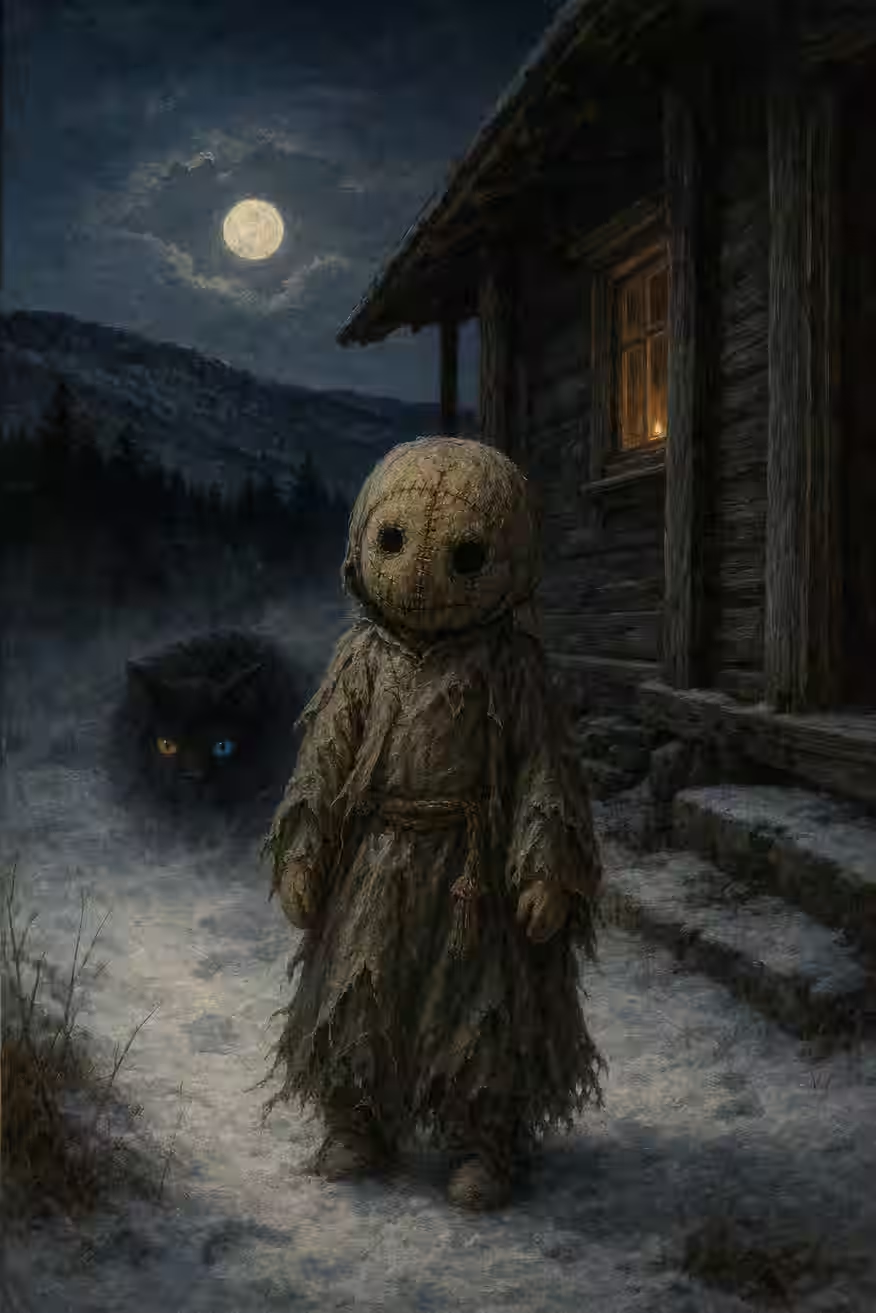
It is deep in February. Outside, the cold sings in the roof beams, and the snow has piled itself into deep drifts against the storehouse wall. Inside the farmhouse everyone is asleep: the children in bed, the husband with his heavy breathing, the dogs curled together by the hearth. But not her. The farmwife sits at the table, and in the half-darkness she holds something in her hands, something small, something she would not show to anyone. It is a figure, small and dark, with features that almost resemble a human face. She whispers to it, words that only she and the little creature know. Then she releases it. It is out in the night.
No one sees it. But by the next morning, the neighbour's chest is a little lighter.
So begin many of the stories about the dradokka.
The Dradokka: the Doll that Drags
In Norwegian folk-life research there exists a belief that is old, tenacious and dangerous: the idea that a person could own a small, living being that had been created with one's own hands and one's own blood, and which served one with absolute loyalty, in exchange for something one perhaps ought not to give. The dradokka, also called dragedokka, dragedukka or dradukken, is a personal helping spirit, in Latin spiritus familiaris, in the shape of a small human.
The name itself points straight to the core of the belief: dra, meaning to drag or draw. The doll drags riches to its owner. It draws from others and brings to you. It is stolen fortune, gathered in darkness and delivered to your door.
In a record from the Norwegian Folklore Archive (NFS Leiro 5, p. 35) it is described thus:
"The dragedokka was a wight that some people had. If there was something they wished for, they need only tell her she should bring it, and she would drag it to them. If a man was rich and had luck with him, they said he had the dragedokka."
Wealth that could not be explained, success that seemed undeserved: all of this was attributed to the dradokka. It was envy's metaphor made into a creature. The neighbour's good harvest, the fisherman's rich catch, the farm's surplus: all of this could have an explanation, that someone had sent out their doll.
How She Was Made
No helping spirit comes into the world without a price. And the birth of the dradokka is not an innocent act.
The most common method was to use the root of the mandrake, Mandragora officinarum, a plant whose root is shaped like a human body with arms and legs. In European tradition the mandrake was long regarded as a being on the border between the plant kingdom and the human; it screamed, it was said, when torn from the earth. To use such a root as a dradukke was to take a creature that was already half alive and make it one's own.
But there were also homemade variants. One of these is as simple as it is eerie. One took birch bark and shaped it into a doll. Then one laid it beneath a river bridge and let it lie untouched for seven years. During those seven years, every time one went to communion, one brought along a small piece of bread and a few drops of wine, and let the doll under the bridge have its share. It is a profound image. The owner passes on something of Christianity's supposed power to their secret servant, connecting the helping spirit to the sacred by letting it drink of it. And after seven years, a whole cycle, a whole set of seasons repeated, the doll is alive.
A third, darker method is also mentioned. One had to steal the right thumb of a hanged or dead thief, wrap it in silk cloth, and let it become one's dradukke. Here it is the thief himself, the criminal's severed hand, that becomes the helping spirit. The logic is as simple as it is macabre: a hand that stole in life continues to steal after death.
But regardless of the method, the dradokka always demanded the same thing: blood from the owner. A few drops, pressed from the fingers, dropped onto the doll. With the blood came life. With the blood came the bond.
The Dark Exchange
Whoever owned a dradokka did not merely own a tool. They owned a relationship, an exchange with the supernatural that had its own rules and its own costs.
The dradokka could be sent far. She travelled out by horse and sledge to other farms, unseen in the night, to fetch grain and sheaves, wool and timber, clothes and food, gold and silver. She could be sent to the bottom of the sea to fetch money from those who had drowned, treasures that lay in the darkness beneath the waves, which no one else dared touch. There is something fascinating and unsettling at once here. The dradokka does not only fetch the neighbour's riches. She also fetches the dead's, the lost's. No fortune is sacred to her.
There is an observation in the sources charged with symbolic weight. When the doll is sent to the bottom of a chest, to steal from neighbours, she laughs. But when she is sent into the depths of the sea to fetch the treasures of the dead, she weeps.
The laughter by the chest is the laughter of desire. She does what she was made for; she drags and drags. But the weeping at the seabed suggests something deeper. Perhaps she senses the distance from the living. Perhaps it is in the darkness beneath the sea that she meets something that cannot be stolen without sorrow.
The owner, most often described as a woman, a farmwife, a neighbour-woman, a witch, was thought to stand in connection with the supernatural. And this was feared. Because the prosperity the dradokka brought did not come from nowhere. It came from others. The neighbour's poverty was the owner's wealth. It was a direct transfer, and everyone knew it.
The Trollcat and the Stolen Milk
Related to the dradokka, but with a different form and function, is the trollcat, called smørkatt (butter cat) in Northern Norway, and smiergáhttu in Sámi, para in Kven. Where the dradokka is a human figure that steals broad wealth, the trollcat is bound to the centre of daily household life, namely milk and butter.
The trollcat was a cat-like creature that witches and those skilled in the magical arts could create from rags and waste. In Northern Norway it was particularly linked to the farm's cows; it sucked milk from other people's cows at night and spat it out at home with the owner, who thus gained a surplus of butter and cream where the neighbour's cows stood dry.
But the trollcat was not merely a tool. It was bound to its owner by a thread of life. The formula spoken at its creation has been recorded thus: "Half I give of my life, half I give of my lifetime, and half I also give of my bell-cow. Only be true to me and do all that I ask!" The owner literally gives of their lifetime to the creature. And if the trollcat was harmed, the owner was harmed. To kill the trollcat, one had to strike the small heart, no larger than a pinhead.
The trollcat could take many forms. It was not always cat-like. It could appear as a grey ball of yarn rolling by itself across the ground, or it could have one yellow and one blue eye. In some tales it is a transformed witch, that is, not a created being but a human who has transformed themselves.
The Bjära in Sweden, the Snakkur in Iceland
The belief in a small, obedient helping spirit that steals for its owner is not uniquely Norwegian. It stretches across the whole of the Nordic region and appears in different forms in each country.
In Sweden the creature is called bjära, also known as mjölkhare, trollhare or puke. The bjära is known since 1596 and is related to the Swedish verb bära, to carry. Like the Norwegian trollcat, the bjära steals milk from the neighbours' cows, but can also take the form of a hare, a bird, or, in Northern Sweden, a ball of yarn woven from nine colours. To give it life, one dripped three drops of blood from one of the left-hand fingers on a Thursday evening and said: "Milk and butter shall you win for me, in hell's fire shall I burn for you." It is the same logic as with the dradokka. A pact with evil itself, a soul paid for earthly wealth.
In Iceland the creature is called tilberi in the north and snakkur in the west and south, the latter word originally meaning "weaver's spool." The tilberi is made from a rib stolen from a recently buried corpse, wrapped in grey wool. Three Sundays in a row, the creator spits consecrated wine onto the bundle at the communion table, and thus it is slowly brought to life. The tilberi climbs onto cows and ewes and sucks them dry, then returns to the owner's butter churn and cries: "Full belly, mother! Take the churn lid off, mother!", and vomits the stolen milk straight into the churn.
There are striking similarities across national borders. The blood, the sacred elements (wine, bread) used for unholy purposes, the vulnerability of the small heart, and the shared life between owner and creature. These beliefs do not merely share motifs; they share a fundamental existential logic about desire and the price it demands.
The Noaidi's Helping Spirits: the Tradition from the South Meets the Tradition from the North
To fully understand the dradokka and the trollcat, we must turn our gaze towards Sámi tradition, and especially towards the noaidi, the Sámi shamanic practitioners.
The noaidi had helping spirits, called noaidegadze or saivogadze, whom they kept around them. These could look like small people, dressed in colourful Sámi clothing, and they served the noaidi as obedient assistants. They could be passed down from one noaidi to another, sold, or even given away as dowry. Here is a direct echo of the dradokka belief: creatures that are inherited, traded and passed on as part of a person's spiritual capital.
Even more closely related are the gandflies, bewitched objects or beings that Sámi noaidi could "shoot" or send after people and animals to harm them. Where the dradokka carries wealth to its owner, the gandflies carry a curse to the enemy. But the underlying principle is the same: a supernatural helper, sent by a skilled person, carries out the owner's will over a distance.
It is no coincidence that these beliefs overlap geographically precisely in Northern Norway, in the space where Norwegian farming culture and Sámi noaidi culture met, traded with one another, and feared one another. The beliefs took shape at the intersection of two worlds, where notions of obedient emissaries found one another and partially merged.
The Shadow of the Witch Trials
The belief in the dradokka was not merely folk superstition. It had legal consequences.
During the witch trials in Finnmark, where 91 people were burned, 14 of them men, most of them Sámi, the belief in such helping spirits was used as evidence. To own a dradokka, to have had contact with a helping spirit, was to stand in league with evil. It was enough to be brought before the court. It was enough to die.
It is in the late Middle Ages that the idea develops systematically that witches and alchemists keep helping spirits that act on their behalf. But in the Nordic region the roots are deeper, more diffuse, woven into an everyday life where the line between fortune and misfortune, between what is one's own and what is stolen, was never entirely clear.
The farmwife who did too well. The neighbour who always had enough butter. The fisherman's inexplicable luck. All of this created a culture of suspicion in which prosperity was interpreted as theft, and where those who had much always risked being asked: what have you given, and to whom?
Desire, Envy and Fear
At the root of all these beliefs lies something deeply human: the fear that another's fortune comes at the expense of your own, and the longing to obtain what one lacks, whatever the price.
The dradokka is the archetype of envy and desire made into a story. She is not merely a creature. She is a reflection of something in the human psyche, that which wants more, that which wants to take it from someone who has it. That she was most often owned by women, farmwives, housewives, those who managed the quiet economy of the household, says something about who bore the stigma of this belief. Women with power over resources were viewed with suspicion.
But there is something more complex here. For whoever owns a dradokka always pays. With blood. With lifetime. With soul. There is no free fortune in this belief's universe, and that is perhaps the deepest truth within it: that stolen wealth always costs more than it is worth. The trollcat drains the owner's lifetime. The bjära binds the owner to hell. The tilberi drains from the owner's body.
These creatures are not merely servants. They are mirrors. They show us what desire does to a person when it is not restrained by morality or society. They show us the consequence of wanting what others have.
The Living Within the Old
Today there are no longer court cases about dradokkas. There is no longer a fear that the neighbour sends something in the night to empty your kitchen store. And yet...
The beliefs live on. They live in folklore archives. They live in local legends and oral tradition. But they also live, in a deeper sense, as expressions of something that never changes: the geography of envy, where the neighbour's fortune always feels like an unexplained threat to one's own; the fear that those who fare better than oneself have gained it unjustly; and the longing for a small, faithful power that fetches what one desires and lays it at one's feet.
The dradokka is not the past. She is a story people have told one another for thousands of years, from Finnmark to Iceland, from Swedish log farmhouses to Sámi turf huts, because the story touched something true. It is not a truth about magic. It is a truth about what we are willing to do to have enough, and what we are willing to believe about those who already have it.
The little doll beneath the river bridge has waited seven years. Tonight, someone finally lets her go.
Sources:
Norwegian Folklore Archive (NFS), University of Oslo, a manuscript collection with folklore records from across the country, including NFS Leiro 5 and NFS Krogh 22
Hodne, Ørnulf. Vetter og skrømt: i norsk folketro. Cappelen Damm, 1995/2012
Hodne, Ørnulf. Norsk folketro. Cappelen Damm, 1999
Bø, Olav. Trollmakter og godvette: Overnaturlige vesen i norsk folketru. 1987
Grambo, Ronald. Norske trollformler og magiske ritualer. 1979