There is a night along the Norwegian coast when the sea no longer belongs to the living. When the fog settles thick as a shroud over Lofoten and Finnmark, when the storm has quietened to a strange, uneasy calm and the waves strike the rocky shore with a heavy, mournful blow, then it is other powers that rule. Then it is the draugen's hour.
He does not come with a roar. He comes with a half boat.
Imagine you are a fisherman. Imagine you have been out at sea for three days, that your hands are cracked and stinging with salt, that your body is a map of weariness and cold. The night is dark, but you know these waters. You have sailed here since you were a boy. Your grandfather prepared tackle on the same quay. You are safe.
And then you see it.
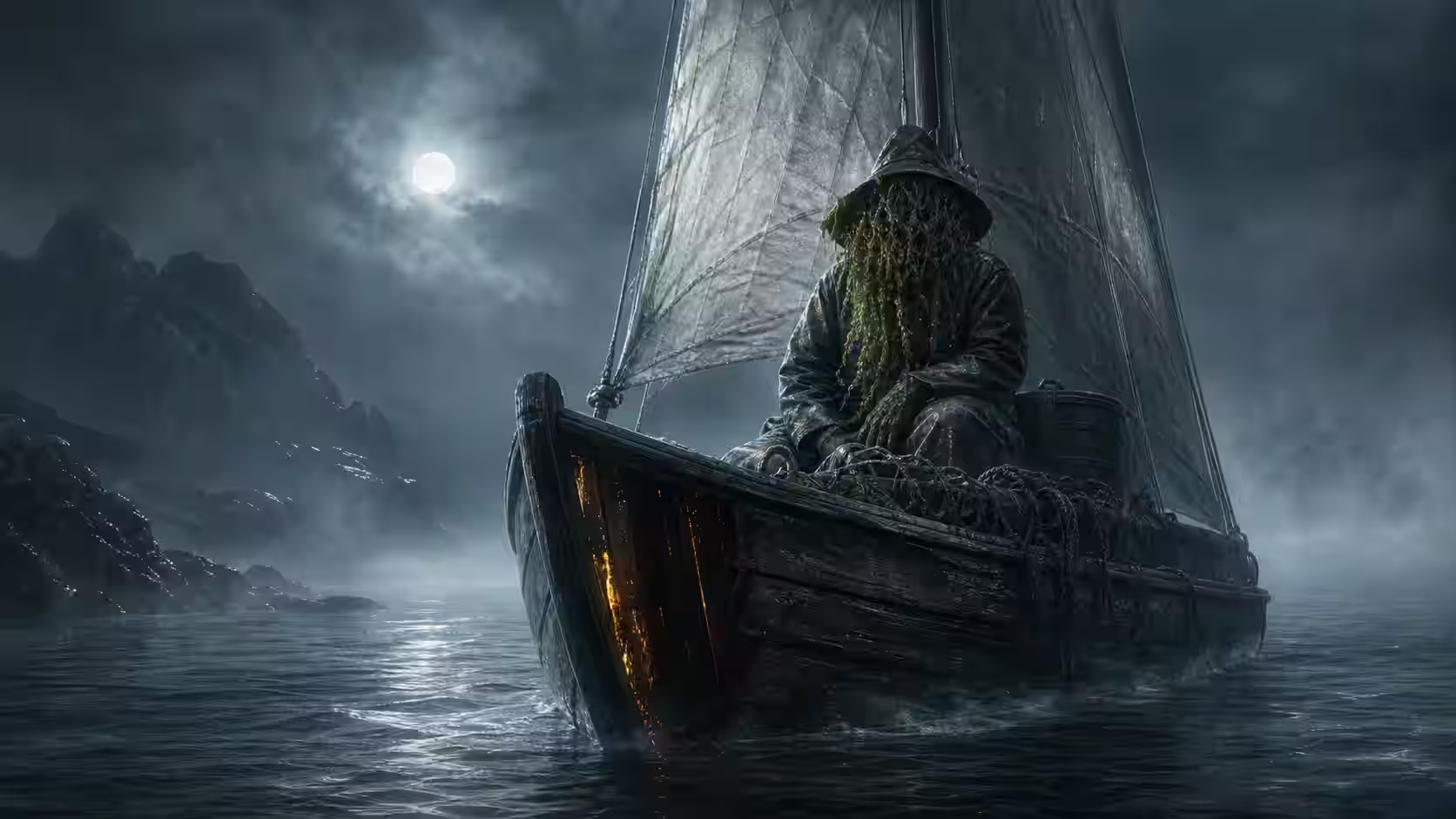
Far out, in the grey-blue darkness where the horizon swallows everything: a boat. A half boat. Not damaged, not capsized, but split, as though a giant's knife had slid lengthwise through the hull and left only one side behind. And yet it sails. With full sails that never catch the wind, sails that never slacken. On the deck sits a figure in a sou'wester and oilskins, and where the head should be, there is only a knotted tangle of seaweed: brown, slimy kelp bobbing where a face should be.
It turns towards you.
You now know that you are going to drown.
An ancient map of fear
The draugen is not merely one being. He is an entire map of the coastal people's deepest dread, drawn up over thousands of years with the sea as their sole livelihood and their grave. The Old Norse sources use the word draugr for the dead who walk again: those who refuse to disappear, who wander back from the grave with a physical body intact, not as a translucent apparition, but as matter, as weight, as something you can touch and which can touch you back.
In the Icelandic sagas, the draugr is the dark brother of the burial mound: he sits in his mound guarding his gold, strong as ten men, able to shapeshift and change size. He is not evil by nature; he is evil because the living intrude into his world, because they steal his peace. Eyrbyggja saga and Laxdæla saga are full of such encounters, where heroes must break into burial mounds and fight the dead on the dead's own terms. It is a test of courage. A test of manhood.
But along the Norwegian coast, something else happens to this figure. Here the draugen leaves the mound and goes out to sea. Here he becomes something far more diffuse and far more threatening, for he is no longer tied to one place, one hiding spot, one piece of gold. He is everywhere the waves break. He is the sea itself, personified as grief.
The priests of the 1700s were the first to record him in writing in a Norwegian context. Hans Egede, the Norwegian priest who also documented the kraken in 1729, mentions in passing another sea creature that people call the drauen, writing that it has no fixed form, but appears in one guise or another. It is a striking precision: formlessness. Something that is there without being able to be pinned down.
Three faces, one being
In Trøndelag, a tale is told of a dispute that unfolded on a beach one night. A corpse had washed ashore, and two draugen quarrelled over whom it belonged to. One was headless, cut off cleanly at the neck, as though the sea had taken the head as payment. The other had a head of seaweed. And between them lay the drowned man, an argument the sea had cast off.
Three types of draugen are attested in the oral tradition. The one with the seaweed head is the most well known: the fisherman who drowned and never received a Christian burial in consecrated ground, and who now sails his half boat along the coast as a living omen. The headless one is darker and more primal, a being without identity, pure dread in the shape of oilskins. And then there is gleip, the third, the most cunning. Gleip hooks itself onto the trouser seams of seamen coming ashore and makes them stumble and fall into the sea on the slippery rocks. He does not kill through strength. He kills through mishap.
It is gleip who reminds us that the draugen is not always a dramatic sight out at sea. Sometimes he is a heaviness in the legs, an unnatural slipperiness beneath the sole, a moment's inattention in the wrong place.
From Lofoten to Finnmark
In the north, the tradition is strongest. There is a reason for this. Along Lofoten, Vesterålen and up through Troms and Finnmark, fishing was not merely a livelihood; it was a pact with the sea, and the sea took its share. Boat crews lost in storms, fishermen who never returned, men who ended up in the sea and were laid to rest in the waters without cross or priest or the rites that bound the soul to the next life: these men became draugen.
"The draugen takes those who are not buried in Christian ground," the tradition says. But behind this Christian formulation lies something far older: the belief that those who die violently and incompletely cannot find rest. The sea is not a grave. The sea is a limbo.
Jonas Lie, the author from Eker who spent years along the northern Norwegian coast, brought the draugen into the light of literature towards the end of the 1800s. In his short stories, the draugen is not merely a supernatural haunting; he is the social trauma itself. Behind every legend about the draugen lies a concrete loss, an actual drowning, a family who never had a body to bury. The draugen is the dark side of the work of grief: what happens to sorrow when it finds no place to rest.
Theodor Kittelsen's drawings of the draugen, created while he lived in Svolvær, are perhaps the most powerful visual expression of this. A figure of sea and night, of seaweed and darkness, of something that once belonged to the human but has now become something else. Kittelsen's draugen stares back from the pictures with the peculiar emptiness of something that knows it is too late.
Related beings
In the Faroe Islands, the dreygur does not wander the sea but the mountains. He is large and strong, pale-skinned with long dark hair, and legend says he eats human flesh. He shares something fundamental with his Norwegian relative: the physical weight, the materiality of something that should have been spirit but refuses to become so, but nature has shaped him differently. Where the Norwegian draugen is the sea that haunts the coastal population, the Faroese dreygur is the mountains that haunt them. Both are the terrain itself personified as danger.
Iceland holds fast to the draugr of the saga sources with a conservative fidelity. Here they are still the mound guardians, the beings beneath the earth, those who protect their mound against the living. But here too they are the unresolved injustice that refuses to be forgotten: the greedy, the violent, those who suffered wrong and never received redress. Icelandic sagas are full of draugar who plague their farms with sickness and misfortune until someone, a Christian priest, a brave farmer, a seiðkona, performs a rite that releases them from the earth's grip.
In Sweden, drög and dröger are more diffuse, understood more generally as revenants and ghosts, and the coastal meaning blends into broader folk belief. But along Skåne, old Danish-Norwegian border country, the words dråe and dråkel carry an undertone of the diabolical, as though the remnants of the old draugen have melted into the Christian conception of hell.
Rávga
In the North Sámi landscape lives a related being: the rávga, and in particular čáhcerávga, the water rávga. These are the shadows of the drowned who live in lakes and rivers, and they are dangerous in a way that recalls the sea draugen of the coast, but adapted to the world of the inland population. They try to pull the living down into the water. They can shapeshift into pike or seal.
There is something deeply meaningful in this correspondence between Sámi and Norwegian tradition along the whole of the northern coast and inland. It is not a matter of borrowing; it is a matter of a shared foundation of experience. In the north, people drown. Inland, people drown. And wherever people drown and are not buried, the notion is born of the unresolved dead who drag the living after them.
The draugen and the rávga are not the same being. But they are answers to the same question: what happens to a soul that cannot find closure?
Christmas night on Helgeland
One of the few draugen ever to be defeated in Norwegian tradition met his match on Christmas night. The farmer Ola came to his boathouse and found a draugen sitting on a stool. The draugen stared at him with its seaweed head and hollow eyes. Ola struck the draugen in the back, the only place one could strike him, and the draugen shot out through the wall in a shower of sparks. Ola ran to the churchyard and called upon the Christian souls there. And it happened: the Christian revenants and the draugen met in battle in the churchyard, with coffin planks and seaweed chains as weapons, and when morning came, everything lay scattered about: coffin planks, boat parts and seaweed. The draugen never returned to that parish.
It is an unusual tale because it lets the living win. Normally the draugen is an omen, not an adversary. Normally he is something you see and then fear, not something you fight. It is as though the story acknowledges that sometimes the work of grief must take the shape of a battle: that it is not enough simply to wait for the unresolved to vanish of its own accord.