Let us establish something right away, for it ought to be said loudly and clearly. These creatures have nothing to do with the seven jolly gentlemen who sing hi-ho on their way to the mine in Disney's Snow White. None of them is called Grumpy, none of them has a disproportionately large head beneath a red cap, and none of them will ever sing in a choir. The Norse dwarves were something far darker, far wiser and far more dangerous, and they deserve to be met on their own terms.
Born of the Primordial Giant's Flesh
In the beginning there was Ymir. The primordial giant, whom the gods Odin, Vili and Vé slew and transformed into the world: his flesh became earth, his blood the sea, his bones the mountains. But in the softening flesh something began to stir. Creatures swarmed forth from the primal substance itself, like maggots in a corpse. These were the dwarves.
So Snorri Sturluson recounts it in the Prose Edda, written down in Iceland around 1220: the dwarves arose as maggots in Ymir's flesh, but the gods granted them human understanding and human form. They were given shape, but their shape came from below, from the dark, the hidden, the earthly. In academic terms, scholars such as Lotte Motz (1974) have argued that the dwarves can, in their origin, be traced back to a common prototype of the mythic master smith bound to the depths of the underworld. They are not gods. They are not humans. They are a third thing, something that exists in the tension between matter and consciousness, between earth and spirit.
In Völuspá, the seeress's prophetic poem, probably from 900-century Iceland, we find what is called the Dvergatal, a catalogue of dwarves' names spanning six stanzas and containing around seventy named beings. Scholars have long debated whether the Dvergatal is a secondary insertion in the poem, but the fact that all surviving manuscript versions include it suggests it was an integral part of the tradition. The names themselves are keys: Dvalinn means 'the delayed one' or perhaps 'the one who lingers', Náinn points towards the Norse ná, meaning corpse, cadaver. Náinn is the near-dead one. Gandálfr carries within it gandr, the magic staff, and álfr, elf. Yes, precisely: Tolkien's Gandalf takes his name from a Norse dwarf. A detail that perhaps says something about how mythic material has wandered through cultures and epochs.
The People of Masters: Those Who Never Give Willingly
To understand the dwarves' role in Norse cosmology is to understand a deeper, paradoxical logic: they are the masters of craft, yet never willing donors. They are the finest craftsmen in the nine worlds, and yet the gods must almost always resort to cunning, coercion or threats to obtain what they want.
Look at the inventory list, and you understand what was at stake: Mjölnir, Thor's hammer, forged by the brothers Sindri and Brokk after Loki had set up an absurd competition over who were the finest smiths. Odin's spear Gungnir, which never misses its mark, forged by the sons of Ivaldi. Freya's necklace Brísingamen, created by the four dwarves Alfrik, Dvalin, Berling and Grerr, and for which Freya paid with four nights, one for each dwarf. The ship Skíðblaðnir, which holds all the Æsir yet can be folded up like a handkerchief. The golden ring Draupnir, which drips eight new rings from itself every ninth night. The invisible bond Gleipnir, which bound the wolf Fenrir, forged from materials that do not exist in the visible world: the sound of a cat's footsteps, a woman's beard, the roots of mountains, the sinews of a bear, the breath of a fish, the spittle of a bird.
The scholar John Lindow has pointed out that the relationship between dwarves and gods is structured as a one-way flow of goods: "the flow of goods is always from the dwarfs to the gods, never the reverse" (Lindow 2002, p. 101). It is a relationship without reciprocity, and this is precisely what distinguishes dwarves from elves and other nature beings within the Norse system. Elves received blót, sacrificial offerings, worship. Dwarves received nothing, because to ask greedy beings for gifts is a logical contradiction. You steal from them, or you trick them. You never ask them.
Light and Darkness: And the Boundary That Blurs
Snorri attempts to tidy up the mythic universe by dividing the world into neat categories. In Gylfaginning he describes a cosmology in which light elves (ljósálfar) live in Álfheim and are more beautiful than the sun, while dark elves (dökkálfar) live beneath the earth and are 'blacker than pitch'. But where Snorri draws sharp boundaries, the older sources seem to operate with far more fluid distinctions.
Research by Alaric Hall and others has shown that the distinction between dwarves and 'svartálfar' in the older sources is unclear: indeed, svartálfr in many contexts is simply a synonym for dvergr. In Hávamál, the wisdom poem in which Odin hangs for nine nights in Yggdrasil to obtain the power of the runes, Dvalinn is mentioned as the one who carved runes for the dwarves. Runes, not merely metalwork and jewellery. The dwarves are not only smiths; they are guardians of hidden knowledge, archivists of that which should not be spoken aloud.
Alvíssmál, 'the words of the all-wise', tells of the dwarf Alvís, who has laid claim to Thor's daughter as his wife. Thor, who is by no means pleased with the arrangement, decides to delay him with a contest of riddles. He asks Alvís for the secret names of all things: the sky, the moon, the sun, the fire, the wind, the forest, as they are called by gods, humans, elves, dwarves, giants and in Hel. Alvís answers precisely and fully. He knows everything. But he cannot outlast the sunrise, and when the dawn breaks, he is turned to stone.
It is a narrative image of great weight: wisdom that cannot withstand the light. Knowledge bound to darkness and to that which is hidden. The dwarves are, in their essence, a people of the night.
Greed, Darkness and Wisdom: The Three Natures of the Dwarves
First, they are the masters of matter. They know what lies within the stone, what is hidden in the ore. They can shape the shapeless. Mjölnir's lightning was actually forged beneath the mountain by two brothers competing over a wager, a myth that contains the entire Norse dwarf tradition within a single tale. The competitive aspect, the trickery, the creative aspect and the fundamental ambiguity of the result. The hammer that Brokk and Sindri forged had a shaft that was too short, because Loki, transformed into a fly, had stung Brokk on the eyelid so hard that blood ran into his eye and the bellows stopped for a moment. A perfect creation, slightly flawed. There is something fitting in that.
Second, they are the wise men who cannot bear the light. Alvís knew the name of everything, yet the dawn was his undoing. Dvalinn carved runes. The Hávamál passage mentioned above links the dwarves directly to the esoteric wisdom tradition, to the runes that are the script of night and the underworld. It is knowledge that comes at a cost, knowledge that is dangerous to bring up into the light.
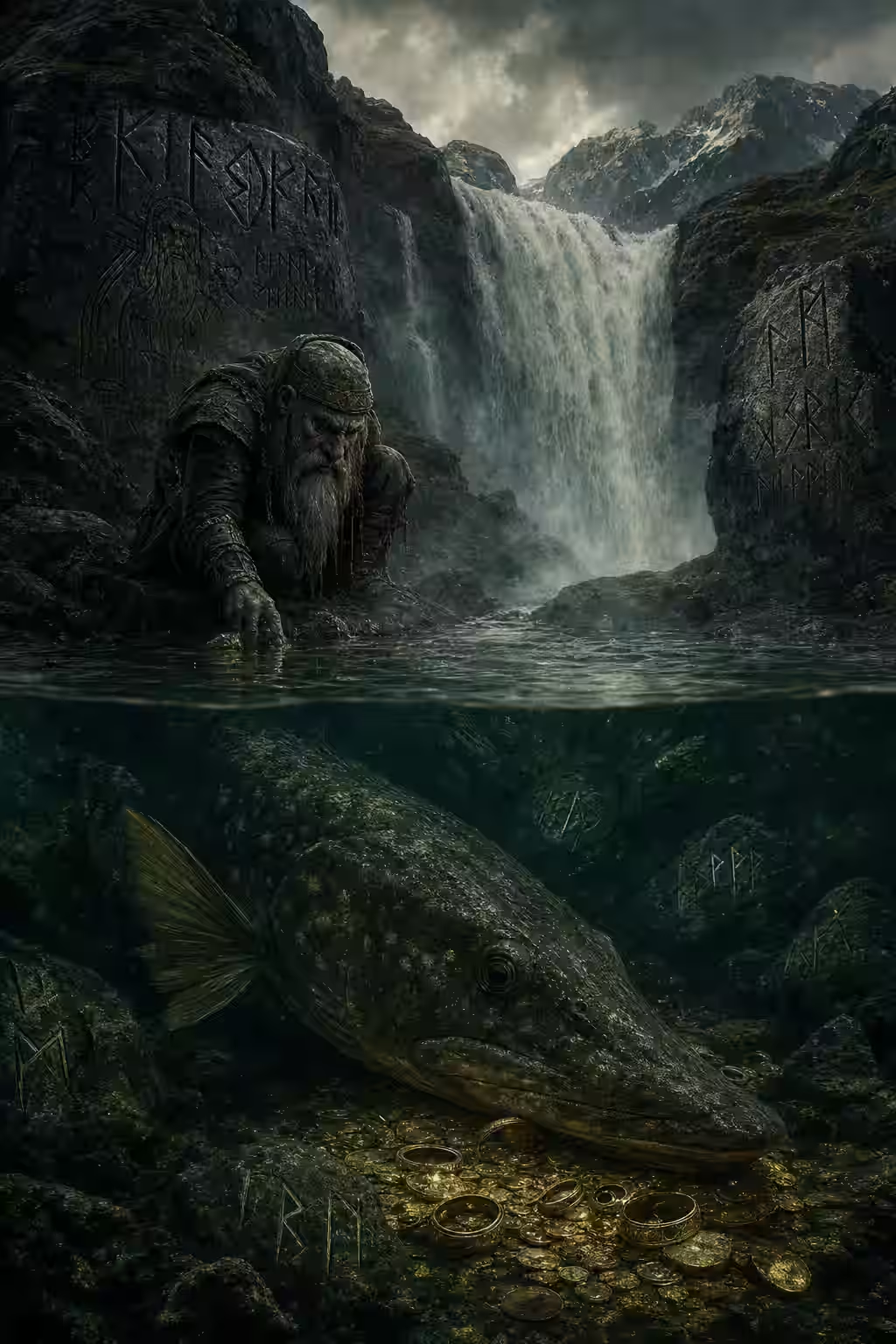
And third, they are greedy. This is not a moral judgement but a cosmological function. Andvari sat in the waterfall guarding his gold. When Loki took it from him by force, he cursed the ring Andvaranaut, and the curse became the twisted thread running through the Völsunga cycle, from Fáfnir, who transformed himself into a dragon out of desire, to Sigurd, who slew him and roasted his heart over the fire, and when he burned his finger on the glowing flesh and put it in his mouth, he suddenly understood the speech of birds, to Brynhild's sorrow and Gudrun's tears. A dwarf's curse: a moral force stretching across generations. That is no small thing. It is, in fact, one of the most powerful narrative structures in Norse literature.
A Living Legacy
There is something profound in the Nordic relationship to the underground that cannot be reduced to superstition or naivety. It is a recognition that the world does not end at the visible. Beneath the stone, there is something. Beneath the field, there is something. Beneath the threshold of the house, there is something. That something demands respect, not worship, not veneration, but the simple, practical courtesy that any neighbourly relationship entails.
The academic folklorist Terry Gunnell has argued that the Icelandic tradition of the huldufólk is not an isolated curiosity but represents a living, continuous religious practice with roots in the pre-Christian worldview: a form of animistic pluralism in which the visible world is but one of several layers in a complex map of existence (Gunnell 2007).
The dwarves in Völuspá, the maahiset of the Finnish forest, the huldufólk in Icelandic stone cairns, the grey figures in the mists of the Faroe Islands: they are all expressions of the same underlying feeling, that the stone is not empty, that the earth is inhabited, that what is hidden is not absent.
It is an insight older than the Edda, older than writing, older than the names we give it. And that is perhaps precisely why it endures, not as a myth in a book, but as a feeling in your spine when you walk alone on the mountain and sense that something is watching you.
Source references
• Snorri Sturluson, Prose Edda (c. 1220). Norwegian translation by Ludvig Holm-Olsen, Aschehoug, 1950.
• The Poetic Edda: Völuspá and Alvíssmál, Codex Regius (c. 1270).
• Lindow, John, Norse Mythology: A Guide to the Gods, Heroes, Rituals, and Beliefs, Oxford University Press, 2002.
• Motz, Lotte, "The Craftsman in the Mound", Folklore 85:1, 1974.
• Hall, Alaric, Elves in Anglo-Saxon England, Boydell Press, 2007.
• Gunnell, Terry, "How Elvish Were the Álfar?", in Constructing Nations, Reconstructing Myth, Brepols, 2007.
• Harva, Uno, Die religiösen Vorstellungen der altaischen Völker, Helsinki, 1938.
• Sontag, Katrin, "Hidden People and Their World in Iceland", in The Supernatural in Estonian and Scandinavian Tradition, 2009.
• Encyclopaedia Britannica, article "Maa-alused", https://www.britannica.com/topic/maa-alused
• Wikipedia/Wikimedia: "Huldufólk", "Dverg (mytologi)", "Völuspá", "Dvergatal"
• World History Encyclopedia, "Elves & Dwarves in Norse Mythology", https://www.worldhistory.org/article/1695/elves--dwarves-in-norse-mythology/ (2021)
Brathair Journal: "Religion, Álfar and Dvergar", https://www.ppg.revistas.uema.br/index.php/brathair/article/download/864/711