Eikþyrnir, the mythical stag that towers upon Valhalla's roof, is far more than a bizarre creature from Norse mythology. This being, described in both the Poetic and the Prose Edda, carries profound symbolism and ties together cosmological, ecological, and spiritual threads in Norse belief. Through a narrative journey we explore not only Eikþyrnir's role in mythology, but also his unexpected connections to shamanic traditions – an angle that sheds new light on an ancient myth.
The majestic guardian of Yggdrasil
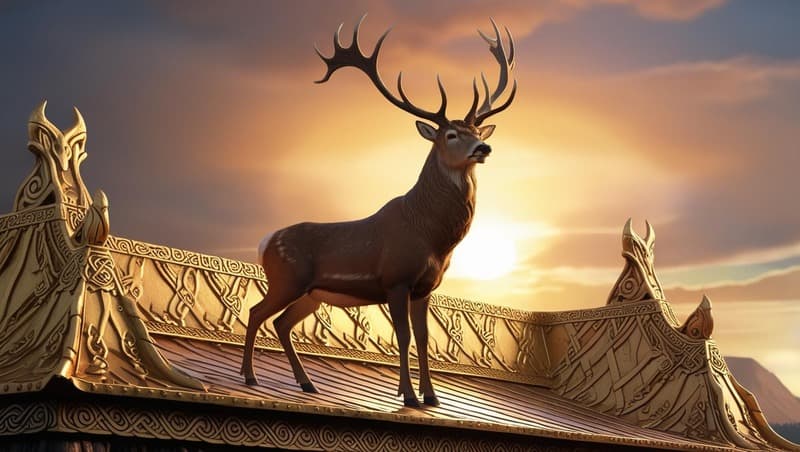
On Valhalla's roof, where the einherjar feast after death, Eikþyrnir stands and grazes on the leaves of the world tree Yggdrasil. According to Grímnismál, water drips from his antlers down into Hvergelmir, the primordial spring that gave birth to all the world's rivers. This image is not merely a poetic description, but a key to understanding Norse cosmology. The stag's ability to feed on Yggdrasil shows his role as a sustainer of life – a creature that both consumes and renews the order of the world.
An unexpected etymological twist
The origin of the name has puzzled scholars. While "eik" (oak) and "þyrnir" (thorn) clearly point toward images of nature, Anatoly Liberman proposes a radical theory: the name may stem from a splitting of the mythological place name Heiðþyrnir, where the halves became both Eikþyrnir and the goat Heiðrún. This underscores the symbiotic relationship between the two animals that share Valhalla's roof.
The cradle of rivers in the antlers
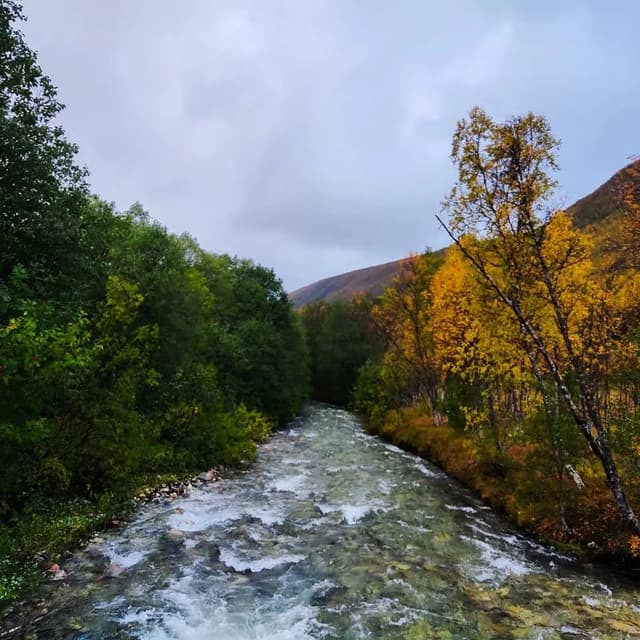
From Eikþyrnir's antlers flows not only water, but as many as 34 named rivers according to Snorri's Edda. Among them Síð and Víð: these names mean "Slow" and "Wide" respectively. Although they are not directly reflected in modern Norwegian river names, "Síð" may have an etymological connection to the Swedish place name Sibro.
Søkin and Eikin: "Søkin" can be interpreted as "The Seeking One", while "Eikin" means "The Raging One". These names reflect forces of nature and may have inspired local river names in Norway.
Svöl: Means "The Cool One" and may have influenced names of mountain streams in Norway.
Gunnþrá: "The Warlike" or "The Brave One", a name that may have inspired rivers connected to historical battlefields.
Fjörm: "The Swift One", a name that fits fast-flowing rivers in Norwegian topography well.
Fimbulþul: "The Mighty Roar", which may have inspired names of waterfalls or rapids in Norwegian rivers.
Rín: This is the Norse form of the Rhine, which shows that mythological rivers could also represent real waterways.
Gípul and Göpul: These names have a possible connection to the Norwegian river that may once have borne the name Goppollen.
Gömul: "The Old One", a name that may have inspired river names connected to ancient settlements.
Geirvimul: "The Spear-Storm", which may have given its name to rivers near historical sites of battle.
Þyn and Vín: "Þyn" means "The Raging One", while "Vín" may mean "Friend of Women". These may have influenced names of rivers known for their strong currents or fertile banks.
Þöll and Höll: "Young Pine" and "Sloping", names that may be reflected in rivers running through pine forests or steep valleys.
Nyt and Nöt: "Use" and "The Burning One", which may have inspired names of rivers known for their resources or hot springs.
Slíðr and Hríð: "Dangerous" and "Gust of Wind", names that may have influenced rivers known for their perilous currents or weather-exposed areas.
Sylgr and Ylgr: "Swallow" and "She-Wolf", which may have inspired names of rivers with deep pools or in wolf-rich areas.
Gjöll: "Noise" or "Din", known from mythology as the boundary river to the realm of the dead. This name may have influenced rivers known for their roaring waterfalls.
Leiptr: "Lightning", mentioned in the eddic poem Helgakviða Hundingsbana önnur as a river by which oaths are sworn. This name may have inspired rivers known for their clear, flashing water. Among these we find:
These rivers were not merely physical watercourses, but symbolized the various aspects of life – from the power of war to collective memory.
Shamanic parallels
Norse religion contained elements of shamanic practice. The rituals of the völvas, in which they traveled between worlds, can be related to Eikþyrnir's position as a bridge-builder between:
Yggdrasil's crown (the realm of the gods)
Midgard (the world of humans)
The underworld (via Hvergelmir)
In Siberian shamanism the stag is a frequent spiritual guide, often associated with
• Journeys to the underworld
• Transformation between animal and human form
• Connection with the tree of life
A find from archaeological excavations shows that Sámi shamans used reindeer antlers in rituals to communicate with the spirit world – a practice that recalls how Eikþyrnir's antlers function as channels of communication between cosmological levels.
The forgotten link to the sun cult
While Eikþyrnir is primarily associated with water, there are indications of a deeper connection to the sun cult. In Norse iconography, deer antlers are often depicted as sunbeams, and in Grímnismál it is mentioned how the stag must avoid being devoured by the wolf Sköll – the same wolf that chases the sun. This may suggest an underlying mythological structure in which Eikþyrnir functions as a guardian of the sun in the darkness of night.
Modern interpretations and legacy
In the present day, Eikþyrnir has experienced a renaissance as:
• A symbol of ecological sustainability
• A metaphor for humanity's place in nature's cycle
• An inspiration for artists seeking Norse spirituality
A striking example is the Norwegian artist Vebjørn Sand's "Deer Series", in which Eikþyrnir is portrayed as a forest spirit in postmodern style – proof of the myth's enduring relevance.
Sources
Snorri Sturluson: The Prose Edda (Gylfaginning)
The Poetic Edda: Grímnismál
Crossley-Holland, K. (1980): The Norse Myths
Liberman, A. (1992): "Eikþyrnir Revisited" in Journal of Germanic Mythology
Oma, K.A. (2008): Animals in Norse Society
Holman, K. (2003): Historical Dictionary of the Vikings
McKay, J.G. (1932): The Deer-Cult and the Deer-Goddess Cult of the Ancient Caledonians
Brink, S. & Price, N. (2008): The Viking World
Metropolitan Museum of Art (2006): The Golden Deer of Eurasia
Davidson, H.R.E. (1988): Myths and Symbols in Pagan Europe