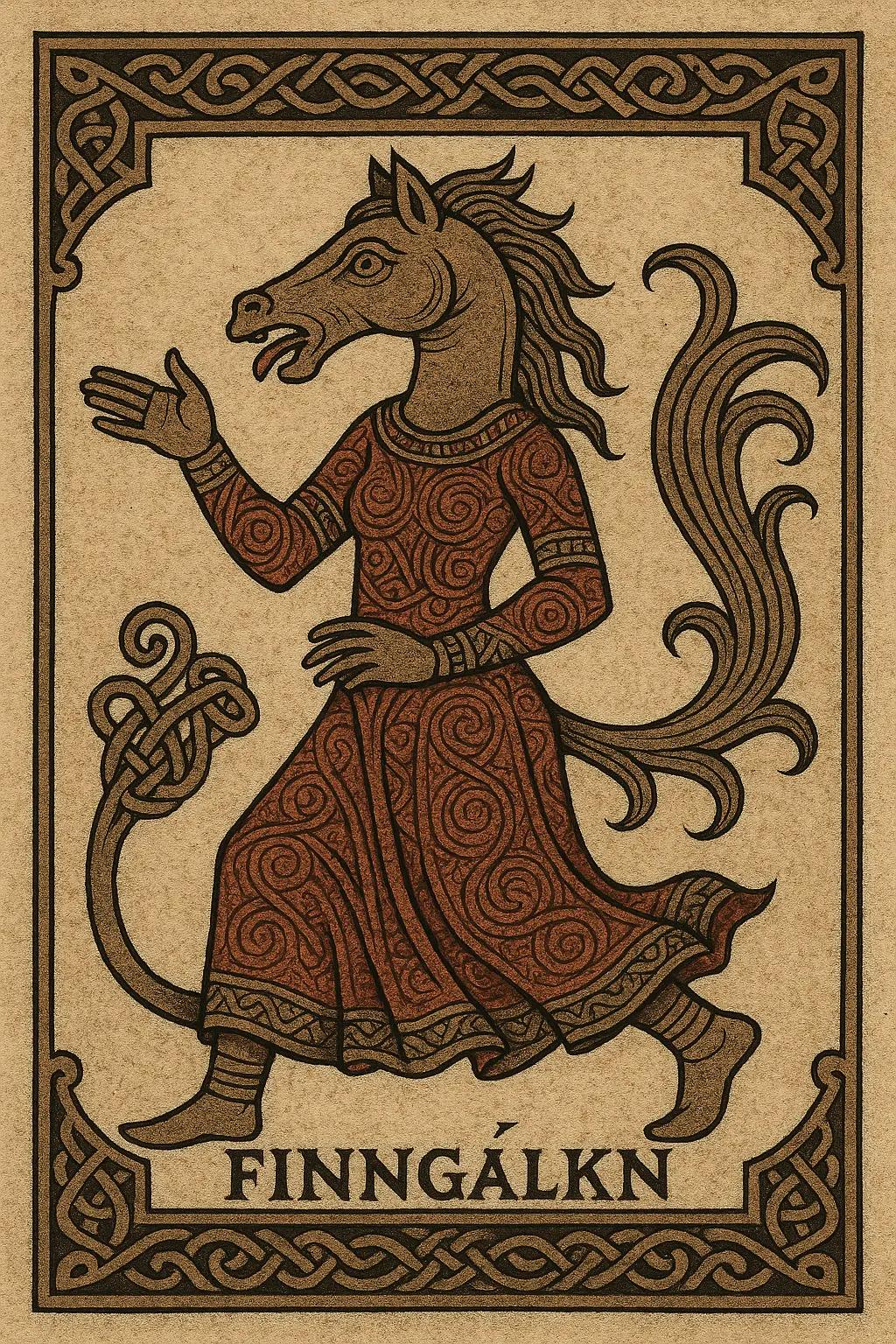
The Finngalken is a little-known being from Norse mythology that can be analyzed through a shamanic perspective in order to understand its role in the pre-Christian world of imagination. This hybrid figure – described with a horse's head, a human body, and a horse's tail – has parallels to shamanic practices connected with animal transformations, spirit journeys, and boundary-crossing experiences.
Mythological background of the Finngalken
The Finngalken (finngálkn) is mentioned in Icelandic sources such as Olav's saga Helga and Flateyjarbók as a dangerous, female monster with the ability to fly. In the Icelandic Physiologus it is depicted as a centaur-like creature, which points toward an animal-human duality. This being differs from more familiar Norse beings (vetter) in its combination of the horse's strength and the human's intelligence.
Shamanic features
Animal transformation and hybridity
The Finngalken's physical form recalls shamans' ability to take on an animal skin (hamr). In the Norse tradition, practitioners of seiðr (a form of magic) in particular could change shape, as described in Vatnsdæla saga, where a fylgja in the form of a horse warns of coming danger. Clive Tolley points out that such transformations in saga literature may reflect authentic shamanic practices.
Spirit journeys between worlds
The Finngalken's ability to fly can be interpreted as a metaphor for the shaman's journey to the underworld (Hel) or the celestial realm (Ásgarðr). In Siberian shamanism, horses are often used as a means of transport on spirit journeys – a notion that may have parallels in Norse belief.
Omens and fate
As a fylgja (accompanying spirit) in the form of a horse, the Finngalken can be seen as a manifestation of fate or ørlög. In a shamanic context, such spirit apparitions are interpreted as guides or warnings, which accords with its role in the sagas as a herald of conflict.
The Finngalken's nature – between animal and human – reflects the shamanic use of hybrid beings as bridge-builders between worlds.
Ritual context and function
In Olav's saga Helga the Finngalken appears in a situation of conflict, which may indicate a ritualized use in war-related shamanic practices. This accords with:
The völva's role as a practitioner of prophecy before battle
The berserkers' use of animal ecstasy in combat
Seiðr-practitioners' ability to influence the outcome of conflicts
The influence of Christianity
The Finngalken's disappearance from folk belief after the arrival of Christianity can be related to the suppression of shamanic practices. Sources such as the Gulating Law explicitly forbade belief in land spirits (landvetter) and pagan rituals, which marginalized such boundary-crossing beings.
Source references
The role of the fylgja concept in beliefs about fate (Wikipedia)
The description of the Finngalken in Norse literature (Hel PhotoArt)
Comparison of Norse and Siberian shamanism (Tolley, 2023)
Shamanic rituals in saga literature (Jill Hammer)
Odin's shamanic features (YouTube lecture)
The evolution of religious practices (Academia.edu)