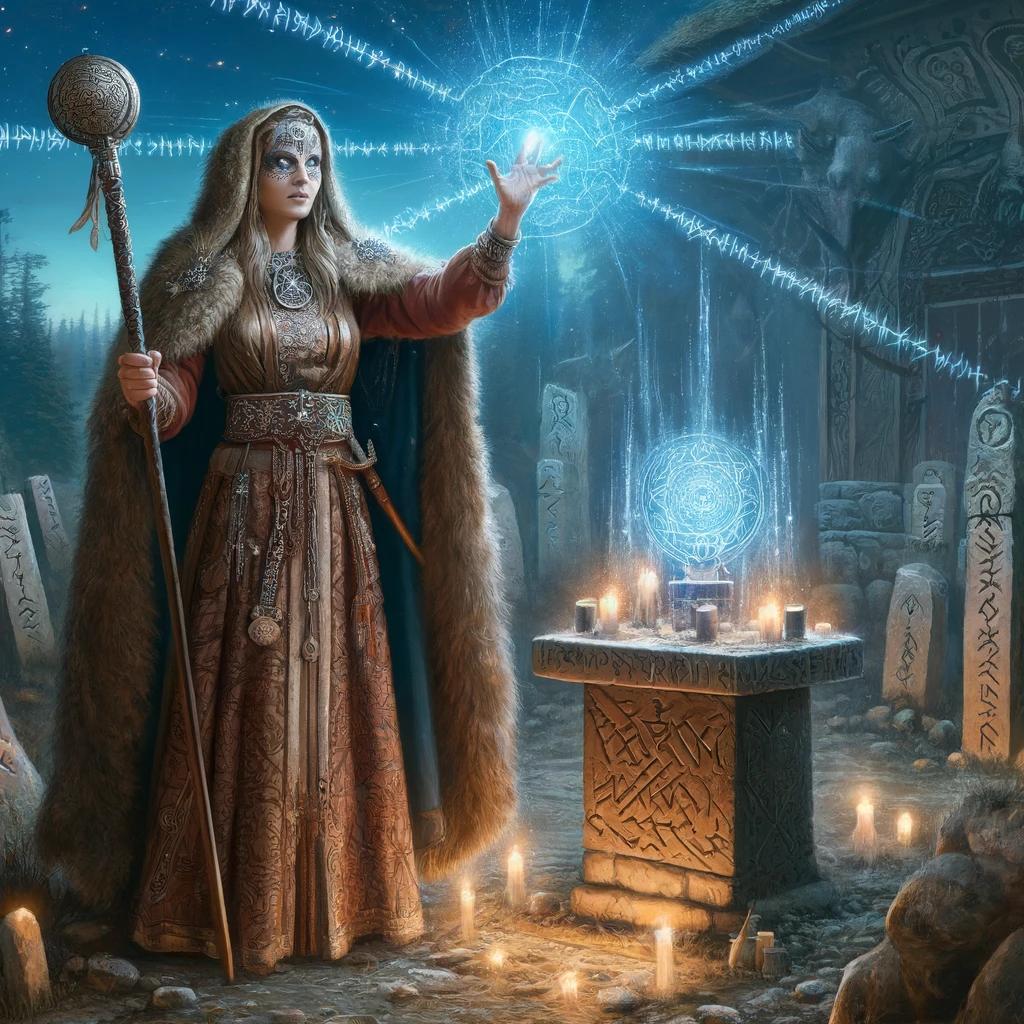
Galdralag, also known as the "magical metre", is a form of Norse poetry that was used in magical formulas and incantations.
The structure and origin of galdralag
Galdralag is a variation of the Norse metre ljóðaháttr. The name "galdralag" literally means "incantation metre" in Old Norse. The structure of galdralag is as follows:
Two alliterating lines with two stressed syllables each
A third "full line" with its own alliteration and either two or three stressed syllables
One or more additional lines that repeat or emphasise the third line
What distinguishes galdralag from ljóðaháttr is precisely these additional lines, which could number between one and three. These extra lines were used to emphasise or repeat the intention of the magical formula.
Alliteration is a literary technique in which the same consonant sound is repeated at the beginning of words that stand close together in a sentence or phrase. It is important to note that it is the sound, not the letter, that is decisive for alliteration. For example, "Peter Piper picked a peck of pickled peppers" is a well-known example of alliteration.
Galdralag has its roots in the Norse oral tradition and was probably developed specifically for magical purposes. The metre is found in several Eddic poems, including parts of Hávamál and Sigrdrífumál.
Historical context and use of galdr
Galdr was a form of Norse magic that primarily involved singing or chanting. The word "galdr" comes from the Proto-Germanic *galdraz, meaning "song" or "incantation". In Norse culture, galdr was used for a range of purposes, both positive and negative:
Helping at childbirth
Inflicting madness on a person
Protecting against fire, sword, arrows and storms
Making weapons blunt and armour soft
Deciding the outcome of battles
Summoning the dead and communicating with them
A master of galdr was said to be able to perform all these acts. Galdr was practised by both men and women, although it was often associated with Odin, who in Hávamál claims to know 18 galdrar.
Practical examples of galdralag
To illustrate the structure and use of galdralag, let us look at some examples from Norse literature and then construct our own galdr.
Example from Hávamál
Þat kann ek it tólpta,
ef ek sé á tré uppi
váfa virgilná,
svá ek ríst
ok í rúnum fák,
at sá gengr gumi
ok mælir við mik.
A twelfth I know,
if up in a tree I see
a hanged man swinging;
thus I carve
and colour the runes,
that the man walks
and speaks with me.
In this example we see the first two alliterating lines, followed by a third line with its own alliteration. The last four lines make up the galdralag extension, which emphasises and expands the meaning of the magical act.
Constructing a modern galdr
Let us now try to construct a modern galdr using the galdralag structure. We will create a protection formula:
Guard me, wise powers,
Guard against the host of evil,
A shield of strength is now made,
Shining bright,
Shielding the soul,
Sending danger far away,
Securing safety, peace and calm.
In this example we see:
Two alliterating lines with "g"
A third line with "sh/s" alliteration
Four additional lines that expand and reinforce the intention of protection
The role of galdralag in Norse literature and culture
Galdralag played an important role in Norse literature and culture, not only as a magical tool but also as a poetic form. It is found in several Eddic poems, including Hávamál, Sigrdrífumál and Skírnismál. In these poems, galdralag is often used to mark especially powerful or magical passages.
In Skírnismál, for example, Skírnir uses galdralag when he pronounces a curse on Gerðr to force her to marry Freyr. This demonstrates the perceived power of galdralag as a magical tool.
Galdralag was not limited to literature alone. It was probably used in actual magical rituals in Norse society. The practice of galdr was closely linked to rune magic, and the two were often used together. We see this in the example from Hávamál above, where runes and galdr are combined to awaken the dead.
Galdralag's relationship to other Norse metres
To fully understand the significance of galdralag, it is useful to compare it with other Norse metres:
Fornyrðislag: This is the most common metre in Eddic poetry. It consists of lines with four stressed syllables, bound together by alliteration.
Málaháttr: A variant of fornyrðislag with longer lines, usually with five or more syllables.
Ljóðaháttr: As mentioned earlier, this is the metre on which galdralag is based. It consists of stanzas of six lines, where the third and sixth lines are longer and have their own alliteration.
Galdralag stands out through its specific magical function and the flexibility in the number of additional lines. This flexibility allowed the practitioner to adapt the formula as needed, which may have contributed to its perceived magical power.
Rituals and performance
While the exact details of how galdr was performed in Norse times are uncertain, the sources give us some hints. Galdr involved high-pitched songs or chanting, often combined with a particular rhythm. This suggests that the performance of a galdr was an intense, focused act that required both vocal skill and mental concentration.
The performance of a galdr could involve several elements:
High-pitched songs or chanting with a particular rhythm.
Physical movements or gestures that could reinforce the magic.
The carving or painting of runes could be part of the ritual.
In some cases, offerings to the gods or spirits could be involved.
An interesting example of galdr in practice is found in Egil's Saga. Here Egil Skallagrímsson uses a combination of runes and galdr to reveal poison in a drinking horn:
"Egil drew his knife and pricked the palm of his hand. Then he took the horn, carved runes on it and smeared them with blood. He chanted:
I carve runes on the horn,
Redden them with blood,
These words I choose
For the ox's wild horn;
Gladly I drink of the gift,
Good ale from Bárðr's hand,
Let us see what happens
To the serving-girl's brew."
This example shows how galdr could be combined with other magical practices to achieve the desired effect.
Galdralag's influence on later literature and culture
Although the practice of galdr and the use of galdralag as a magical tool largely disappeared with the Christianisation of the Nordic countries, the concept has continued to fascinate and inspire. We can see traces of this tradition in later Nordic folk culture, where magical formulas and incantations often retained some of the structural elements of galdralag.
In modern times, interest in Norse culture and magic has led to a rediscovery of galdralag. Many modern practitioners of Norse-inspired spirituality have begun to experiment with creating and performing galdrar based on the old principles.
Galdralag has also influenced modern literature, especially within the fantasy genre. Writers such as J.R.R. Tolkien, who was well versed in Norse literature, incorporated elements of magical verse into their works. Although Tolkien's magical verses do not follow the galdralag structure directly, one can see a clear inspiration in the idea that certain verse forms have inherent magical power.
Challenges in interpreting galdralag
Despite our knowledge of the structure and use of galdralag, there are still many challenges in interpreting this poetic form:
Limited source material: Most of the examples we have of galdralag come from a relatively small number of literary sources, primarily the Eddic poems. This limits our understanding of how galdralag was used in everyday life.
Christian influence: Much of the Norse material we have was written down in Christian times, which may have affected how galdralag and galdr were portrayed.
Linguistic challenges: Old Norse has been a dead language, and many nuances of meaning and use may have been lost over time.
Cultural context: Our understanding of the Norse worldview and magical practices is incomplete, which makes it difficult to fully understand the role and significance of galdralag.
Variation in practice: It is likely that the use of galdralag varied between different regions and over time, which makes it difficult to establish a unified understanding of the practice.
Galdralag represents a fascinating link between poetry and magic in Norse culture. As a specialised form of metre designed for magical purposes, galdralag gives us insight into how the Norse peoples perceived the relationship between words, rhythm and supernatural power.
The structure of galdralag, with its alliterating lines and flexible extensions, allowed practitioners to create powerful, rhythmic incantations that were believed to be able to affect the world around them. From helping at childbirth to influencing the outcome of battles, galdr was an integral part of Norse magical practice.
Although the original practice of galdr has been lost, galdralag continues to fascinate scholars, poets and practitioners of modern Norse-inspired spirituality. It represents a unique connection to the past and a reminder of the deep relationship between language, rhythm and the supernatural that existed in Norse culture.
Further research on galdralag and related magical practices may potentially give us deeper insight into the Norse worldview, ritual practice and the relationship between literature and magic in pre-Christian Scandinavia. At the same time, galdralag continues to inspire modern creative expression, demonstrating the enduring power of this unique poetic form.
References
Lindquist, W. (1923). Die Zaubersprüche der Völker des europäischen Kulturkreises. Hamburg: L. Friederichsen & Company.
Reichborn-Kjennerud, I. (1928). Vår gamle trolldomsmedisin. Oslo: Det Norske Videnskaps-Akademi.
Dronke, U. (1969). The Poetic Edda: Heroic Poems. Oxford: Clarendon Press.
Frank, R. (1984). "Skaldic Poetry" in Old Norse-Icelandic Literature: A Critical Guide. Ithaca: Cornell University Press.
Price, N. (2019). The Viking Way: Magic and Mind in Late Iron Age Scandinavia. Oxford: Oxbow Books.
Ohrt, F. (1925). "Herba, Gratia Plena": Die Legenden der älteren Segensprüche über den göttlichen Ursprung der Heil- und Zauberkräuter. Helsinki: Suomalainen Tiedeakatemia.
Wanner, K. (2008). Snorri Sturluson and the Edda: The Conversion of Cultural Capital in Medieval Scandinavia. Toronto: University of Toronto Press.
Schier, K. (1986). "Edda, Ältere" in Reallexikon der Germanischen Altertumskunde. Berlin: Walter de Gruyter.
Quinn, J. (2000). "Verseform and voice in eddic poems: the discourses of Fáfnismál". Scripta Islandica, 51, 101-122.
Tolley, C. (2009). Shamanism in Norse Myth and Magic. Helsinki: Academia Scientiarum Fennica.