Spirit journeys are a central concept in shamanic practice and represent the shaman's ability to travel to other worlds or dimensions in order to communicate with spirits, seek knowledge, or perform healing. This practice is fundamental to the shaman's role as an intermediary between the physical world and the spirit world.
The concept of spirit journeys
In shamanic cosmology, the universe is often divided into three main spheres:
Upper world: Often associated with heavenly forces, ancestors, and higher guidance.
Middle world: The physical world we live in, but also its spiritual aspects.
Lower world: Connected to the earth's deeper forces, healing, and transformation.
Spirit journeys involve the shaman mentally travelling to one or more of these worlds to carry out specific tasks or seek insight. This concept is based on the idea that the soul or consciousness can be separated from the physical body and move freely through these spiritual dimensions.
Carrying out spirit journeys
The process for carrying out a spirit journey varies between different shamanic traditions, but some common elements include:
Preparation:
Purification of body and mind, often through fasting, meditation, or ritual cleansing.
Creation of a sacred space or altar.
Invocation of protective spirits or power animals.
Induction of an altered state of consciousness:
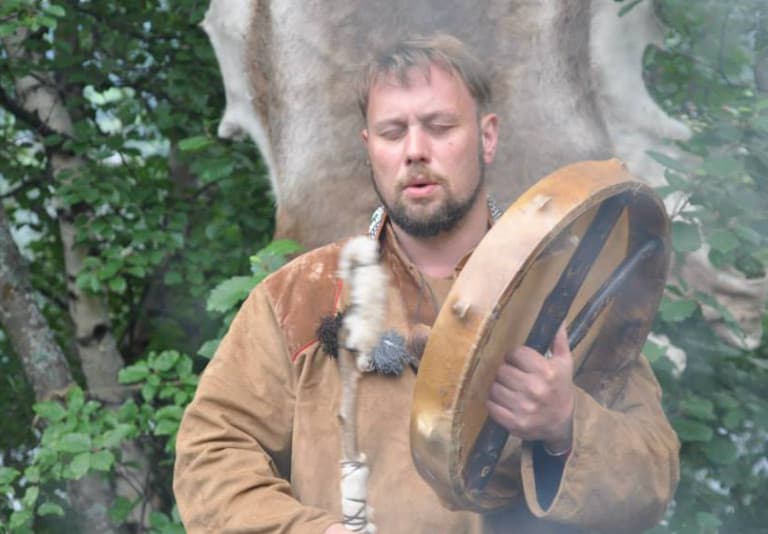
Rhythmic drumming is the most widespread method. The rhythm of the drum, often 4-7 beats per second, helps the shaman enter a trance state.
Other methods include rattling, song, dance, or, in some cultures, the use of psychoactive plants.
The journey:
The shaman visualises an entrance to the desired world, often described as a hole in the ground, a tree, a cave, or a cloud.
During the journey, the shaman often meets spiritual guides, power animals, or other entities.
The shaman carries out their task, which may be to gather information, find lost souls, or negotiate with spirits.
The return:
The shaman returns to the physical world, often guided by the rhythm of the drum or a helper.
It is important to "close" the entrance to the spirit world in order to maintain the balance between the worlds.
Integration:
The shaman interprets and integrates the experiences from the journey.
Information or healing is conveyed to the client or the community.
Significance in shamanic practice
Spirit journeys have several important functions in shamanic practice:
Healing:
The shaman can travel to find the cause of illness, retrieve lost souls, or negotiate with spirits to restore health and balance.
Divination and guidance:
Through spirit journeys, the shaman can seek answers to questions, predict future events, or receive guidance from spirits and ancestors.
The psychopomp function:
The shaman can guide the souls of the dead to their rightful place in the afterlife.
Maintaining cosmic balance:
Spirit journeys are used to maintain the harmony between humans, nature, and the spirit world.
Initiation and personal transformation:
For the shaman themselves, spirit journeys are part of the initiation process and a source of personal growth and insight.
Gathering knowledge:
The shaman can travel to learn new healing techniques, songs, or rituals from the spirits.
Community service:
The information and healing obtained through spirit journeys are used to help individuals and the community as a whole.
Modern perspectives
In modern times, the concept of spirit journeys has become the subject of both scientific interest and controversy. Some researchers have suggested that the altered states of consciousness experienced during spirit journeys can be explained through neuroscience and psychology. Others argue that spirit journeys represent genuine spiritual experiences that cannot fully be reduced to physiological processes.
Regardless of interpretation, spirit journeys continue to be a central practice both in traditional shamanic cultures and in modern neo-shamanic movements. They represent a unique approach to healing, self-exploration, and spiritual insight that has fascinated people for thousands of years.
In a modern context, spirit journeys have also been adapted and integrated into various therapeutic and personal development practices, often detached from their original cultural and spiritual context. This has led to debates about cultural appropriation and authenticity in shamanic practice.
Despite these challenges, spirit journeys continue to be a powerful tool for those who seek deeper insight into themselves and the world around them, and they remain an integral part of the shamanic worldview.
Sources:
Eliade, M. (1964). Shamanism: Archaic Techniques of Ecstasy. Princeton University Press.
Harner, M. (1990). The Way of the Shaman. HarperOne.
Vitebsky, P. (2001). Shamanism. University of Oklahoma Press.
Noel, D. C. (1997). The Soul of Shamanism: Western Fantasies, Imaginal Realities. Continuum.
Tedlock, B. (2005). The Woman in the Shaman's Body: Reclaiming the Feminine in Religion and Medicine. Bantam.
Walsh, R. (2007). The World of Shamanism: New Views of an Ancient Tradition. Llewellyn Publications.
Narby, J., & Huxley, F. (Eds.). (2001). Shamans Through Time: 500 Years on the Path to Knowledge. Thames & Hudson.
Znamenski, A. A. (2007). The Beauty of the Primitive: Shamanism and Western Imagination. Oxford University Press.
Winkelman, M. (2000). Shamanism: The Neural Ecology of Consciousness and Healing. Bergin & Garvey.
Ingerman, S. (2004). Shamanic Journeying: A Beginner's Guide. Sounds True.