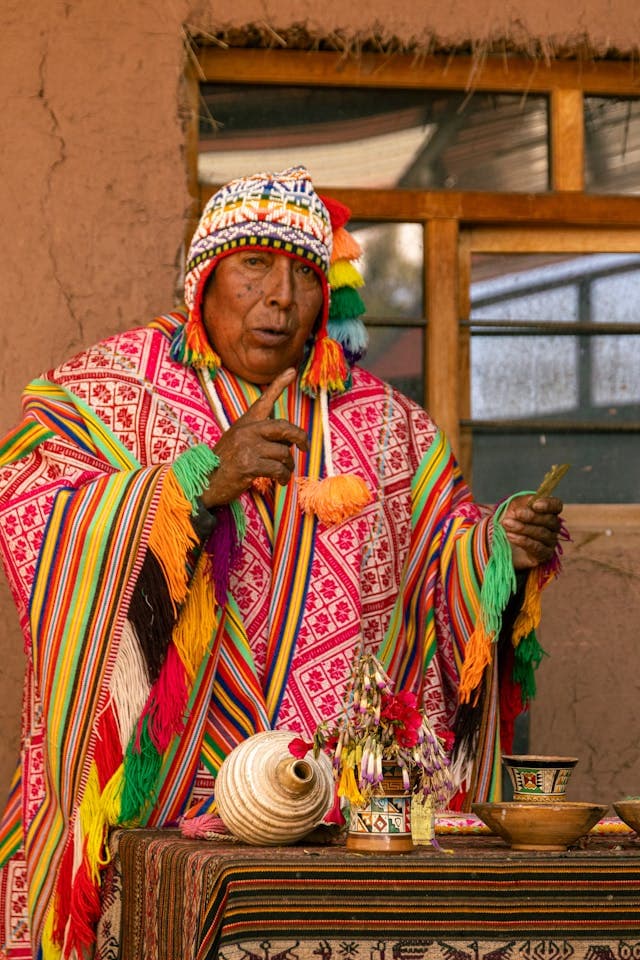
Shamanism is one of the oldest spiritual practices in the world, with roots that stretch back thousands of years. Shamans have traditionally played a central role in many indigenous cultures as healers, spiritual guides, and mediators between the physical and the spiritual world. Today we are seeing a growing interest in shamanic practices in modern societies as well. But what does a shaman actually do, and how has the role developed over time?
The traditional roles of the shaman
Healer and medicine person
One of the shaman's most important and most universal roles is that of healer. In traditional cultures, illness was often seen as the result of imbalance or spiritual disturbance, and the shaman was the one who could restore harmony.
Among the Nanai people of the Amur region in Northeast Asia, for example, the shaman would travel to the heavens to fetch an embryo soul (omija) from the tree of embryos (omija muoni) if a woman was unable to have children. Among the Khanty people of northern Siberia, the shaman determines how many reindeer must be sacrificed to appease the spirit causing an illness.
The shaman's healing methods may include:
Herbal medicine and natural remedies
Spiritual cleansing rituals
Soul retrieval – recovering a lost soul
Driving out evil spirits or energies
Spiritual guide and mediator
The shaman serves as a link between the physical world and the spirit world. Through trance and other altered states of consciousness, the shaman can communicate with spirits, ancestors, and other non-physical entities.
In many cultures the shaman is seen as someone with the ability to:
Interpret visions and dreams
Convey messages from the spirit world
Guide souls to the realm of the dead
Maintain the balance between people and nature
For example, among the Evenki, Buryat, and Yakut peoples of Siberia, shamans use drumming and song to enter trance states and travel to the spirit world.
Ceremony leader and keeper of tradition
The shaman often plays a central role in important rites of passage and ceremonies in the community. These may include:
Birth rituals
Initiation rituals for young people
Wedding ceremonies
Funerals and soul journeys for the dead
Among the Buryat people, for example, the shaman performs offerings after births to help the child develop more quickly.
The shaman is also often a keeper of knowledge and a storyteller who preserves and passes on the community's traditions, myths, and sacred knowledge.
Seer and clairvoyant
Many shamans are credited with the ability to see into the future and uncover hidden knowledge. This may involve:
Predicting future events
Finding lost objects or animals
Interpreting signs in nature
Giving advice about hunting, fishing, and other important activities
The role of the modern shaman
Today we are seeing a growing interest in shamanic practices outside traditional indigenous cultures as well. Modern shamans often adapt old practices to a new context, and their role can look quite different from that of the traditional shaman.
Healer and therapist
Modern shamans often function as alternative healers or therapists. They may offer services such as:
Energy healing
Soul journeys for personal growth and healing
Integration of shamanic techniques with modern psychotherapy
Healing ceremonies
Many modern shamans combine traditional methods with newer holistic healing techniques such as reiki, chakra balancing, or sound healing.
Spiritual guide and coach
Rather than being the community's primary spiritual leader, modern shamans often function as personal guides or coaches. They may offer:
Individual guidance for spiritual development
Workshops and courses in shamanic techniques
Retreats for self-development and healing
Advice on how to live more in harmony with nature and oneself
Ceremony leader
Modern shamans often lead ceremonies and rituals for groups of like-minded people, rather than for a traditional tribal community. These may be:
Sweat lodge ceremonies
Group drum journeys and soul journeys
Seasonal rituals and celebrations
Rites of passage adapted to modern needs
Bridge-builder between cultures
Some modern shamans see it as their task to build a bridge between indigenous wisdom and modern society.
Teaching about traditional shamanic practices
Working to preserve indigenous knowledge and traditions
Promoting ecological awareness and a sustainable lifestyle
Adapting old practices to modern challenges
Similarities and differences between traditional and modern shamanism
Although modern shamans are often inspired by traditional practices, there are important differences in how shamanism is practised today compared with traditional societies.
Similarities
Focus on healing: Both traditional and modern shamans are concerned with healing on the physical, emotional, and spiritual level.
Use of altered states of consciousness: Trance and other techniques for altering consciousness are central to both traditional and modern shamanism.
Connection with the spirit world: Communication with spirits and non-physical entities is important in both traditions.
The significance of nature: Respect for and connection with nature is central to both traditional and modern shamanism.
Differences
Cultural context: Traditional shamans operate within a specific cultural framework, while modern shamans often blend practices from various traditions.
Role in society: Traditional shamans often have a central and recognised role in their community, while modern shamans operate more on an individual basis.
Training and initiation: In traditional cultures, shamans go through strict processes of selection and initiation, often with elements of suffering or illness. Modern shamans often choose to enter the role themselves and may learn through courses and workshops.
Use of technology: Modern shamans may incorporate modern technology into their practice, such as using digital tools for healing at a distance or online courses.
Focus on personal growth: Modern shamanism often places greater emphasis on individual self-development and personal spiritual growth than traditional shamanism.
Challenges and controversies
The rise of modern shamanism is not without controversies and challenges. Some important points to be aware of are:
Cultural appropriation
There is an ongoing debate about whether it is ethically justifiable for non-indigenous people to practise shamanic techniques from indigenous cultures. Critics argue, often rightly, that this can be a form of cultural appropriation that undermines indigenous peoples' rights and traditions. If one is to practise indigenous traditions, it should be on the terms of the tradition-bearers and with permission given.
Authenticity and qualification
In traditional cultures, shamans go through strict processes of selection and training. In the modern context, anyone can call themselves a shaman, which raises questions about authenticity and qualifications.
Commercialisation
There is concern that shamanic practices are being commercialised and trivialised in the modern context, particularly in connection with "shamanic tourism" and expensive retreats.
Safety and responsibility
Powerful shamanic techniques can involve risk. It is important to ensure that modern shamans have sufficient knowledge and take the necessary precautions to safeguard the safety of participants.
The relevance of shamanism in today's world
Despite the challenges, many believe that shamanic practices have much to offer modern society. Some potential benefits include:
A holistic approach to health
Shamanism's holistic view of health, which includes physical, emotional, mental, and spiritual aspects, can be a valuable complement to modern medicine.
Ecological awareness
Shamanism's deep respect for nature and understanding of humanity's connection with the environment can contribute to greater ecological awareness and a sustainable lifestyle.
Stress reduction and mindfulness
Shamanic practices such as meditation, drum journeys, and nature-based rituals can help reduce stress and increase presence in a hectic modern world.
Cultural bridge-building
Modern shamanism can serve as a bridge between indigenous wisdom and modern society, helping to increase understanding and respect for indigenous cultures and traditions.
Sources
Britannica. (2024). Shamanism - Rituals, Beliefs, Practices.
Britannica. (2024). Shamanism | Definition, History, Examples, Beliefs, Practices, & Facts.
Miragenews.com. (2024). Exploring Shamanic Rituals: Shamans in Diverse Cultures.
Livingasacredlife.com. (2023). Shamanism: Ancient Medicine in a Modern World.
Contemporaryshaman.wordpress.com. (2011). Contemporary Shamanism and Traditional Shamanism.
Wikipedia. (2024). Regional forms of shamanism.
Britannica. (2024). Shamanism - Selection.
Wikipedia. (2024). Shamanism.
Wikipedia. (2024). Neoshamanism.
Hraf.yale.edu. (2019). Cross-Culturally Exploring the Concept of Shamanism.
.Linkedin.com. (2023). The Ancient Origins of Shamanism and Its Modern Applications.
Livingasacredlife.com. (2023). Shamanism: Using Ancient Medicine in a Modern World.
If you have read our articles and feel inspired by the wisdom of shamanism, you might consider becoming a member of Sjamanistisk Forbund. We are a faith community for those who find the sacred in nature.
Membership with us is free, but it does require you to leave any other faith communities. We offer an inclusive fellowship where you can explore nature-based spirituality, take part in ceremonies, and become part of a community that values the power and wisdom of nature.
With Sjamanistisk Forbund, you get the opportunity to:
Explore your spiritual path
Take part in fellowship with like-minded people
Learn about shamanic traditions
Contribute to cultural preservation and environmental awareness
Join us today and experience the magic of nature!