At the heart of shamanic traditions around the world we find power animals - mysterious and fascinating beings that have captured human attention for millennia. These spiritual guides have a unique ability to touch our souls and lead us through life's many challenges.
A journey into the world of power animals
Imagine a world where the boundary between the physical and the spiritual is blurred, where animals are not merely creatures of flesh and blood but bearers of ancient wisdom and power. This is the world seen through the shaman's eyes. In this world, power animals are more than just symbols; they are living, spiritual beings that choose to guide and protect us.
When a shaman closes their eyes and sets out on a spiritual journey, it is often a power animal that meets them. Perhaps it is a majestic eagle soaring above them, symbolizing freedom and spiritual awakening. Or perhaps a wise bear emerges from the forest, carrying strength and healing powers. Every encounter with a power animal is unique and meaningful, filled with learning and insight.
But power animals are not reserved for shamans alone. In shamanic tradition it is believed that everyone has at least one power animal, even though many of us may not be aware of it. These spiritual companions are always there, waiting to be discovered and acknowledged.
The many roles of power animals
In the world of shamanism, power animals play a number of important roles. They are not merely passive symbols but active participants in our spiritual journey. A shaman may call upon their power animal for guidance in difficult times, seek protection against negative energies, or ask for assistance in healing rituals.
Imagine a shaman facing a challenge in her community. She closes her eyes and calls on her power animal, a lithe puma. In her inner vision she sees the puma come to her, graceful and strong. The puma whispers wisdom in her ear, gives her the strength to act decisively, and shows her how to navigate the dangerous terrain of conflict with both power and agility.
Power animals can also play an important role in personal growth and development. They can help us develop specific qualities or overcome personal challenges. For example, someone struggling to find their voice in the world might discover that their power animal is a wolf. By learning from the wolf's qualities - its courage to howl at the moon and its strong bond with the pack - the person can find the strength to express themselves and form stronger bonds with others.
Finding your power animal
Discovering your power animal is often a deeply personal and transformative experience. It is not something you choose, but something that chooses you. This journey can take many forms, and each person's path to meeting their power animal is unique.
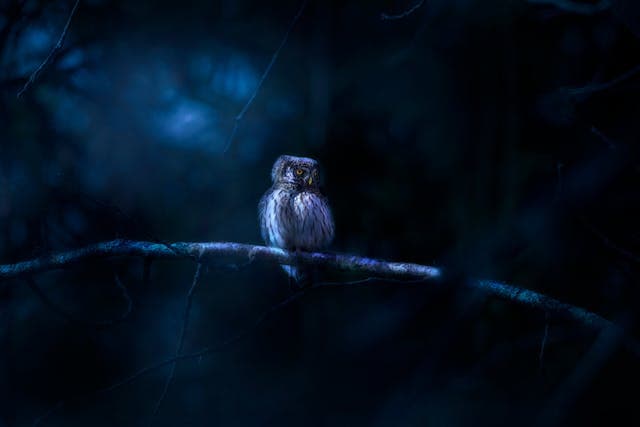
Imagine a young woman who has felt lost and without direction in life. She decides to take part in a shamanic workshop, where she learns techniques for entering an altered state of consciousness. One evening, as the drums beat a hypnotic rhythm, she closes her eyes and feels herself drawn into another reality. In this vision she finds herself in a dense forest. Suddenly she hears the beating of wings, and a great owl lands on a branch in front of her. The owl looks at her with eyes full of wisdom and invites her to follow. Through this vision journey the woman learns about the owl's qualities - its ability to see through the darkness, its patience, and its intuitive wisdom. When she returns to normal consciousness, she feels a deep connection to the owl and a new sense of clarity in life.
But not everyone meets their power animal through such dramatic experiences. For some it may be a gradual realization that emerges through dreams, meditation, or simply by paying attention to the animals that appear in their lives. A man might, for instance, notice that he often sees or dreams about foxes during periods when he needs to be especially cunning or adaptable. Over time he may begin to see the fox as his power animal, a guide that helps him navigate life's challenges with agility and cleverness.
Power animals in the world's cultures
The concept of power animals is not limited to one culture or region. It is like a colorful mosaic stretching across the entire globe, with each culture contributing its own unique nuances and interpretations.
In North America we find rich traditions connected to power animals, often called "totem animals." Imagine a young Lakota warrior going through a vision quest ceremony. After days of fasting and prayer in solitude, he has a vision of a mighty bison. This vision becomes a turning point in his life, and the bison becomes his lifelong spiritual companion, a symbol of endurance and abundance.
Traveling to Siberia, the homeland of the word "shaman," we find cultures where power animals play a central role in spiritual practice. A Tungusic shaman may enter a trance with the help of a special drum, decorated with symbols representing various power animals. Through the rhythm of the drum, the shaman journeys to the spirit world, guided and protected by their power animals.
In the Sami tradition, power animals can take the form of both animals and humans. A Sami noaidi (shaman) may have a power animal known as "Noaidegàssi" or "Sueie," which can manifest as a reindeer in one vision and as an ancestor in another.
Even in the Celtic tradition we find traces of power animals. Think of the ancient Irish heroes who were often associated with specific animals representing their qualities and destiny.
This global diversity of traditions connected to power animals shows how deeply rooted this concept is in humanity's spiritual and cultural heritage. It is a reminder of our shared search for meaning and our deep connection to nature and the animal kingdom.
Science's view of power animals
While shamans and spiritual practitioners have worked with power animals for millennia, modern science has begun to turn its scrutinizing gaze on this phenomenon. Researchers from various disciplines - anthropologists, psychologists, and even neuroscientists - have begun to explore the different aspects of the power animal concept.
Anthropologists have long been fascinated by how different cultures integrate animals into their spiritual practices. They examine how belief in power animals shapes societies, influences decisions, and gives meaning to life's challenges. For example, an anthropologist might study how a tribe in the Amazon uses power animals in its initiation rites, and how this affects young people's transition into adulthood.
Psychologists, especially those following Carl Jung's analytical tradition, view power animals as potential manifestations of the collective unconscious. They argue that these animal symbols may represent deep, archetypal aspects of the human psyche. A Jungian therapist might, for example, work with a client who dreams of a lion, exploring how the lion's qualities - such as courage and leadership - may reflect the client's own undeveloped potential.
Neuroscience has also begun to shed light on the neurological processes that may underlie experiences with power animals. Studies of brain activity during drum journeys have revealed interesting patterns in brain activity. These studies suggest that certain altered states of consciousness may open the door to experiences resembling the traditional encounters with power animals.
Evolutionary psychologists have proposed that our tendency to attribute spiritual significance to animals may have deep roots in our evolutionary history. They argue that our ability to observe and learn from animals was critical to our survival as a species, and that this may have laid the foundation for later spiritual interpretations of animals.
Although science can neither confirm nor deny the metaphysical existence of power animals, these studies give us valuable insight into the psychological, cultural, and neurological aspects of the phenomenon. They help us understand why the concept of power animals continues to resonate with people all over the world, even in our modern, technology-driven age.
Power animals in a modern context
In today's globalized world, the concept of power animals faces both challenges and new opportunities. On the one hand, increased interest in alternative spiritual practices has led to a renaissance for shamanic traditions in the West. This has given many people the opportunity to explore the power animal concept and find meaning and guidance through this practice.
At the same time, this popularization has raised concerns about cultural appropriation. Critical voices point out that Western practitioners often borrow elements from Indigenous traditions without full understanding of or respect for their cultural context. This raises important questions about authenticity, respect, and cultural sensitivity in the practice of shamanic traditions.
There is also a growing commercialization of the power animal concept, ranging from books and courses to jewelry and other products. While this can make the idea more accessible to a wider audience, it also risks diluting or distorting the original meanings and practices.
Nevertheless, despite these challenges, the power animal concept continues to inspire and guide people in their personal and spiritual development. Many find that working with power animals gives them a tool for self-reflection and personal growth, regardless of their cultural background or belief system.
In therapeutic settings, some practitioners have begun to integrate the power animal concept into their work. An art therapist might, for example, ask clients to visualize and draw their power animal as a way of exploring subconscious themes and emotions. A coach might use power animal metaphors to help clients identify and develop personal strengths.
Environmental advocates have also found inspiration in the power animal concept. By fostering a deeper connection between humans and animals, they hope to raise awareness of the importance of protecting endangered species and ecosystems. The notion that each animal carries a unique wisdom and power can help foster a more respectful and protective attitude toward nature.
Power animals as bridge-builders between worlds
Having explored the diverse world of power animals, from their deep roots in shamanic traditions to their place in modern science and culture, we are left with a rich and complex picture. Power animals appear as fascinating bridge-builders - between the physical and the spiritual, between different cultures, and between our modern world and our ancient roots.
Whether we view power animals as literal spiritual beings or as powerful metaphors for aspects of our own psyche, their potential to inspire, guide, and transform is undeniable. They remind us of our deep connection to nature and to the mysterious forces that many believe permeate the universe.
In a world that often feels fragmented and alienating, the power animal concept offers a way to rediscover a sense of wholeness and connection. It invites us to look deeper, to listen more attentively, and to recognize the inherent wisdom in the nature around us and in the depths of our own souls.
At the same time, it is important to approach this subject with respect, openness, and critical thinking. By balancing traditional wisdom with modern insight, we may be able to find new ways of relating to nature, to one another, and to ourselves - inspired by the rich symbolism and wisdom that the power animal concept represents.
Whether you are an experienced shaman, a curious explorer, or a skeptical observer, the world of power animals invites you on a journey of discovery. It is a journey that can lead us deeper into the mysteries of nature, into the hidden corners of our own psyche, and perhaps even to the very edge of what we understand as reality. In this journey lies the potential for personal growth, cultural understanding, and a deeper connection to the living world around us.
Harner, M. (1990). The Way of the Shaman. HarperOne.
Eliade, M. (1964). Shamanism: Archaic Techniques of Ecstasy. Princeton University Press.
Hultkrantz, Å. (1973). A Definition of Shamanism. Temenos - Nordic Journal of Comparative Religion, .
Vitebsky, P. (2001). Shamanism. University of Oklahoma Press.
Narby, J. & Huxley, F. (2001). Shamans Through Time: 500 Years on the Path to Knowledge. Tarcher.
Tedlock, B. (2005). The Woman in the Shaman's Body: Reclaiming the Feminine in Religion and Medicine. Bantam.
Winkelman, M. (2000). Shamanism: The Neural Ecology of Consciousness and Healing. Bergin & Garvey.
Znamenski, A. A. (2007). The Beauty of the Primitive: Shamanism and Western Imagination. Oxford University Press.
Kehoe, A. B. (2000). Shamans and Religion: An Anthropological Exploration in Critical Thinking. Waveland Press.
Harner, M. (2013). Cave and Cosmos: Shamanic Encounters with Another Reality. North Atlantic Books.
Ingerman, S. (2004). Shamanic Journeying: A Beginner's Guide. Sounds True.
Villoldo, A. (2005). Shaman, Healer, Sage: How to Heal Yourself and Others with the Energy Medicine of the Americas. Harmony.
Rutherford, L. (1996). Principles of Shamanism. Thorsons.
Walsh, R. (2007). The World of Shamanism: New Views of an Ancient Tradition. Llewellyn Publications.
Cowan, T. (1996). Shamanism as a Spiritual Practice for Daily Life. Crossing Press.