A shamanic worldview represents one of the oldest spiritual traditions in human history. This perspective on existence has roots that stretch back thousands of years and has shaped how many indigenous peoples and traditional societies understand and interact with the world around them. In today's modern society, shamanism is experiencing a renaissance, as many seek a deeper connection with nature and a more holistic approach to spirituality and health. However, we live in a modern world, and it is therefore important to seek a balance between modern society and a traditional shamanic worldview. There are none, or at least very few of us, who manage to live as we did hundreds or perhaps thousands of years ago. In Sjamanistisk Forbund we encourage each individual to find a healthy and rewarding existence in balance with modern society and with consideration for our fellow creatures.
Fundamental principles of the shamanic worldview
The interconnectedness of all things
One of the most fundamental principles of the shamanic worldview is the belief that everything in the universe is interconnected and interdependent. This involves an understanding that every action, thought and feeling affects the whole. In contrast to a mechanistic worldview that sees the universe as a collection of separate parts, shamanism regards the world as a living, breathing being in which everything is ensouled and has inherent value.
The spiritual dimension
Shamanism recognises the existence of a spiritual dimension that exists in parallel with the physical world we can see and touch. This spiritual world is considered just as real and meaningful as the material one, and shamans act as bridge-builders between these two dimensions. Through various techniques such as drum journeys, meditation and rituals, shamans seek to communicate with spirits, ancestors and the forces of nature in order to gain insight, healing and guidance.
The sacredness of nature
In the shamanic worldview, nature is regarded as sacred and alive. Trees, rivers, mountains, animals and even the elements are considered to have their own consciousness and spirit. This leads to a deep respect for the environment and an understanding of humanity's role as guardians of nature, not its rulers. This attitude fosters a sustainable way of life and an ecological awareness that is highly relevant in our time of climate change and environmental challenges.
Healing and balance
Shamanic spirituality places great emphasis on healing and the maintenance of balance on all levels – physical, emotional, spiritual and social. Illness or disharmony is often seen as the result of imbalance, whether within the individual or between the individual and their surroundings. Shamanic healing practices aim to restore this balance through various methods such as energy work, herbal medicine and spiritual rituals.
Seeing oneself as part of the circle
A central part of the shamanic worldview is the understanding that human beings do not stand outside or above nature, but are an integral part of the circle of life. This way of thinking stands in stark contrast to many modern, Western perspectives that often place humanity in a special position, separate from and superior to nature.
The medicine wheel as metaphor
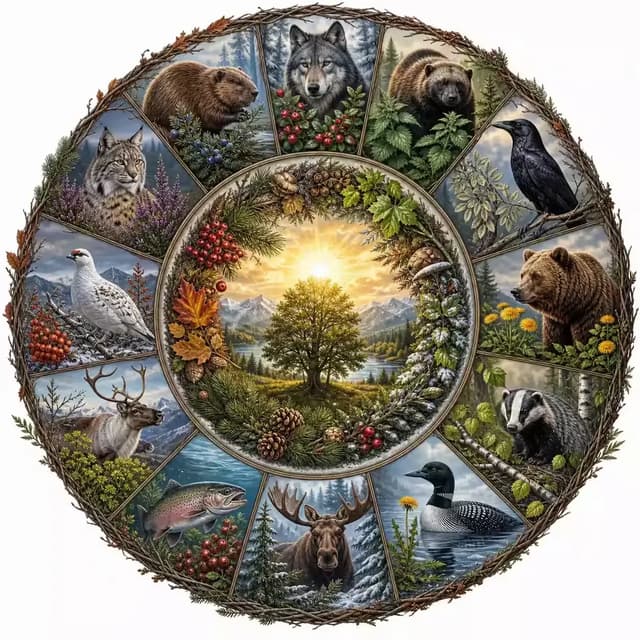
In many shamanic traditions, the medicine wheel is used as a powerful metaphor for the circle of life and our place within it. The medicine wheel represents the four cardinal directions, the four elements, and the various stages of the life cycle. By placing oneself at the centre of this wheel, one acknowledges one's connection to all aspects of existence.
East: Represents birth, new beginnings and spring. This is where the sun rises, symbolising new insight and possibilities.
South: Symbolises youth, growth and summer. This is the time of life energy and flourishing.
West: Connected to maturity, wisdom and autumn. Here we reflect on life's experiences and reap the fruits of our work.
North: Represents old age, introspection and winter. This is the time for inner work and preparation for transformation.
By seeing oneself as part of this cycle, one understands that one's life is inextricably linked to nature's rhythms and the turning of the seasons. This perspective fosters a deep humility and gratitude for the gifts and challenges of life.
Interdependence
In the shamanic worldview, one recognises that one's actions have consequences that reach far beyond oneself. Just as an ecosystem depends on a balance between all its components, shamanism sees humanity as an integral part of a larger, cosmic ecosystem.
This understanding of interdependence leads to an ethics based on respect and responsibility. When one sees oneself as part of the circle, it becomes clear that harm inflicted on nature or on other beings ultimately also harms oneself. In the same way, one understands that actions that promote harmony and balance in one's surroundings also contribute to one's own well-being and growth.
A cyclical understanding of time
In contrast to the linear understanding of time that dominates many modern cultures, shamanism operates with a cyclical understanding of time. Life is seen not as a straight line from birth to death, but as an eternal cycle of renewal and transformation.
This cyclical understanding of time shapes how one relates to life and death, success and failure. Nothing is permanent; everything is in constant change. This perspective can lead to a greater acceptance of life's ups and downs, and a deeper understanding that every ending also marks a new beginning.
Practical implications of a shamanic worldview
Embracing a shamanic worldview is not merely a theoretical exercise, but has deep practical implications for how one lives one's life and interacts with the world around oneself. But, unlike many other religions, there are no dogmas in shamanism. It is therefore up to each individual how they wish to implement shamanism in their own life.
Connection with nature
One of the most immediate consequences of adopting a shamanic worldview is a renewed and deeper connection with nature. This can manifest in many ways:
Spending time outdoors: Regular contact with nature becomes a priority, not only for recreation but as an essential part of one's spiritual practice.
Observation and learning: One becomes more attentive to nature's cycles, the changes of the weather, and the behaviour of animals and plants. This leads to a deeper understanding of ecological connections.
Respectful interaction: When one sees nature as ensouled, the way one interacts with it changes. This can mean asking permission before harvesting plants, or showing gratitude for the food one eats.
A holistic approach to health
The shamanic worldview promotes a holistic understanding of health that encompasses body, mind and spirit:
Integrated medicine: One may seek to combine modern medicine with traditional healing practices for a more holistic approach to health.
Emotional and spiritual well-being: Equal weight is given to mental and spiritual health as to physical health. Practices such as meditation, drum journeys and nature therapy can become part of one's health routine.
Community health: Health is seen not only as an individual matter, but as something that concerns the whole community and the ecosystem one is part of.
Rituals and ceremonies
Rituals and ceremonies play an important role in the shamanic worldview, and can be integrated into daily life to mark transitions, express gratitude and seek guidance:
Daily rituals: Simple acts such as lighting a candle, offering a little of one's food or drink to the earth, or meditating at the beginning and end of the day.
Seasonal ceremonies: Marking solstices, equinoxes and other natural cycles in order to synchronise oneself with nature's rhythms.
Rites of passage: Ceremonies to mark important life stages such as birth, puberty, marriage and death.
An ethical way of living
A shamanic worldview naturally leads to an ethics based on respect, reciprocity and responsibility.
Awareness around consumption and waste, with a focus on living in harmony with nature.
Respect for all forms of life. An expanded understanding of what has value, which includes plants, animals and ecosystems.
Community engagement. Active participation in creating positive change in one's local community and in the world.
Personal growth and transformation
Shamanism sees personal growth as a lifelong journey of self-discovery and transformation.
Practices such as self-reflection, shadow work and dream interpretation become tools for personal development.
A greater understanding and acceptance of life's natural phases, including ageing and death. The cultivation of one's natural intuition and sensitivity to subtle energies.
Challenges of embracing a shamanic worldview
Adopting a shamanic worldview in a modern context is not without its challenges. Tensions can arise between this ancient wisdom tradition and today's social structures and values.
Cultural appropriation
An important challenge is to navigate the line between respectful adoption of shamanic practices and cultural appropriation. It is essential to acknowledge the origins of these traditions and to seek knowledge and guidance from authentic sources.
Scientific scepticism
The shamanic worldview, with its focus on spirits and non-physical realities, may meet scepticism from scientific circles. The challenge lies in finding a balance between respect for the scientific method and openness to experiential knowledge.
Social stigma
In many modern societies, shamanic practices may be misunderstood or stigmatised. This can lead to social challenges and potential conflict with family, friends or employers who do not share this worldview. This is something Sjamanistisk Forbund works to reduce or remove entirely.
Practical limitations
Living fully in accordance with a shamanic worldview can be challenging in an urban, technology-driven world. The challenge lies in finding ways to integrate these practices into a modern lifestyle. We in Sjamanistisk Forbund encourage each individual to find the balance that feels right for them, rather than seeking an existence as it was hundreds or perhaps thousands of years ago.
Embracing a shamanic worldview involves a fundamental change in how one perceives oneself and one's place in the world. It is about seeing oneself not as separate from, but as an integral part of, nature's great circle. This perspective fosters a deep respect for all life, a holistic understanding of health and well-being, and an ethics based on reciprocity and responsibility.
In a time marked by ecological crises and social fragmentation, the shamanic worldview offers valuable insights and practices. It reminds us of our deep connection with nature and with one another, and encourages us to live more consciously and harmoniously. At the same time, it is important to approach this wisdom tradition with respect, openness and critical reflection, and to find ways to integrate its insights in an authentic and meaningful way into our modern lives.
Whether one fully adopts a shamanic worldview or simply draws inspiration from its principles, this ancient tradition can offer valuable perspectives for navigating our complex world. It invites us to see more deeply, to live more consciously, and to acknowledge our place in the great circle of life.
References
Sjamanistisk Forbund. (2023). Grunnleggende om å holde seremoni - forberedelser og innkalling.
The Sacred Trust. (2024). The Shamanic Worldview - Deeply Sacred.
Soul Cruzer. (2024). Embracing Connectivity and Empathy: Lessons from Shamanic Teachings.
Embracing Shamanism. (2023). How Does Shamanism Relate to Nature and Ecology?
Embracing Shamanism. (2023). The Role of Nature in Shamanic Training.
Help Us Green. (2024). Shamanic Healing Guide: Ancient Wisdom & Incense Rituals.
Shamanic Education. (n.d.). The Sacred Ceremony of Life.
Mirage News. (2024). Exploring Shamanic Rituals: Shamans in Diverse Cultures.
Shamanic Drumming. (2001). Eight Core Beliefs of Shamanism.
Iris Publishers. (2019). Shamanic Healing Ceremonies, Hypnosis and the Survival of the Suggestibles.