Shamanism is an ancient spiritual practice found in many cultures all over the world. This article will explore the various cultures that practice shamanism, their unique traditions and rituals.
Shamanism in Siberia and Central Asia
Siberia is regarded as the classic homeland of shamanism, and many of the most well-known shamanic traditions originate from here.
The Evenki people
The Evenki people of Siberia have a rich shamanic tradition. Their shamans use drums and special costumes adorned with animal hides, feathers and bells to symbolize their connection to nature and the spirit world. The Evenki shamans enter trance states, often induced by drumming, singing or the use of psychoactive plants, in order to journey to the spirit world.
The Buryat people
Among the Buryats there is a ritual called "shanar" in which a candidate is initiated as a shaman by an already established shaman. The Buryat shamans serve as intermediaries between humans and spirits, and perform healing rituals and divinations.
The Tuva people
The Tuva people of southern Siberia have a shamanic tradition that likely has its roots in Asian shamanism. Their shamans are known for their throat singing and use of special drums during rituals.
The Yakut people
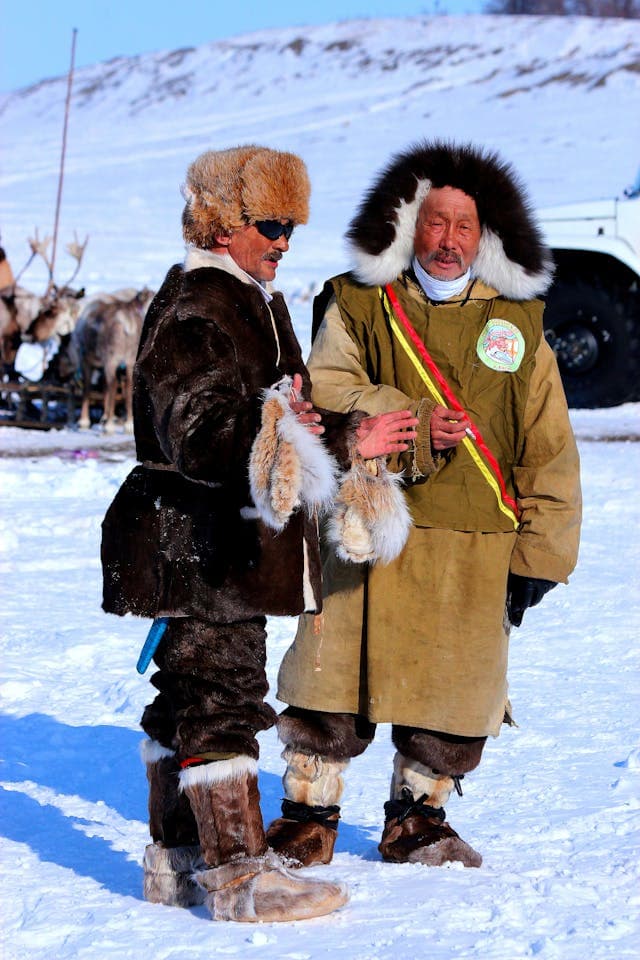
The Yakut people of eastern Siberia also have a strong shamanic tradition. Their shamans often wear a special costume with metal ornaments symbolizing the skeleton, representing the shaman's ability to travel between the worlds.
Mongolian shamanism
In Mongolia, a form of shamanism known as Tengerism is practiced. Mongolian shamans, called "boo" or "böö", enter trance states through drumming and singing to communicate with ancestral spirits. They perform rituals to heal the sick, bless livestock and protect against misfortune.
Shamanism in North America
Inuit and Yupik cultures
Among the Inuit and Yupik peoples (formerly known as Eskimos), shamanism plays a central role in religious life. Their shamans, known as "angakok" (plural "angákut"), have as their main task to heal and to undertake trance-based journeys underwater to the Mother of the Sea Animals to ensure plentiful game and to help childless women become pregnant.
Native American cultures
Many Indigenous groups in North America have shamanic traditions. These vary considerably between different tribes, but often include the use of sacred plants, sweat lodge rituals and vision-seeking practices. Not all tribes practice shamanism, but most of them have some form of animistic belief. Population groups that may practice a form of shamanism include: the Haida, Tlingit and Coast Salish. But not limited to these.
Shamanism in South America
The Q'ero people
The Q'ero people of the Andes have preserved much of their original culture and shamanic practice. Their shamans are known for their deep connection to nature and the use of coca leaves in rituals.
Amazonian shamanism
In the Amazon rainforest, shamans use ayahuasca, a powerful hallucinogenic brew, to induce visionary states and communicate with the spirits of the forest. These ayahuasca ceremonies are central to the spiritual life of many Amazonian tribes, such as the Shipibo and Ashaninka.
The Mapuche people
Among the Mapuche people of Chile, a shaman is called a "machi". This is usually a woman who serves the community by performing ceremonies to cure illness, ward off evil, influence the weather and the harvest, and practice other forms of healing such as herbal medicine.
The Aymara people
For the Aymara people of South America, the Yatiri is a healer who heals both body and soul. They serve the community and perform rituals for Pachamama (Mother Earth).
Shamanism in East Asia
Japanese shamanism
In Japan, shamanic elements are found both in the native Shinto religion and among the Ainu people.
Shinto
The Shinto religion, which means "the way of the gods", contains shamanic elements. Followers of Shinto believe in the presence of spirits known as "kami" that inhabit the landscape and living things.
The Ainu people
The Ainu people, Japan's Indigenous population, practice an animistic and shamanically based belief that centers around the worship of bears, which are considered sacred and archetypal animals for their culture.
Korean shamanism
In both North and South Korea, shamanism is still practiced. In the south, female shamans are known as "mudang", while male shamans are called "baksoo mudang". A person can become a shaman either through inheritance or natural ability. In modern society, shamans are consulted for financial and marital decisions.
Chinese shamanism
Manchu shamanism was one of the few shamanic traditions to hold official status into modern times, becoming one of the imperial cults of the Qing dynasty in China (together with Buddhism, Taoism and traditional Heaven worship).
Shamanism in Southeast Asia and Oceania
Malaysian shamanism
In Malaysia, a form of shamanism is practiced in which invoking the tiger's spirit and achieving trance ("lupa") are characteristic features. During the trance, spirits take possession of the shaman and answer questions from the audience.
Indonesian shamanism
Various forms of shamanism are practiced on Sumatra, Borneo and Sulawesi. Among the Ngaju Dayak people of Borneo there is a special class of shamans called "basirs" (literally "unable to reproduce"). These intersex individuals are considered to be intermediaries between heaven and earth because they unite the feminine element (earth) and the masculine element (heaven) in their own person.
Shamanism in Oceania
In Oceania, shamanism is widespread, especially on the Malay Peninsula and in the Pacific Islands. On the Malay Peninsula, the shaman heals with the help of celestial spirits or by using quartz crystals. In the Andaman Islands, the shaman gains their power from contact with spirits, often through an experience of "dying" and returning to life.
Shamanism in Africa
Southern Africa
In southern Africa there is the "sangoma", traditional healers among the Ndebele, Swazi, Xhosa and Zulu peoples. These healers are highly respected community leaders who often practice specialized forms of divination and herbal medicine. The sangomas use animal parts, herbs and other natural objects in special spiritual medicines called "muti".
West Africa
The Yoruba people
The Yoruba people of West Africa have a unique shamanic tradition. Their shamans, known as "babalawo", are specialists in the Ifa oracle and play an important role in society as healers and advisors.
Mali
In Mali, Dogon sorcerers (both male and female) communicate with a spirit called Amma, who advises them on healing and divination practices.
Sudan
Shamanism is known among the Nuba people of Kordofan in Sudan.
Shamanism in Europe
Sami shamanism
The Sami, the Indigenous people of northern Scandinavia and parts of Russia, have a rich shamanic tradition. Their shamans, known as "noaidi", use drums decorated with symbols to journey to the spirit world.
Seiðr - the Norse shamanic tradition
Seiðr was the primary form of shamanism in Norse culture. This was a complex magical practice that involved divination, transformation and communication with the spirit world.
Practitioners of seiðr
Völva/seiðkona: Female practitioners of seiðr, often traveling seers.
Seiðmenn: Male practitioners, although this was less common and could be seen as "unmanly".
Central elements in seiðr rituals
Magical songs
The use of a staff or stick
A ritual seat or platform
Shamanic features in Norse mythology
Odin as a shamanic figure
Odin, the supreme god in the Norse pantheon, displays several shamanic traits:
Self-sacrifice on Yggdrasil to gain knowledge of the runes.
The ability to travel between worlds.
Mastery of galdr (magical songs) and rune magic.
Yggdrasil - the world tree
Yggdrasil functions as a cosmic axis in Norse cosmology, similar to shamanic traditions around the world.
Archaeological finds
Archaeological excavations have uncovered objects connected to shamanic practice:
Grave finds with iron staffs, interpreted as belonging to seiðr practitioners.
Spindle whorls with runes, possibly used in magical rituals.
Shamanism in Norse literature
The saga literature and the Eddic poetry contain several references to shamanic practices:
Descriptions of völvas performing divination rituals.
Tales of Odin's magical feats and quest for knowledge.
Comparisons with other shamanic traditions
Norse shamanism shares several common features with shamanic practices from other cultures, especially from the Arctic and sub-Arctic regions:
The use of trance to communicate with the spirit world.
The concept of soul journeys.
Animistic notions about nature.
Modern interpretations and revival
In recent times there has been a growing interest in Norse shamanism:
Academic studies exploring shamanic elements in Norse religion.
Neopagan movements that attempt to recreate or adapt Norse shamanic practices.
Challenges in the study of Norse shamanism
Limited source material, mostly written down in Christian times.
Difficulties in distinguishing between historical practice and literary portrayal.
Debate over whether "shamanism" is an appropriate term for Norse practices.
Norse shamanism represents a fascinating blend of spiritual practices, myths and rituals that were deeply integrated into pre-Christian Nordic society. Although many aspects remain unclear, the study of this tradition continues to shed light on the rich spiritual heritage of the Norse peoples.
Celtic shamanism
In European traditions one can see shamanic elements in the nature religions of the Celts and the druids. These traditions often involve communication with nature spirits and ancestors.
Modern shamanism
Today, shamanism is experiencing a kind of renaissance in many parts of the world, including in Western countries. This often takes the form of neoshamanism, which combines elements from various traditional shamanic practices with modern spiritual and psychological approaches.
References
1 https://en.wikipedia.org/wiki/Regional_forms_of_shamanism 2 https://paradigmuniversity.com/shamanism-3/ 3 https://www.miragenews.com/exploring-shamanic-rituals-shamans-in-diverse-1261415/ 4 https://www.pbs.org/splithorn/shamanism1.html 5 https://www.greenshinto.com/2014/08/27/ainu-spirituality/ 6 https://creatrip.com/en/blog/11065 7 https://www.56thparallel.com/shamanism-in-siberia/ 8 https://templeofthewayoflight.org/information/ayahuasca-shamanism/ 9 https://en.wikipedia.org/wiki/Traditional_healers_of_Southern_Africa 10 https://mongolianstore.com/mongolian-shamanism/ 11 https://www.chaplainoftheheart.com/journal/shamanism-and-divination 12 https://www.britannica.com/topic/shamanism/Shamans-outside-of-northern-Asia 13 https://www.inspireclothing.art/blogs/mystic-arts/shamanism-around-the-world