In both Sami and Norwegian folk culture, people have used special verses and formulas to protect themselves against illness and misfortune. Such verses were used by people who were called "readers" – individuals with knowledge of ancient rituals. They could help both people and animals by reciting particular verses, often in a special way.
But where did these verses come from? How could something so old live on after Christianity was introduced? The answer is that many of these verses originally came from pre-Christian, so-called pagan traditions, and that they survived by blending with Christian faith.
Noaidevuohta
Before Christianity came to Sápmi, the Sami had their own religion. An important figure in this faith was the noaidi – a kind of shaman or spiritual leader. The noaidi could communicate with spirits and forces of nature in order to help people. The noaidi used special verses, joik (a kind of song), and a drum (called the rune drum) in their work.
The Sami believe that everything in nature has a spirit – mountains, lakes, animals and people. If something fell out of balance, for instance if someone became ill or the weather turned bad, the noaidi could help to restore the balance. He did this with verses and rituals. Some Sami still follow the old faith.
A verse could, for example, be used to speak to an illness and ask it to disappear. It might sound like this:
"Wind and water, go your way,
illness, leave and come no more.
In the name of nature, let the body be clean."
Even though this is a modern example, it shows how people spoke directly to the illness as if it were a person.
What happened when Christianity arrived?
When Christianity was introduced in the Nordic region and eventually in Sápmi (from the 11th century onward, but the intense Christianization of the Sami took place in the 17th century), the old faiths were forbidden. The noaidis were persecuted, and the rune drums were burned. Now people were supposed to believe in only one God, and it was forbidden to speak with spirits or to use magic.
But faith and traditions do not disappear so easily. Many Sami continued to use verses and rituals in secret. To avoid trouble, they began to include Christian elements in the verses. Now it was suddenly Jesus or God who made the illness go away – not spirits of nature or the old gods. Even today there are verses rooted in the old faith.
A typical "Christianized" verse might read like this:
"God who created all that is,
let the body be healed, sin pass away.
In Jesus' name the pain shall go,
and peace dwell and remain in the heart."
In this way many continued to perform ancient healing rituals, but with new names and Christian phrasings. This was the beginning of what we call the reader tradition.
What is the reader tradition?
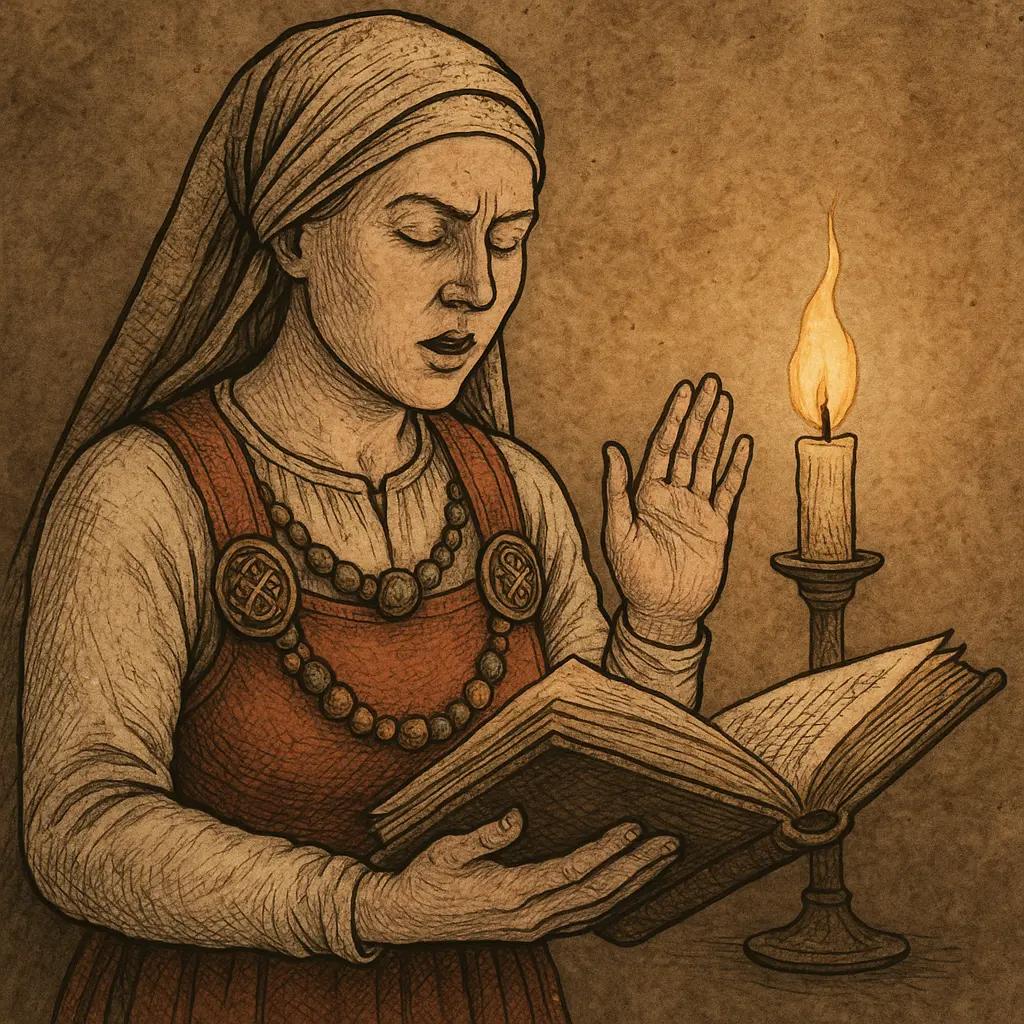
Readers were ordinary people, often elderly women and men who had learned healing verses from parents, grandparents or neighbours. It was said that some had "the gift of reading" – meaning that they could recite special verses with power.
The verses were used to:
Stop blood,
Take away fever or pain,
Protect children, animals or the home,
Stop illness ("still" the illness),
Bind weather and wind.
Readers often blended ancient words and rhythms with biblical imagery. Even though Christianity dominated society, these verses lived on in secret – as a safe tradition among ordinary people.
A concrete example from Tana in Northern Norway shows how a Sami reader gave help to a child with a fever:
"Fever, fever, fly with the wind,
out onto mountain and over peak.
Leave the child, find a tree,
and rest there in the peace of Jesus."
At the same time the reader made the sign of the cross over the child three times. This was seen as both prayer and healing – and there was often great respect surrounding the readers.
What are black books?
In Norway there was also a tradition of healing and magic. Here people often used black books – secret books filled with magical verses, incantations and recipes. These black books were often handwritten and were passed down within families.
The contents of the black books closely resembled what the readers in Sápmi used, but could also contain more "dangerous" formulas, such as:
How to stop blood,
Protection prayers,
Love magic,
Weather magic,
And sometimes harming formulas (for example, giving someone a toothache).
Black magic was feared – but many black books were entirely ordinary healing books. They mixed in Christian phrasings to make their use "lawful."
Example from a black book against bleeding
"Three men walked through Galilee,
they saw a man who was bleeding.
Jesus said: "Stop bleeding, stop!"
And the bleeding stopped.
As it stopped there, so shall it stop here.
In the name of the Father, the Son and the Holy Spirit. Amen."
Such verses were often repeated three times while the one reading stroked their hand over the wound or made the sign of the cross.
What do these two traditions have in common?
Both in the Sami reader tradition and in Norwegian black books we find many similarities:
They use fixed verses and repetitions.
They attempt to influence reality through words.
They speak to illness or forces of nature as if they were people.
They connect old and new – pagan (pre-Christian) ideas and Christian language.
They are about protection, healing and balance.
People believed that the words held power – but only if you said them correctly, at the right time and with the right thought. It was not only what you said, but also how you said it.
Why did these traditions survive?
An important question is: Why did these old traditions not disappear when Christianity arrived? The answer is that people still needed help with things the doctor or the priest could not fix: illness, accidents, restless animals, bad weather and poor seasons.
In addition, the readers or the black books were not necessarily seen as evil – often these were people in the village who wanted to help. They were a kind of cross between doctor, priest and wise person. Many went first to the reader before they went to the doctor.
Christian expressions were used to protect against accusations of sorcery. When you ended a verse with "In Jesus' name" or "Amen," you were in the clear – and at the same time it gave extra power to the words.
How is this used today?
Even today there are people who use ancient verses and healing rituals. The most famous in Norway in modern times is perhaps Snåsamannen – Joralf Gjerstad – who became renowned for "reading for people" and using his hands to heal.
In Sápmi there are still readers and joikers who blend old traditions with new forms of religious expression. Many today use both traditional knowledge and Christian faith together – proof that syncretism (the blending of religions and traditions) is still alive.
Example of a modern Sami verse for illness
"Spirit and strength, light and peace,
like snow upon earth, fall softly down.
The wind carries away the evil bond,
and may Beaivvi bless them with a healing hand."
Example of a modern pagan verse
The staff is raised, and the word is spoken!
The staff is strong, and the rune is painted!
The staff is raised, and the word is spoken!
Light and luck, be near me!
Sun and moon, look upon me!
Wind and water, cleanse my hand!
Sun and moon, look upon me!
Give your power, let the way be opened!
Hear my call, you ancient might!
Hear my voice, you honour of the lineage!
Hear my call, you ancient might!
Let seiðr weave, let fortune grow!
Kyrre Franck
What can we learn from this?
The story of the verses shows that culture and faith are always changing. Even when something is forbidden, it can live on in other forms. By wrapping the old verses in new words – Christian words – people could keep using them for generations.
This also shows how important words are to people. It is not only about magic – but about hope, love, and the wish to help others. The verses became an expression of care and community – a way of coping with the unknown.
From ancient myths and shamans, through Christian readers and black books, all the way to today's alternative healers and tradition-bearers – words have held a special power. And perhaps most importantly: they have helped people feel safer when facing illness and danger.
The Sami reader tradition and the Norwegian black books show us that magic, religion and everyday life are not always as different as we think. They are all ways of understanding and influencing the world – and of giving comfort when life is hard.
Sources
Rydving, Håkan. The End of Drum-Time: Religious Change among the Lule Saami, 1670s–1740s. Uppsala: Uppsala University Press, 1993.
Hagen, Rune Blix. Trolldomsprosessene i Finnmark. Cappelen Damm, 2011.
Kvideland, Reimund & Sehmsdorf, Henning (eds.). Scandinavian Folk Belief and Legend. University of Minnesota Press, 1988.
Holck, Per. Svartebøker og magi i Norge. Pax Forlag, 2001.
Hultkrantz, Åke. Shamanic Healing and Ritual Drama: Health and Medicine in Native North American Religious Traditions. Crossroad Publishing Company, 1992.