In the beginning there was nothing – and everything
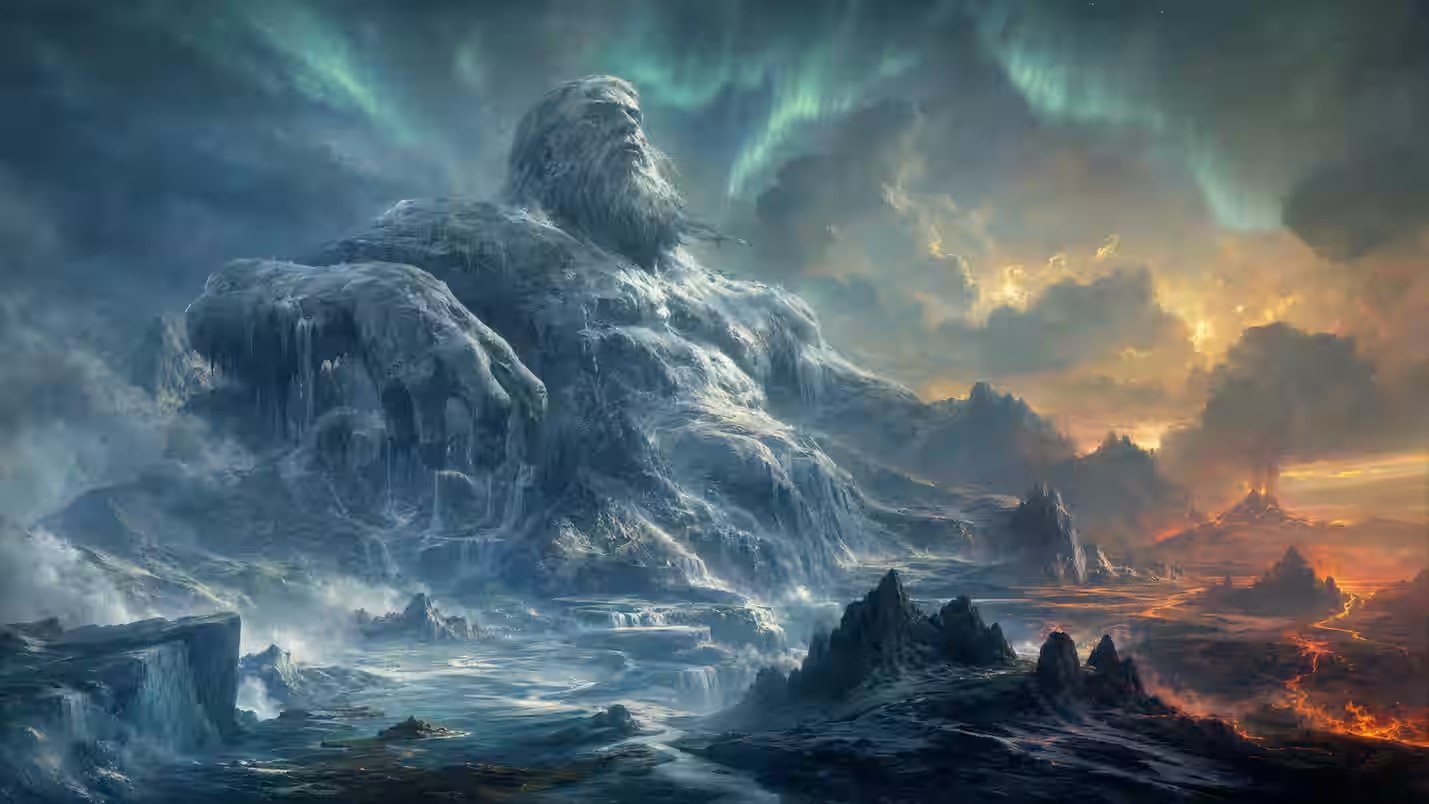
Imagine absolute nothingness. Not darkness, for darkness presupposes something that can see. Not cold, for cold presupposes something that can freeze. Only Ginnungagap: the yawning void, the gaping abyss that stretched between the eternal realm of ice in the north and the dazzling world of fire in the south. In this nothing, where frost and glow met like two infinite hands in a gentle handshake, rime melted into droplets. And from these droplets, as Snorri Sturluson tells it in Gylfaginning, the first form took shape. The first jötunn.
His name was Ymir. And he was not a monster. He was the very possibility of the world.
Jötnar are among the most misunderstood beings in Norse mythology. Popular culture has turned them into foolish, blundering trolls who make fools of themselves. But a closer encounter with the primary sources, the Eddic poems, Snorri's Edda, and the dense body of scholarship surrounding them, reveals something far more fascinating: ancient, wise and cosmically necessary forces, older than the gods themselves, shaped by nature's outermost elements, and inseparable from the deepest layers of the Norse worldview.
Before the gods existed
There is a fundamental fact in Norse cosmology that is often overlooked: the gods came after the jötnar. Ymir existed before Odin, Vili and Vé. He was there in the void, and he grew, not as a conscious being with ambitions, but as a primal force, spontaneously arising at the meeting point of opposites.
From Ymir came the first jötnar. He sweated, and from his sweat sprang a pair, a man and a woman. His legs bred a son together. Thus began a race. While Ymir slept, he was nourished by the cow Auðumbla, and she licked the primordial being Búri from the salty rime: Odin's grandfather.
Then came what Snorri calls "the great gods": Odin and his brothers. They killed Ymir. His blood flowed out like a sea and drowned nearly all the jötnar. Only Bergelmir and his wife saved themselves on a kind of raft, and from them descend all the jötnar who live on in the mythology. Ymir's flesh became earth, his bones mountains, his hair trees, his brain clouds. The world was literally created from the jötunn's body.
Midgard, the world of humans, was built from Ymir's eyebrows as a fortress against the outermost realm. It is a striking image: the very boundary between human civilisation and the unknown is made from a jötunn's body. The jötnar are not merely outside the world. They are the world.
And Odin? The supreme god, the all-knowing All-Father, is half jötunn on his mother's side. Bestla, his mother, was the daughter of the jötunn Bölthorn. The boundary between divine and jötunn blood is, from the very first, not a clear line but a porous membrane.
The depth of the word
The word jötunn itself carries the past within it. It traces back to Proto-Germanic *etunaz, related to the verb "to eat". The philologist Julius Pokorny linked this to the ancient Indo-European root for "to swallow", and it is highly likely that the semantic connection between *etunaz and Proto-Germanic *etanan ("to eat") holds true. It is natural to understand jötunn as "the greedily-eating one" or "devourer": an image pointing towards chaos, towards nature's relentless consumption of all life.
The Norwegian words "jotun" and "jøtul" are related to the Old English eoten, the same word used for Grendel in Beowulf, the terrifying primordial troll who ravaged Heorot. Grendel is not merely an arbitrary monster in the Anglo-Saxon epic; he is an eoten, a devourer, one who threatens the very space of civilisation with his consuming nature. In Danish and older Norwegian we find the form "jette", and in Old Norse literature jötunn is used both for the great, wise jötnar and for far more sinister beings.
Tommy Kuusela, cited in research published in the Icelandic journal Gripla at the Árni Magnússon Institute, emphasises something crucial: the oldest Norse sources do not at all present the jötnar as disproportionately large or intellectually inferior to the gods. That is a late, Christian-influenced simplification. In the Eddic poems, the jötnar are equal adversaries, and sometimes even superior guides to the gods themselves.
Neither fools nor monsters
One need not read far in the Eddic poems before the simple story of foolish jötnar defeated by clever gods begins to unravel.
Take Vafþrúðnismál, the poem about Odin's contest of wisdom with the jötunn Vafþrúðnir. Odin travels in disguise to the jötunn's hall to test his wisdom. Vafþrúðnir is no primitive force; he is one who knows what happened "in the dawn of time", who ruled "before the gods ruled", and what will happen after Ragnarök. The only question Odin can ask that Vafþrúðnir cannot answer concerns Odin's own final words to Baldr on the funeral pyre. It is an unanswerable question, for only Odin knows the answer. Vafþrúðnir does not lose because he is foolish. He loses because it is physically impossible to know something one cannot know.
As Margaret Clunies Ross points out in Prolonged Echoes: Old Norse Myths in Medieval Northern Society (Odense University Press, 1994), the relationship between the Æsir and the jötnar is structured around a fundamental cosmological tension: the gods represent order and human civilisation, the jötnar represent the unstructured, the potential, that which lies beyond. But this is not synonymous with a simple scheme of good versus evil. Clunies Ross shows how the gods continually turn to the jötnar to obtain knowledge, wives and cosmic resources, thereby acknowledging the jötnar's irreplaceable function in the world order.
Mímir is another example. This mysterious figure, whom Norse scholarship, among others John Lindow in Norse Mythology: A Guide to Gods, Heroes, Rituals, and Beliefs (Oxford University Press, 2001), regards as closely related to the jötnar, guards the well at one of the roots of Yggdrasil: the well of wisdom. It is to Mímir that Odin sacrifices his own eye in order to drink from the well. Wisdom does not reside in Asgard; it resides in the realm of the jötnar.
Utgard: the outermost world
Norse cosmology is spatially conceived, and the language of space is political. At the centre lies Midgard, "the middle enclosure", the world of humans and gods, organised, named, raised above chaos. Outside lies Utgard, "beyond the fence", that which cannot be tamed, cannot be named, cannot be brought within the logic of civilisation.
Here dwell the jötnar. In the north and east, beyond mountains and seas and fire. Jötunheimr is not merely a geographical point on the map of cosmology; it is a state, a quality of existence. It is the wilderness, the Arctic, the volcano, the storm, the ocean floor: all the places where human control is an illusion. As Clunies Ross observes, this spatial division carried a profound meaning: Midgard is the central ring in which humans and gods hold their ground against the unknown. But the unknown is not absence; it is excess. Nature is not empty; it is filled with forces the gods can never fully control.
Ægir and Rán are the jötnar of the coastline and the sea, and in every respect but mythological form they are recognisable to any Norwegian fisherman who has lost a boat. Ægir brews ale in deep copper vats and invites the gods to feast in his hall at the bottom of the sea; Rán casts her net over drowned sailors and draws them down. They are not enemies of the gods on principle; they are natural forces that sometimes cooperate, sometimes consume.
Enemies of the gods, kin of the gods
The paradoxical truth about the jötnar in Norse mythology is that they are inseparable from the gods, not merely as adversaries, but as family members.
Jörð, "Earth", is Thor's mother and a jötunn. She is the personification of the very soil. Thor's violent hammer-blows against jötnar are thus a son of jötunn blood fighting against his mother's kin. Skaði, daughter of the jötunn Þjazi, married Njörðr and was given a place in Asgard. She is the goddess of skiing and hunting, and she never ceased to be a jötunn. Rindr bore Odin a son, Váli. Loki is the son of a jötunn; his father is the jötunn Fárbauti.
Most of the Æsir have jötunn blood on one side or the other. John Lindow emphasises that the jötnar are not beings of another kind than the gods; rather, they are a different lineage group, distinguished by relation and cosmological function, not by morphology or intelligence. The jötnar are just as great, just as beautiful, just as wise, and sometimes far wiser, than the gods.
Diana Paxson captures the inner logic of this relationship in "Utgard: The Role of the Jötnar in the Religion of the North" (2012): "The jötunn expresses the natural force, while the god embodies the qualities humans need to deal with it." This is not a battle between good and evil. It is an interplay between primordial principles and human consciousness, between that which has always existed and that which we try to understand and master.
A passage from Þrymskviða, the poem about the jötunn Þrymr who stole Thor's hammer Mjölnir, shows this complexity from a new angle. Þrymr demands the goddess Freyja as a bride in exchange. Instead, the gods send the disguised Thor, and the jötunn, believing he sits at the table with the most beautiful of goddesses, reveals his vulnerability. Humour, mistaken identity and deadly seriousness mix together. Þrymr is not a simple villain; he is one who wants what the gods have, and who suffers under his exclusion from Asgard's order.
The voice of natural forces
Rudolf Simek emphasises in Dictionary of Northern Mythology that the jötnar were regarded as everything from cultic ancestors to personifications of nature's most uncontrollable forces: winter storms, earthquakes, the rage of the sea, the weight of mountains. They are not randomly placed on the periphery; they belong to the periphery by their very nature.
It is Paxson's sharp observation that perhaps puts this best into words: it is not the gods who are natural forces, as 1800s romantic mythological scholarship assumed. It is the jötnar. Odin is the god of war and wisdom: the highest ideals of human consciousness. Thor is the divinity of the protector: humanity's hope of surviving in a dangerous world. But the mountains themselves, the sea itself, the blind snowstorm itself: these are the jötnar. Ægir is the sea. Surtr is the fire. Jörð is the soil.
This is not mere poetics. It is an ontology: an understanding of how reality is composed. And in an age when the peoples of the North lived closely and brutally with the elements, this understanding gave the world a face. You made offerings to Ægir not because you loved him, but because the sea devours, and you needed to acknowledge that.
Sacred groves and hidden cult
For a long time, scholars assumed that the jötnar were never worshipped on equal terms with the gods. No temples to Ymir. No sacrificial rites for the jötnar. But the picture is far more nuanced than that.
In Lokasenna, the provocative poem in which Loki tears down all the gods one by one with sharp words, Skaði answers him with a remarkable reply: she points to her sacred groves and consecrated holy sites. Not as a plea, but as pride. Topographical place names in Scandinavia confirm this: places bearing names pointing to Skaði are found scattered across the North, and several of them are linked to religious functions. As Paxson points out, there are thus traces suggesting that jötnar, particularly jötunn women, were indeed worshipped in Norse religious life. Not as evil demons one sought protection from, but as primordial principles one honoured to maintain the balance between the human and the natural.
Ragnarök: the debt is paid
But it is in Ragnarök that the cosmological role of the jötnar culminates with the most dramatic force.
Völuspá, the poem of prophecy, in which a völva sees the entire history of the world from creation to destruction and rebirth, is not a tale of evil's triumph. It is a tale of cosmic debt. The gods took the world from Ymir. They created Midgard from his body without his consent. They shut the jötnar out behind Ymir's own eyebrows. They married jötunn women and took from them what they wanted, and killed jötunn fathers such as Þjazi without always keeping their word.
And the jötnar remember. Surtr, the fire jötunn who has waited at the border of Muspelheim since the beginning of the world, marches against Asgard with his flaming sword. Jörmungandr, the world serpent descended from jötunn origin, rises from the sea. Fenrir, son of a wolf jötunn, bites through his bonds. It is not an invasion of the foreign; it is a debt being paid.
Paxson views this with a clear, poetic eye: Ragnarök is a reversal of creation. What was taken from chaos is delivered back to chaos. The world returns to its primary elements: fire, sea, emptiness, that which was always there in Ginnungagap before Ymir took form. And then, after the destruction, a green earth rises anew from the sea. The birds sing. A man and a woman who hid in Hoddmímis holt survive and repopulate the world. Even Baldr returns.
The Norse worldview is not nihilistic. It is cyclical. And within the cyclical, the jötnar are not the destroyers; they are the restoration, the necessary dissolution that makes new creation possible.
The Christian transformation
As Christianity spread through the North from the 900s onwards, what always happens to complex, ambivalent pagan thought when a new monotheistic order takes over happened here too: the nuances were flattened, and the ambivalent was made unambiguous.
The jötnar were gradually transformed into purely demonic beings. In medieval translations and saga narratives, jötunn is used for Satan and for Typhoeus, the Greek primordial chaos-dragon. The inhabitants of Hell are described with jötunn vocabulary. Where the oldest Eddic poems show us the wise Vafþrúðnir and the honourable Skaði, the later sagas show us cannibalistic trolls and savages.
The academic consensus, as both Rudolf Simek and John Lindow emphasise, is clear: as the Church's influence grew, the jötnar were gradually portrayed as increasingly negative and less impressive. The intelligent, ancient, nature-bearing beings of the oldest layers of Norse religion became the trolls, giants and demons of Christian medieval aesthetics.
Beowulf illustrates the transition: Grendel has a "heathen soul", is described as a descendant of Cain, and has already at this stage become a pure monster without a trace of Vafþrúðnir's wisdom or Ægir's hospitality.
Beyond the fence, and into us
There is something deeply human about the jötnar that continues to draw attention, not only among scholars of Old Norse studies, but among all who recognise themselves in the great questions of nature and civilisation, chaos and order, inheritance and debt.
The jötnar represent that which always exists beyond the organised. Utgard, beyond the fence, is not merely a mythological place. It is psychological geography. It is everything within us and around us that refuses to be tamed: the unconscious, the wilderness, death, the ocean floor, the fire-mountains. We build cities and rule over vast lands, and Midgard grows. But Utgard never grows smaller. It merely withdraws further away, and waits.
The brilliant insight of Norse religion, preserved in fragments of Eddic poetry, in place names, and in patient scholarly reconstruction from Margaret Clunies Ross to Tommy Kuusela, is that those who dwell in Utgard cannot be ignored. They can be respected, honoured, negotiated with. Ægir can be invited to a feast. Skaði can be given sanctuaries. Odin can travel to Vafþrúðnir and learn.
We need the jötnar as we need wilderness: as a reminder that the world is older than us, greater than us, and that the gaping abyss in which Ymir once took form still exists, quiet, patient, always there, on the other side of what we call civilisation.
Sources
Margaret Clunies Ross, Prolonged Echoes (1994)
John Lindow, Norse Mythology (2001)
Rudolf Simek, Dictionary of Northern Mythology
Tommy Kuusela, cited in Gripla
Diana Paxson, "Utgard" (2012