Far to the south of Korea, out at sea where the wind meets black volcanic beaches and Mount Hallasan looms like a silent guardian, there exists a tradition that bears traces of history, resistance and living spiritual practice alike. This is Korean shamanism, often called muism, a diverse and deeply rooted tradition that lives, first and foremost, not in books or institutions, but in people, places, songs, rituals and memories.
For an outsider, shamanism can quickly become a word that seems both foreign and vague. But in Korea, this is not merely an abstract area of belief. It is a way of understanding the connection between people, ancestors, landscape and spiritual forces. Rather than placing the sacred far away, as many religions do, Korean shamanism experiences the spiritual as woven into everyday life: in the home, in the village, in the mountains, in illness, in grief and in hope.
Cheju as a spiritual landscape
This world becomes especially clear on Cheju Island. Cheju is a large volcanic island with its own language, its own history and a strong local identity, shaped by geographic isolation and centuries of cultural distinctiveness. The island was long an independent kingdom before it was subjugated by the central power on the mainland, and in later periods attempts were made to suppress local customs and religious expressions, first under Confucian reforms, later under Japanese colonial rule and modern campaigns against so-called superstition.
Nonetheless, the tradition did not disappear. It withdrew, adapted and survived.
On Cheju, the landscape is not merely a backdrop for the rituals; it is their very foundation. Mountains, springs, village boundaries and shrines are part of a living cosmology. The local shrines, tang, form nodes in a spiritual network that binds people together with deities and ancestors. Here, the island is not experienced as a neutral geographic surface, but as a populated universe, where both visible and invisible beings have their place.
The shrine as centre
In the Cheju tradition, the village shrine is the heart of religious life. Each shrine has its own function and its own deity, often connected to the land, fishing, livestock, children's health or the village's shared fate. The most important shrine is usually dedicated to a kind of original ruler of the area, a deity who guards the landscape and maintains order over life and death in the village.
What is fascinating about this structure is that the gods are not perceived merely as lofty and distant powers. They are thought of as kin, as a kind of mythical family. The villagers speak of them with honour and closeness, as ancestors, and see themselves as their descendants. Thus, the relationship between people and gods becomes not only hierarchical, but also one of kinship and territory. One belongs to a place, and this place also belongs to a history greater than any single generation.
It is precisely here that Cheju shamanism distinguishes itself clearly: it is not only about the needs of the individual, but about the continuity of the community. The ritual affirms that people do not live alone, but as part of a larger, inherited order.
The myths that carry the history
In many cultures, myths live on as old stories. On Cheju, they do more than that. They do not merely explain the world; they hold the world together.
The myths associated with the shrines, ponp'uri, tell of the lineage of gods, of separation and homecoming, of parents and children, of origin and transformation. Several of these stories have an epic character that recalls great heroic poems rather than short myths. They follow a dramatic movement in which a divine family is formed, splits apart and re-emerges in new forms. Some of the gods are described as local and native, others as more foreign or connected to the mainland, and the tension between the local and the outside mirrors the island's own history.
In this way, the myths also become historical mirrors. They tell of a people who have felt pressed by central authorities, yet who have at the same time preserved a strong sense of their own identity. In the stories of children who are abandoned and later return, one can sense a deep echo of the Cheju people's own experience of rupture, displacement and rebuilding.
The myths are therefore not merely explanations for rituals. They are bearers of collective memory.
The theatre of ritual
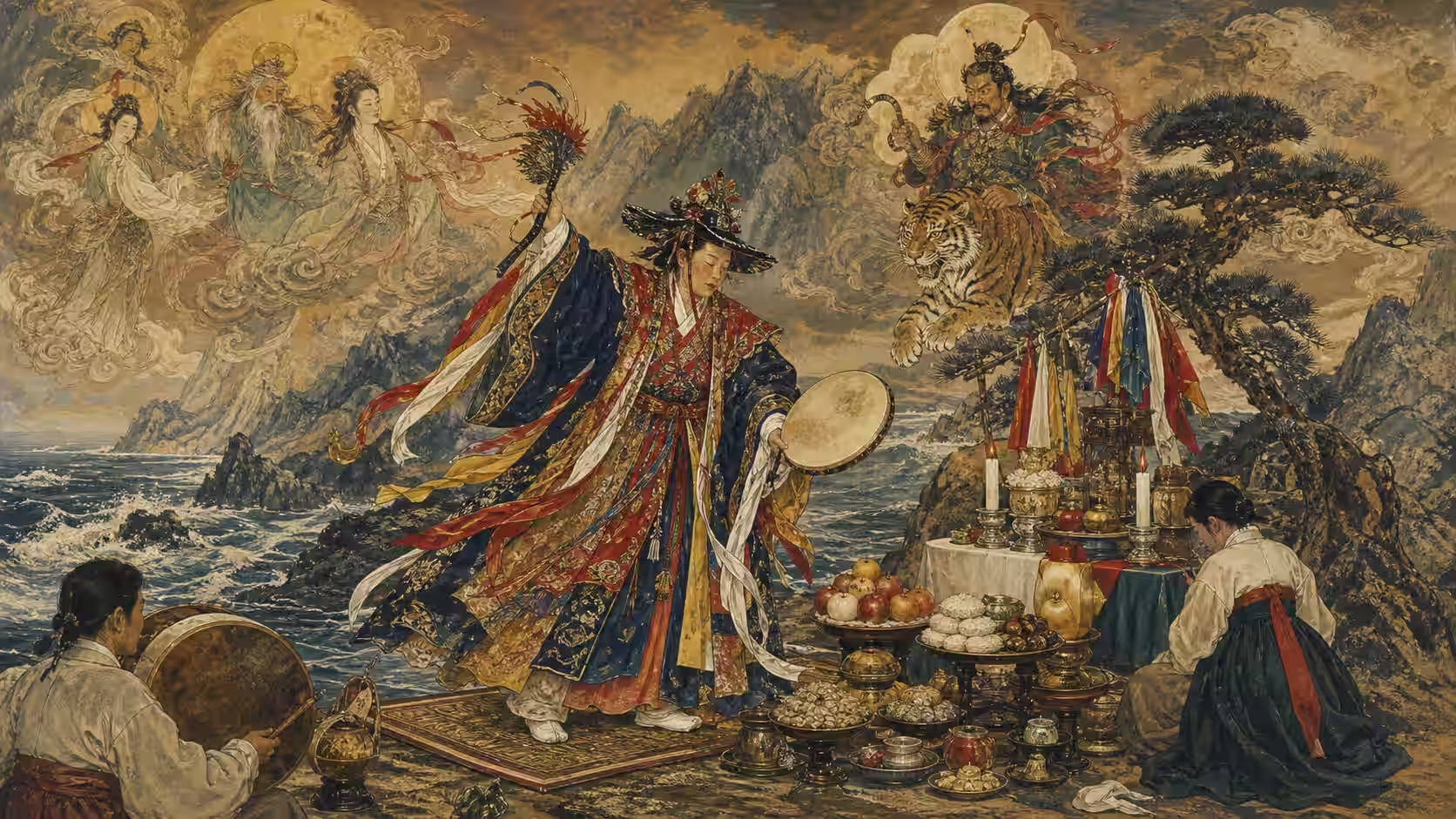
When a great ceremony, kut, takes place, this cosmology comes alive in the space. A kut is not merely a prayer or a ceremony in the narrow sense. It is a composite event in which narrative, music, dance, offering and dramatic performance fuse into a whole. It is a ritual theatre in which the spiritual and human worlds meet.
What makes kut so distinctive is precisely the interplay between the forms. The shaman recites myths, welcomes deities, offers food and gifts, and performs actions that both soothe, entertain and renew the bond between the worlds. Drums, song and movement create a rhythm that carries the action forward. The ritual is not quiet and contemplative in a Western, inward-looking way; it is lively, physical and social.
In larger rituals, altar frames and ribbons are also set up, marking how the gods descend and take their place in the ceremony. This turns the whole space into a small cosmos. The sacred order is not merely presented as an idea, but is actually built up before the eyes of the participants. In this way, the participants get to feel that the world is still ordered, that the connection between heaven and earth has not been broken.
The shaman's role
The shaman on Cheju, simbang, holds a distinctive position. Unlike many notions of shamans as people who attain power through ecstasy or trance, the Cheju shaman is traditionally a hereditary role. Shamanism is often passed down within family or close connections, and the one who is to enter the role learns through training, experience and initiation.
This makes the shaman's authority complex. The simbang is both a servant of the gods and a helper of the people. She or he is the one who knows the rituals, the one who knows how the gods should be addressed, and the one who can move between the levels of the spiritual order. At the same time, shamans have historically held an ambivalent social status. They have been respected within the context of ritual, but also looked down upon in everyday life.
This is a reminder that spiritual competence does not always grant social power. On the contrary, those who hold the deepest resources of a culture can, at the same time, live on the margins of society. Precisely for this reason, the shaman's role often carries a strong ethical and historical weight.
Illness, soul and healing
Korean shamanism is not concerned only with the great cosmic questions. It is also closely connected to people's daily experiences of illness, fear and vulnerability. The tradition often understands illness as a sign of soul loss, disturbance in the relationship between humans and the spirit world, or the influence of restless spirits.
When a child is frightened, falls often, or seems out of balance, this can be interpreted as the soul having gone astray. A ritual to retrieve the soul, nok durim, may then be performed. If this does not help, the shaman can continue working with purification, the banishing of harmful spirits, or reconciliation with forces that have taken hold in the person's life. Here we encounter a fundamental idea central to many shamanistic traditions: the human being is not a closed, isolated individual, but a being in constant relation to unseen influences.
It is precisely this relational understanding that gives the tradition its lasting power. It offers not only explanations, but also actions that can restore balance.
Between suppression and revival
The history of Cheju shamanism is also a history of resistance. Under intense modernisation and moralisation projects, shamanism was long portrayed as ignorance, superstition and an obstacle to progress. Shrines were demolished, rituals suppressed, and shamans marginalised. But the tradition did not disappear. It survived within families, in villages, and in rituals that continued to live under pressure.
Later, a new phase also emerged, in which cultural heritage, local identity and ritual practice once again gained greater value. In many places, rituals were revived, not only as expressions of faith, but also as living cultural heritage. This creates an interesting tension: on the one hand, the tradition is preserved; on the other, it is sometimes shaped by tourism, public cultural policy and modern expectations.
Yet perhaps it is precisely this that shows the strength of Korean shamanism. Like Sámi shamanism, it is not a museum piece. It is a tradition that has survived by changing.