In the heart of the Alps, when the December darkness descends over snow-covered mountains and valleys, an ancient tradition is celebrated that stands in stark contrast to the usual cosiness of Christmas. Krampusnacht, or Krampus Night, is a fascinating blend of pagan folklore and Christian tradition that has survived centuries of cultural change.
Krampus
Krampus is a fascinating figure in Central European folklore. Described as a half-goat, half-demon creature, Krampus is known for his frightening appearance, with large claws, sharp horns, and a strikingly long, red tongue. The name "Krampus" derives from the German word "Krampen," meaning "claw," which underscores the creature's menacing nature.
Unlike the jovial figure of St. Nicholas, who rewards well-behaved children with gifts, Krampus serves as a dark counterweight. Tradition holds that Krampus punishes naughty children by beating them with birch branches and sticks. In some more extreme versions of the legend, it is even said that Krampus eats the naughty children and carries them off to hell.
Origin
Krampusnacht, celebrated on 5 December, has deep roots in the pre-Christian, pagan traditions of the Alps. The origins of this custom can be traced back more than two thousand years, to the time before the Romans conquered the region at the end of the first century BC, during the reign of Emperor Caesar Augustus.
It is believed that the pagan peoples who inhabited this part of the Alps at the time, known as the Rhaetians, had already begun to associate Krampus with 5 and 6 December. They likely held a festival in which Krampus played a central role at this time of year. This was the precursor to the more modern Krampusnacht.
Some scholars believe that Krampus has his roots in Norse mythology and that he is the child of Hel, the Norse goddess of the underworld. Other theories suggest that Krampus is a representation of the horned god in witchcraft. The folklorist Maurice Bruce wrote in 1958:
"There seems to be little doubt as to his true identity, for in no other form is the full regalia of the Horned God of the Witches so well preserved. The birch - apart from its phallic significance - may have a connection with the initiation rites of certain witch-covens; rites which entailed binding and scourging as a form of mock-death."
Whatever the correct origin story may be, we know that the legend of Krampus became associated with the Christmas celebration during Europe's transition to Christianity.
Krampusnacht and Christian influence
As with many other pagan customs, Krampus and Krampusnacht were incorporated into the Christian faith in the centuries that followed the mass conversions of European peoples to Christianity between the third and tenth centuries.
This merging of traditions illustrates the survival of ancient beliefs through adaptation, rather than the direct continuation of a single mythological tradition. Krampus developed into a counterpart to St. Nicholas in the pre-Christmas celebration, creating a balance between reward and punishment that is common in many cultural traditions.
The Church, however, was not always enthusiastic about this pagan influence. There were several attempts to ban Krampus from the Christmas celebration, but these attempts were largely unsuccessful. This shows how deeply rooted these ancient traditions were in the consciousness and culture of the people.
The Krampusnacht celebration
Krampusnacht, or Krampus Night, is celebrated annually on 5 December, the night before the celebration of St. Nicholas's Day. According to legend, Krampus spends the night visiting every house. He may leave bundles of sticks for naughty children - or he may simply beat them with the sticks instead. He may throw them into a sack or basket on his back and then toss it into a stream, or he may simply carry them off to hell.
Traditionally during Krampusnacht, revellers would dress up as Krampus and St. Nicholas to visit homes and businesses together. Those dressed as the devil Krampus would chase naughty children through the streets. The children are reprimanded for their bad behaviour by Krampus and given bundles of ruten (twigs) so that they do not forget him or the consequences after he leaves.
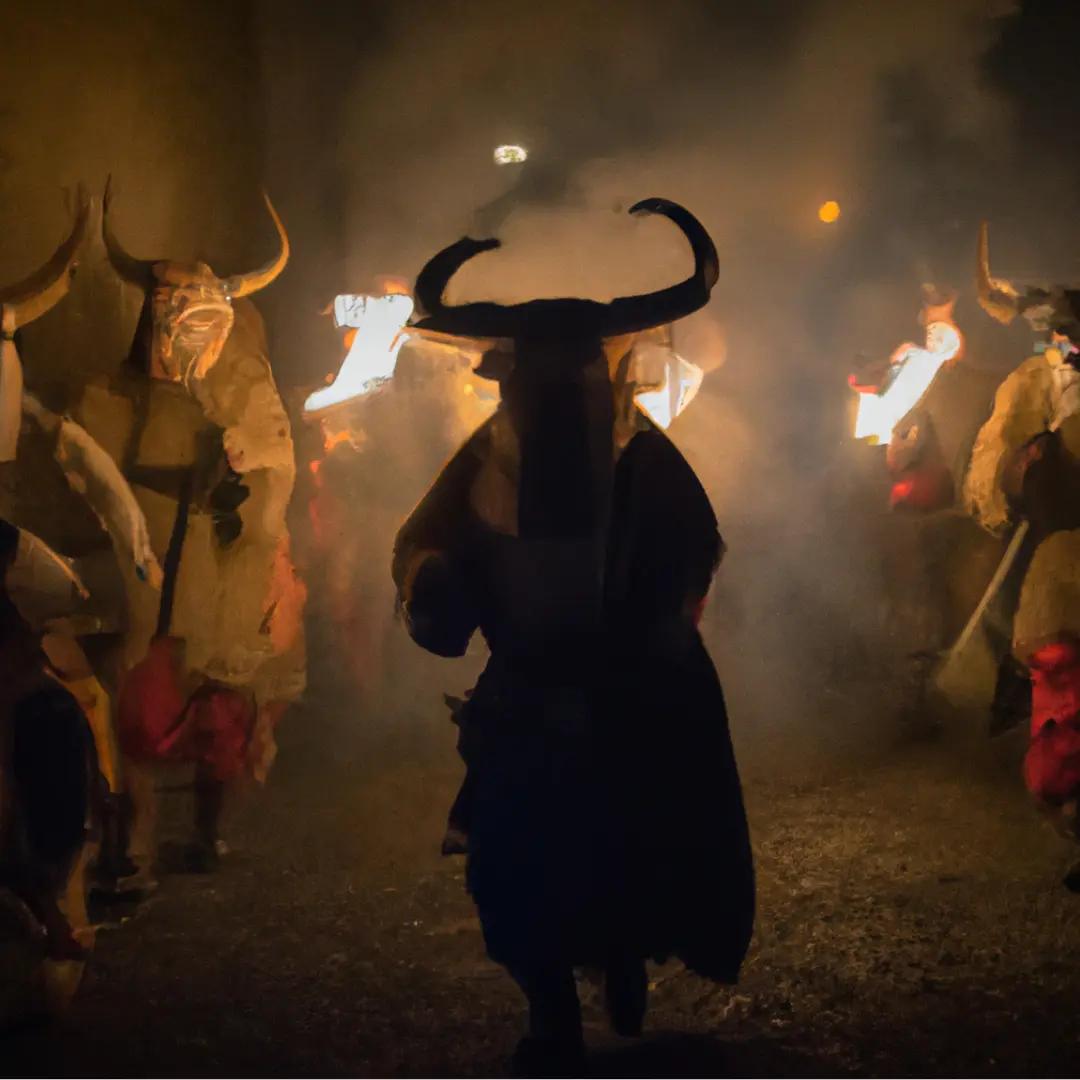
One of the most prominent manifestations of Krampus in modern times is the Krampuslauf, a traditional parade held in many Alpine regions during the Christmas season. Participants don elaborate Krampus costumes, complete with demonic masks and fur-covered bodies, and roam through the streets to frighten onlookers.
Similar traditions in Norway
Although Krampusnacht is not a direct part of Norwegian tradition, there are similar customs and figures in Norwegian and Norse folklore that share some common features with Krampus.
Julebukk
One of the best-known Norwegian Christmas traditions that bears similarities to Krampus is the julebukk (Yule goat). The julebukk was originally a frightening figure associated with the god Thor in Norse mythology. Like Krampus, the julebukk was later incorporated into Christian Christmas traditions.
Traditionally, people dressed up as julebukk and went from door to door to sing Christmas carols and receive treats. This is reminiscent of how people dress up as Krampus during the Krampuslauf. Although the julebukk today is more associated with cosiness and fun, it originally had a more frightening role, not unlike Krampus.
Odin and the Yule visitor
In Norse tradition, Odin was sometimes associated with the Christmas celebration. He was seen as a figure who rode across the sky during the Yule season, which may later have influenced the notion of Santa Claus. While Odin was not a punishing figure like Krampus, he shared some characteristics as a mysterious, nocturnal visitor.
In some parts of Norway there is also the tradition of the "julesvenn" or "julenisse," who could be both kind and naughty. This duality is reminiscent of the dynamic between St. Nicholas and Krampus.
The Nix and other frightening beings
In Norwegian folklore there are many frightening beings that, like Krampus, were used to warn or frighten children. The Nix (Nokken), for example, was a water being said to lure people, especially children, down into the water to drown them. Although the Nix is not directly connected to Christmas, it shares Krampus's role as a frightening figure in folk tales.
Krampusnacht from a shamanic perspective
From a shamanic perspective, Krampusnacht and the figure of Krampus can be interpreted in several interesting ways:
Balance and duality
In shamanic traditions, the concept of balance between light and dark, good and evil, is often central. Krampus, as a counterpart to St. Nicholas, represents this duality. From a shamanic point of view, this can be seen as a reminder of the necessity of acknowledging and integrating both the light and dark aspects of existence.
Transformation and initiation
Krampus's role in punishing the "naughty" can, from a shamanic perspective, be interpreted as a form of initiation or transformation. In many shamanic traditions, initiation rituals often involve elements of fear, pain, or symbolic death, followed by rebirth or renewal. Krampus's threat of punishment can be seen as a metaphor for this process, where the fear of consequences leads to personal growth and improvement.
Spiritual cleansing
The Krampusnacht celebration, with its wild parades and frightening costumes, can be interpreted as a form of spiritual cleansing. In shamanic practices, dramatic rituals are often used to drive out negative energies or spirits. The Krampuslauf can be seen as a collective rite of purification, where the community symbolically confronts and drives out its "inner demons" before the holy Christmas season.
Contact with the spirit world
In shamanic thinking, the boundary between the physical world and the spirit world is often blurred, especially during certain times of the year. Krampusnacht, which takes place in the dark winter season, can be seen as a time when the veil between the worlds is thin. Krampus himself can be interpreted as a manifestation of spirit beings that come closer to the physical world at this time.
The cycles of nature
Shamanism is often closely tied to the cycles of nature. Krampusnacht, celebrated near the winter solstice, can be interpreted as an acknowledgement of the darkest time of the year. Krampus can represent the challenging aspects of winter - cold, darkness, and the scarcity of resources - which must be confronted and overcome.
Collective consciousness and shadow work
From a Jungian-inspired shamanic perspective, Krampus can be seen as a manifestation of society's collective shadow. By giving this shadow a physical form and interacting with it through rituals and celebrations, the community can collectively engage in a form of "shadow work," a process of acknowledging and integrating the darker aspects of the human psyche.
Krampusnacht in modern times
In recent years, interest in Krampus and Krampusnacht has experienced a significant revival, not only in the traditional Alpine regions, but also internationally, especially in the United States.
In Bavaria there has been an artistic revival of carving Krampus masks by hand. These masks are often used during the Krampuslauf, which has become a popular tourist attraction. While the Krampuslauf is most popular in Germany and Austria, there are signs that this tradition may be spreading to other parts of the world, including the United States.
Interestingly, many believe that Krampus's growing popularity was a reaction to the commercialisation of Christmas. Ironically, Krampus himself has now become the subject of commercialisation, with Krampus-themed products such as T-shirts, cards, and decorations becoming increasingly popular.
Krampusnacht is now celebrated in various ways. In some places Krampus balls are held, while in others young men from local Krampus groups may don carved wooden masks, cowbells, chains, and elaborate costumes to run through the town in a Krampuslauf, where they frighten and sometimes strike onlookers.
Sources
History Defined: "The Strange Origins and History of Krampusnacht"
The Wicked Griffin: "Krampus and Krampusnacht: Exploring the Pagan Origins"
Bodmin Jail: "Unveiling the Enigmatic Origins of Krampus: A Dive into the Dark Side of Holiday Folklore"
Arcane Alchemy: "Who is Krampus || Pagan Yule Traditions"
Celtic Jackalope: "Legend of Krampus & Origin of Krampusnacht"