There are creatures that live in the margins of history, in the dark space between folk belief and myth, between story and fear. The lindorm is one of them. It crawls through Nordic and Scandinavian tradition like a long, heavy thought: a serpent that is more than a serpent, a monster that bears traces of dragon, serpent power, subterranean dread and old symbolism, and which in folk belief often guards treasures, boundaries or hidden dangers. In some traditions it is an obstacle that must be overcome; in others it is a warning sign that something old and wild still stirs beneath the ground, beneath the water, beneath the very story of the Nordic lands.
To write about the lindorm is therefore not merely to describe a legendary creature. It is to enter a mental geography where the landscape itself seems to have memory. Mountains, bogs, lakes, ancient trees and churchyards become not just places, but doors. And behind them lies the same notion: that the world is not entirely safe, that beneath the surface there is something alive, something growing, something that may one day break forth.
Name and form
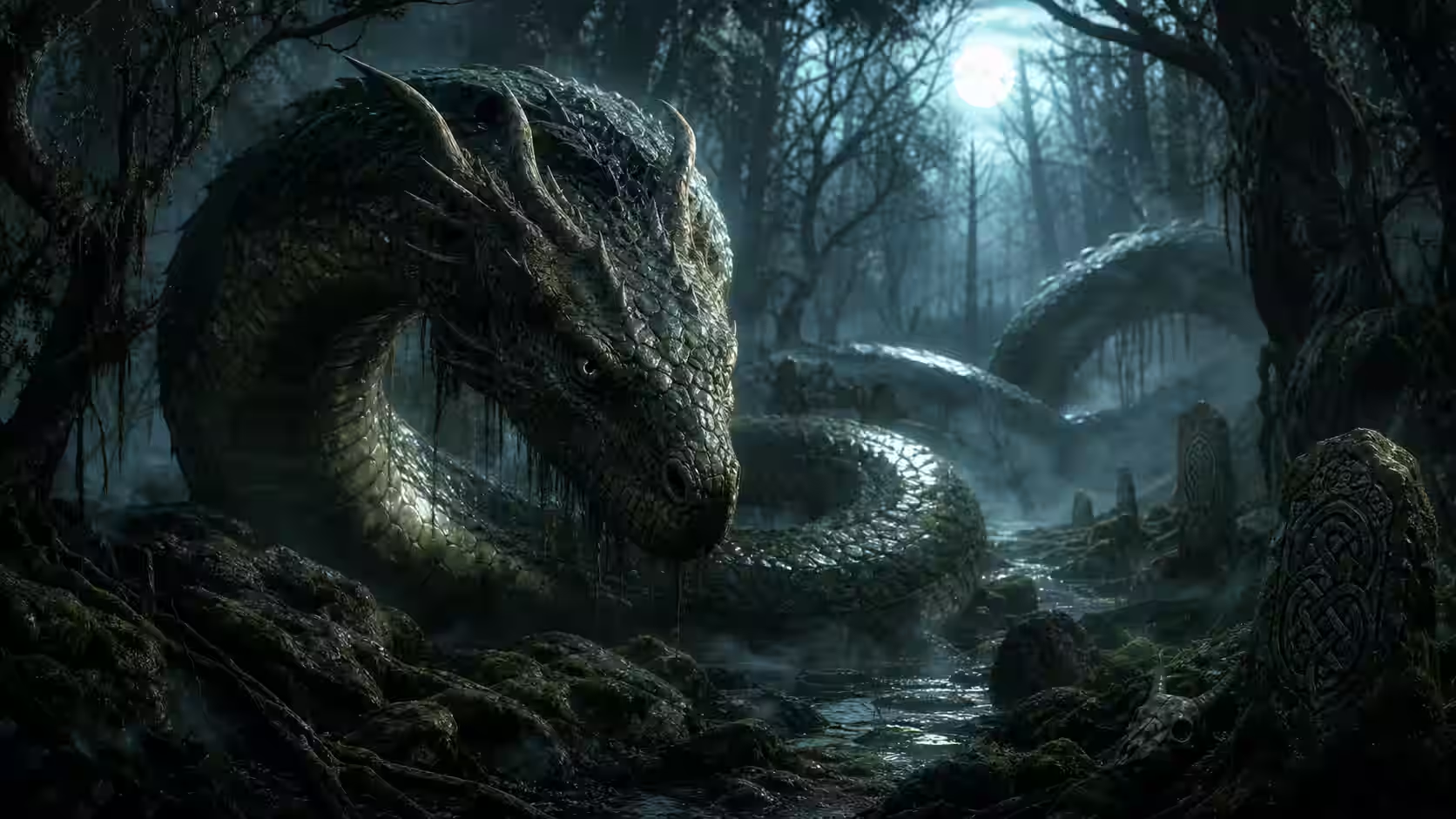
The word lindorm is found in Germanic and Nordic traditions, and the term is linked to a dragon- or serpent-like creature, generally without wings in Scandinavian folk tradition. In Swedish tradition the lindorm is described both as a benevolent and a dangerous being, and folk belief distinguishes between the good and the evil type. The good lindorm brings luck, and to meet or touch it could, in certain legends, grant magical abilities; its skin could be a means to insight, protection or an understanding of nature's language.
At the same time there exists the darker relative: the man-eating, destructive, greedy lindorm that coils through the forest or beneath the earth and which, in many tales, must be slain by a hero, a smith, a priest or a cunning woman. This dual nature is important. The lindorm is not merely a monster. It is a border figure, a being that holds both fertility and danger, a sign of luck and a shadow of death, and which therefore fits so well into a tradition where nature is never entirely unambiguous.
Beneath the ground
Axel Olrik's classic survey of the serpent motif in Nordic folk belief shows how the lindorm is often imagined as a monster in the depths, in a mound, a mountain or a subterranean chamber, where it lies and grows until one day it breaks forth and destroys everything it reaches. In his reading, this is not primarily a Christian demon or an incidental fairy-tale figure, but an animistic nature being: a creature that has its own life within the earth, and which connects to experiences of earthquakes, subterranean sound, rumbling, unrest and fear of the unseen.
It is a striking image. Not a monster that comes from outside, but something that is already here, hidden within the very terrain. The Nordic lindorm does not always dwell in a distant sky or a mythical realm; it can lie beneath a church, in a mound, in a sleepy hillside in the countryside, as if the earth itself had a secret vein of rage. In several Danish legends a lindorm lies beneath a church and threatens to destroy both building and parish, which makes it a clear symbol of the struggle between old and new, between pagan ground and the power of the new faith.
The Midgard Serpent and kinship
When modern readers hear of a great Nordic serpent, thoughts often turn to the Midgard Serpent. This is understandable, but not quite accurate. The lindorm and the Midgard Serpent share kinship in form and fear, but in folk belief the lindorm is generally more place-bound and more closely tied to the landscape, while the Midgard Serpent belongs to the great cosmic mythology. In Norse tradition there are also other great serpents and snake-like beings, such as Níðhǫggr beneath the world tree, but they play different roles within the mythic universe.
Nevertheless, there is a deep resonance between them. The one crawls beneath a mountain; the other encircles the world. The one threatens the parish; the other threatens the cosmos. Both carry the notion that the serpent is more than an animal: it is a force that twists the world, an image of that which lies dormant awaiting its hour. Thus the lindorm in folk belief can also be understood as a local, earthbound sister to the great cosmic serpents of mythology. Where the Midgard Serpent circles the outer edge of world order, the lindorm lies in the nearby darkness, listening.
The tale of King Lindorm
No text within Nordic tradition has given the lindorm a more enigmatic, psychological and poetic fate than the fairy tale of King Lindorm. In Swedish and Danish folk tradition, a queen is advised to eat one rose in order to have a child, but she eats two and gives birth to both a lindorm and a prince. It is a wild and almost unbearable image: the same womb brings forth both beauty and dread, human and monster, desire and curse. The tale has been recorded in several variants and has long fascinated folklorists and literary scholars, precisely because it seems to unite deeply human symbols with the outward drama of the fairy tale.
The lindorm in this tale is not merely a monster to be slain. He is the twisted brother, the repressed half, the hidden figure who must meet a woman's courage, patience and purification before he can become human again. In some interpretations the lindorm becomes a manifestation of blockage, division and unresolved identity; in others it is read as an image of infidelity, a break in the family line, or the dangerous connection between desire and transgression. Thus the tale carries a double pulse: it is both gothic and moral, both erotic and healing, both frightening and hopeful.
It is precisely this blend that makes the lindorm so literarily charged. It is not merely a being, but a conflict that has grown scales. It creeps into the story as an obstacle to love, but also as the very key to love becoming real. He who meets the lindorm meets not only a monster, but also the question of what a human being is when divided in two.
In the landscape of folk belief
When one follows the lindorm out of the fairy tale and back into the legendary landscape, it becomes part of local communities' remembrance. In Norway, tales are told of lindorms at Slottsfjellet in Tønsberg, in caves by Randsfjorden, in Finnskogen and in various rural landscapes where it either guards treasure or devours livestock. In some traditions it is a clear threat to people, in others it is above all a warning that a place is charged with power.
The Seljord serpent in Telemark has not always been referred to as a lindorm in modern language, but it stands within the same family of tradition: an elongated, serpent-like lake monster that makes the landscape alive and unsettled. It is worth noting that such tales do not only create fear; they also create identity. A lake is no longer merely a lake. It gains a past. A valley is no longer merely a valley. It gains a voice. And that voice may belong to a serpent.
Olrik points out that such legends are often bound to specific natural sites and should therefore not be read as abstract mythology alone, but as tales in which landscape and belief are inseparably linked. The lindorm is thus not merely a symbolic figure; it is also a local mode of interpretation. It makes the place larger, more unsettling, more charged. Where others see a hill, the legend-teller sees a resting power.
Paganism and church
In several traditions the lindorm becomes an image of the struggle between pagan and Christian order. Historisk Atlas describes, for example, how the lindorm in Nordic tradition is often said to coil around the church and thereby symbolise this tension. It is an image that almost writes itself into the landscape: a long, dark body coiling around sacred ground, as though trying to hold the old fast around the new.
But this symbolism is not simple. The lindorm is not merely a pagan adversary; it is also a trace of an older understanding of the world in which nature itself is animate. When Christian culture enters the legends, the serpent is often demonised or made into an enemy that must be overcome, while older notions of it as guardian, bearer or harbinger are downplayed or reinterpreted. The lindorm thus becomes a memory of the shift in culture's imagination: from a living, animistic landscape to a moralising world order.
At the same time there is a deeper continuity. The serpent that threatens the church is also the serpent that threatens the world at the end of time. The local and the apocalyptic merge. In Axel Olrik's material, the lindorm is precisely a being that can lie in a mound until doomsday, or be released when a boundary is crossed. Thus it becomes both local legend and world legend, a creature that lets the small world mirror the great.
The shadows of interpretation
The modern reader may be tempted to read the lindorm psychologically. This is not unreasonable. In King Lindorm it has been interpreted as the repressed, the divided, the darkness that must be reunited with the human side. In such a reading, the lindorm stands for everything that has no place in an ordered identity: desire, aggression, shame, original sin, imbalance. The tale then becomes not merely a story of a monster, but of a self that must be put back together.
But such an interpretation should not erase the older, folkloric power. The lindorm is also a piece of material imagination, born of dark forests, restless waters, low horizons and a world in which nature could still answer. It was not merely an image within the human being; it was also out there in the terrain, in the physical and social spatial understanding of those who told the tales. This is perhaps why it has survived so long. It can be read symbolically without losing its body.
The living legacy
The lindorm never entirely disappeared. It lives on in local history, heraldry, art and popular culture, and in modern stories it is often given new life as a dragon, sea serpent or fantasy creature. Yet there is something distinctly Nordic about the older figure: not the wings, not the flames, but the weight. It lies close to the ground. It is close to moss, roots, rock and water. It is not a soaring dragon from a distant realm, but a being whose origin lies in the very slow geology of the north.
This is perhaps why it still grips us. The lindorm is a tale about that which can hide within the ordinary. That a hill can be a border post, that a church can have an enemy beneath it, that a legend can carry an entire cultural history within its scales. And when it rarely raises its head, it does so not merely as a monster, but as ancient memory: a reminder that the Nordic lands have always been populated by more than human beings.
In the end, the lindorm remains one of the most multifaceted beings in Scandinavian tradition. It is terror and protection, chaos and heritage, nature and interpretation. It is the serpent that lies beneath the ground, but also the thought that lies beneath history. And perhaps that is precisely why it never ceases to fascinate: because it cannot be captured by a single meaning, but glides between myth, legend, fairy tale and cultural memory with the same silent, coiling dignity that has always followed it.
Sources
Olrik, A. (1909). Nordisk folketro.
Lid, N. (1964). Norsk og svensk folketro.
Bø, O. (1987). Norsk naturmytologi.
Ørnulf, O. (ed.). (publication year varies). Norske folkeeventyr og sagn.
Lindorm – Lokalhistoriewiki.lokalhistoriewiki
Lindorm – Wikipedia in Swedish