by Lillian S. Eid, chair of Sjamanistisk Forbund Oslo and Viken, gydje
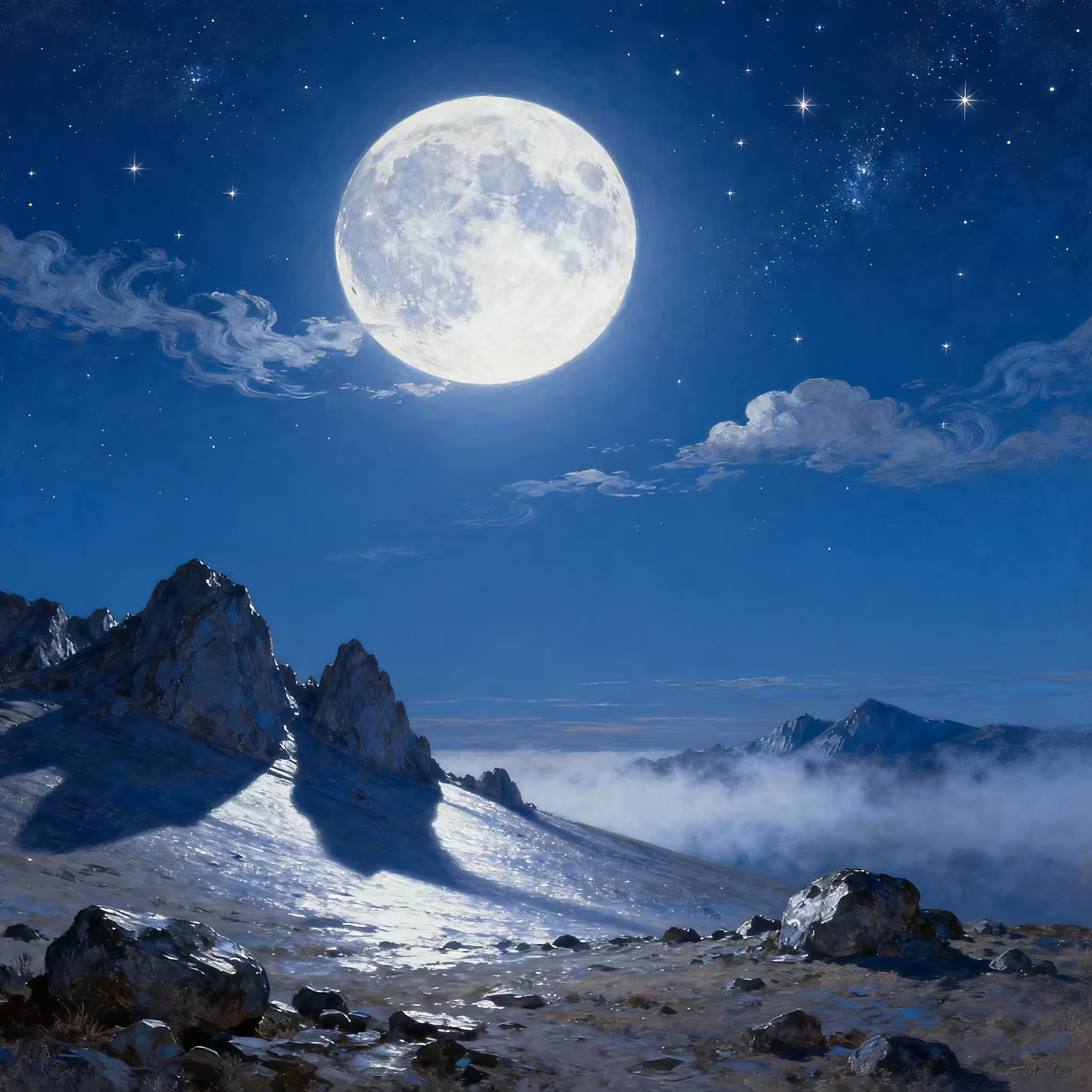
The moon has always been a companion. It has hung there above us, night after night, like an eye that sees, a light that watches and a rhythm that keeps order in time. Before humans had clocks and calendars, before we measured time in seconds and dates, the moon was the very measuring tape for the pulse of life. Our ancestors – both the Norse and all those who lived in step with the earth before us – looked up at the moon and knew where they were in the course of the year.
The luminous sphere across the sky told them when it was time to sow, to harvest, to gather eggs, to slaughter, to rest. The moon showed them the rhythm in all living things. It was the heart of the year, and each beat was a phase, a reminder of life's ever-changing cycle.
The moon as calendar and timekeeper
The modern calendar – the Gregorian – divides the year into twelve months, and each month has its four weeks. This seems self-evident to us today, but it has not always been so. In pre-Christian times, also here in the Nordic region, it was the moon that governed the course of the year. People did not live by a fixed number of days, but by light and darkness, by how the moon rose and waned across the sky.
In Iceland, which has preserved many old traditions, we find traces of this reckoning of time. There the year was divided into two main seasons: summer and winter. Not four seasons as we have now, but two great cycles – light and darkness, warmth and cold, growth and rest. The Icelandic calendar had eleven fixed months, and in addition an extra week – a “sumarauke” – which was added when needed to keep the rhythm in step with the sun and the moon.
This tells us something deep about how people experienced time: not as a linear stream, but as a living cycle. A year was not a straight line from January to December, but a circle, a wheel, in which everything is connected. The moon was the hand of this circle's clock.
In many ancient cultures we find the same principle. The moon and the sun are two poles in an interplay, where the one gives rhythm and the other direction. The sun is constant – it rises and sets at regular intervals, it is predictable. The moon, on the other hand, changes constantly. She grows and wanes, shows herself and hides herself. She is the living expression of change – just as we ourselves change in step with the breath of nature.
The sun and the moon – two different lights
If one follows this line of thought, one sees that the sun and the moon represent two entirely different ways of experiencing the world. The sun is the same every day – apart from its course across the sky, its height and angle that tell us of the season. It stands for clarity, for the outer reality, for the visible.
The moon, by contrast, is different every night. She changes her garb, creates shadows, opens space for dreams and reflection. In shamanic tradition the sun symbolizes the conscious, while the moon stands for the unconscious, for what lives beneath the surface. She mirrors not only the sun's light, but also our own inner landscapes. When the moon grows, many feel that energy rises – projects are set in motion, dreams are nourished. When she wanes, we are drawn inward, toward reflection and rest. This is a rhythm that lives in us, even though the modern world has often forgotten to listen.
The moon as goddess and entity
In Norse times the moon was not merely a celestial body. She was a power, a deity, a being with will and personality. In many traditions the moon is spoken of as a goddess – a feminine principle, bearer of fertility, intuition and mystery.
In Norse mythology we find both the moon god Máni and the sun goddess Sól, but there is also a deeper, folk tradition in which the moon was seen as a living power that governed the rhythm of the earth and the minds of humans. It is difficult to say exactly how our ancestors thought about this luminous being in the sky, but everything indicates that they saw the moon as an entity – a living presence.
Many ancient cultures, from Sámi to Celtic and Siberian, have preserved ceremonies that honored the moon as a goddess. She was both mother and daughter, both creator and destroyer – an image of the cyclical nature of life.
Ceremonies in the light of the moon
The ceremonies in the Norse and primal-faith context followed the rhythm of the moon. People gathered, cleansed, made offerings and healed in step with her phases. The full moon was the time to manifest, to honor, to release the power. The new moon was the time to sow seeds – both in the earth and in the mind – and to set intentions.
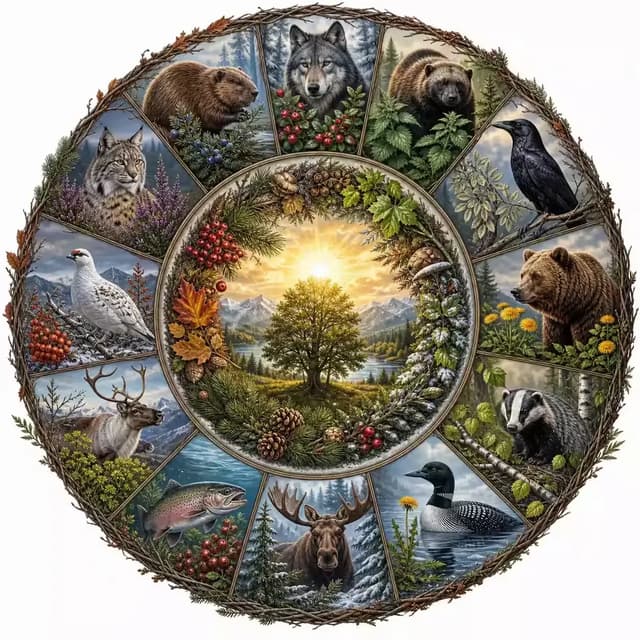
Today, in Sjamanistisk Forbund, we still keep this tradition alive. We celebrate full moons in the rhythm of the year, and each month carries its own energy. The moon in January is often called the Wolf Moon – a name that carries winter's stillness, the strength of the instincts and the wisdom of the pack. In March we meet the Raven Moon and the Worm Moon, symbols of the messenger and the one who renews. June brings the Loon Moon and the Dandelion Moon, the time of light and life force. When autumn sets in, the Lynx Moon comes in November, with the predator's gaze that sees in the dark – and the Heather Moon or the Willow Moon, when nature returns to the earth.
Each full moon has its own being, its own song. And when we gather in a circle under the light of the moon, we feel how her energy speaks through us, through the drum, through the heart.
The moon and the human being's water
It is not only symbolic that the moon affects us. She actually affects the earth physically. The tides – the breath of the sea – are governed by the moon's gravity. When she pulls on the sea, the waves rise. And since we humans ourselves consist of around 60–70% water, it is perhaps not so strange that many feel her pull in their own inner being.
Some experience unrest around the full moon, sleeplessness, restlessness. Others notice increased energy, creativity or emotional openness. In many cultures such changes were seen as signs that the moon was touching the human soul – that she was stirring what usually lay at rest. In shamanic understanding this is not a “phenomenon” to be explained away, but an invitation to listen. When the moon lights up the night, she also lights up our own dark rooms. She reminds us of everything that lives in there: the feelings, the dreams, the memories, the intuition.
The moon and the cyclical forces
The moon teaches us about cycles. That everything grows and wanes, is born and dies, only to be born again. This is not merely a poetic image – it is the law of nature.
In Norse and shamanic tradition there has always been respect for this rhythm. When one lived by the calendar of the moon, one lived in a constant alternation between activity and rest. There were times for work and times for reflection, times for community and times for stillness.
The moon became a mirror for life itself. Her growing light was hope, her waning shadow was a lesson. The dark moon, when she disappears from the sky, was not a void, but a seed – a pause before rebirth.
So too lives the shaman's path: in waves, in breath, in cycles. The drum's rhythm imitates the heartbeats of the earth and the moon, and the ceremonies follow the same pulse beats as nature itself. When we let ourselves be led by the moon, we let ourselves be led by nature's own intelligence.
The moon as teacher
For the one who walks the shaman's path, the moon is not merely an observation – she is a teacher. She teaches us to endure change. She reminds us that everything in life is in motion. That nothing lasts forever, but everything returns in new forms.
She also shows us balance. Without darkness there is no light. Without rest, no strength. Without stillness, no song.
The moon is both the outer and the inner compass. She points to our cyclical nature – how we ourselves grow, blossom, wither and sprout anew. In shamanic practice this is fundamental: we are not separate from nature, we are a part of it. When the moon changes, so do we.
The lost rhythm – and the rediscovery
In our modern world we have lost much of this rhythm. Electric light and busy calendars have meant that we no longer notice the phases of the moon. But the old knowledge still lies within us, like a primal memory. When we turn our gaze up toward the moon in the darkness of night, something familiar awakens.
Many feel a pull – a wish to live closer to the pulse of nature again. This is precisely what lies at the core of shamanism: to rediscover the connection. To listen to the moon as our forefathers and foremothers did, to notice how her light falls on the trees, on the water, on ourselves – and to know that we are a part of this rhythm.
When we today celebrate the full moon in Sjamanistisk Forbund, it is not a reintroduction of an old tradition – it is a continuation. We step into a stream that was never broken, only forgotten for a while.
The moon in you
The moon exists not only in the sky. She exists also in us. She is the rhythm in our hearts, in our feelings, in our breath. When you see her next time, you can try to listen. Perhaps you hear the sea within you move a little. Perhaps you feel an old rhythm awaken.
The moon reminds us that we are living beings in a living world. She shows us that everything is connected – sky and earth, light and darkness, tides and tears, body and soul.
So let us live with the moon again. Let us follow her course as our ancestors did. Let us celebrate her light and her darkness. For in her cycle we find our own balance. In her change we find life's eternal stillness.
Sources and inspiration:
Icelandic reckoning of time: www.islandsk.no/vis/dager-og-maneder
The moon in Norse and modern tradition: Wikipedia – Moon (god)
Traditional shamanic practice, ceremonies and observations from Sjamanistisk Forbund