It is night. The room is dark, and you have just sunk into sleep. Your body is heavy, your breathing steady. Then it happens.
You wake up, but your body is no longer yours.
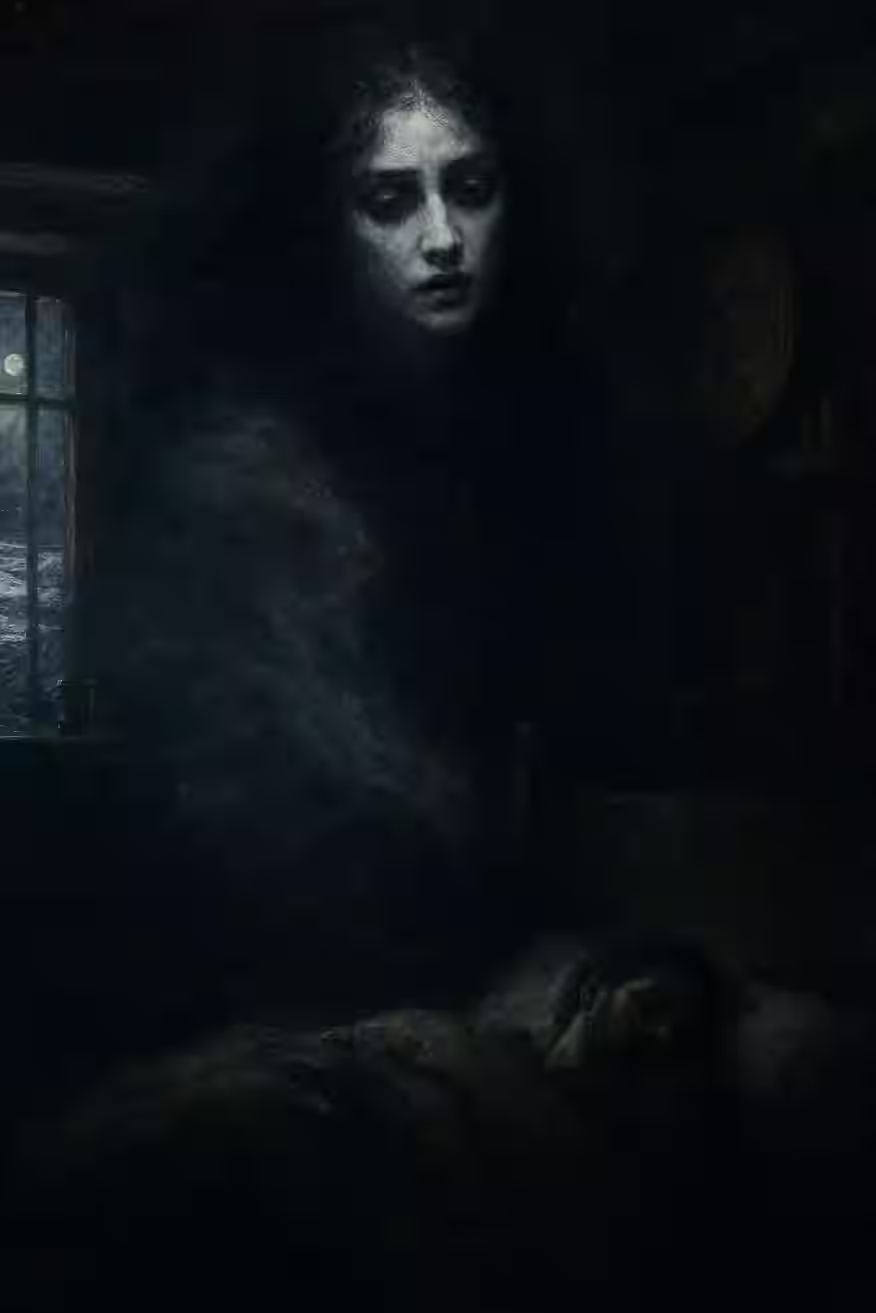
You cannot move. You cannot cry out. It is as though something invisible is pressing you down into the mattress, gripping your chest with a weight that does not belong to the physical world. You breathe, but only just. And in the darkness you hear something: a voice, a breath, a presence that was not there when you lay down.
For hundreds of years, Norwegians had a name for this. They called her Maren.
The oldest nightmare
The English word nightmare is not a poetic metaphor. It is a legacy from a time when people took it literally: mare means "crusher" or "presser" in Old Norse, and night-mare was simply a night when Maren rode you. In Norwegian, this became mareritt, her ride. You were the horse. She was the rider.
The belief is ancient. Older than Christianity in the Nordic countries, older than the Vikings as we know them. The oldest written source we have is the Ynglinga Saga, recorded in the 1200s but with roots far back in oral tradition. It tells of King Vanlende of Uppsala, upon whom the sorceress Huld sends a mare in revenge. The king's men rush to protect him (some holding his head, some his legs), but the mare only rides him harder. Until his legs are crushed. Until he dies.
This is not a metaphor for a bad dream. It is a description of a force that killed kings.
Who was she really
Maren could not easily be defined, and that is precisely why she was so dangerous in the popular imagination. She was not one particular being: she was a category of something that forced its way in.
In Norwegian folk belief, the most common explanations were that the mare was:
An old spinster who returned to haunt after her death. Unused life force, unfulfilled longing, a soul that never got what it sought. After she died, she found her way into sleeping men's bedchambers and took in death what she never got in life. There is something almost tragic about this notion: not only frightening, but also mournful.
A living person with unconscious mare-power. This is perhaps the most striking feature of the tradition: the mare did not need to be a ghost. She could be the neighbour's wife, the sister, a wife lying at home in her own bed while her soul wandered out at night without her even knowing it. Children born with a caul (the amniotic membrane intact around the head) were considered to have this trait from birth. They were not seen as evil, but as dangerous without meaning to be.
A sent mare: a tool in the hands of a wise woman or witch who knew what she was doing. Like Huld in the saga. Like the wife who sent the mare against her husband when he had not come home after ten years.
And then there were the cases no one could explain. Where the mare simply came, night after night, without anyone having sent her. These were perhaps the most unsettling of all.
How she came in
Maren had no body in the ordinary sense, not a body that needed a door. She pressed herself through the smallest crack. Through the keyhole. Through a window left ajar. Through a barely visible crack in the timber wall. Scandinavian tradition was consistent on this point: no opening was too small.
Once inside the room, she took her form: sometimes invisible, sometimes as a heavy dark shadow, sometimes as a beautiful woman the sleeper could not resist. She sat upon his chest, or lay on top of him, and then it began. The breathing grew heavy. The body became paralysed. Visions came, not always evil, but always alien. And sometimes voices too.
What we today call sleep paralysis (the physiological state in which the brain is half-awake while the body remains locked in the paralysis of sleep) was not, in Nordic tradition, a neurological event. It was Maren's grip.
And it is worth noting: those who have experienced sleep paralysis rarely describe it as neutral. Almost everyone reports a sense of presence. Something is in the room. Something is watching you. Something is not your friend.
Folk culture gave it a name. Modern medicine explains the mechanism. But the experience is the same across time.
She also rode animals
Maren did not confine herself to humans. In Norwegian tradition it was well known that she also rode horses. A horse that stood sweating, exhausted and restless in the stable in the morning, even though it had not been outside, had been ridden by the mare in the night. And the mane? Plaited, tangled, twisted into inexplicable knots. This had its own name: marefletter or marelokker (mare-plaits or mare-locks).
Even trees could be affected. Branches that were, without explanation, twisted and tangled: the mare had ridden them in the dark.
There is something in this that tells us Maren, in the popular imagination, was not merely a psychological notion. She was a force that acted upon the physical world. A force that drained the life energy from everything living that she got hold of.
How she was driven away
Norwegian tradition was not only full of fear of the mare, it was full of resistance to her. Generations of wise women, readers of black books and ordinary farmers had gathered knowledge of what worked. Some of the methods bordered on the absurd in their simplicity. Others had an inner logic that still makes sense today.
Iron was the foremost protection. Maren could not ride over iron. A knife, awl or needle under the pillow was widespread throughout Scandinavia. Some laid a scythe across the door threshold. Iron was not merely a material, it was a principle: the solid, the forged, the man-made that could not be pierced by the invisible.
Mare-crosses and pentagrams. The five-pointed star diagram was, in Norwegian tradition, directly called a mare-cross, not because of Christian symbolism, but because it stopped her. Drawn above the door, above the bedhead, carved into the timber wall. The eight-petalled rose that adorns many old Norwegian woven blankets was a double mare-cross, and people slept beneath these blankets for a reason.
Shoes with the heels facing the bed. One of the most widespread everyday pieces of advice: place your shoes in the evening so that the heels point towards the bed. The mare would then become confused, unable to orient herself, unable to climb up.
Plug the keyhole. Since she entered through the smallest crack, the answer was simple. Remove the cracks. Wax, a wooden peg, a cloth. No opening, no entry.
Name her. This is perhaps the deepest principle in all Nordic magical tradition. That which is named loses its anonymous power. To shout, not whisper, shout, "Mare, I know you" was in itself a protection. She was no longer the nameless darkness. She was something bounded, something defined, something that could be confronted.
The thumb in the fist. A simple bodily technique from the tradition, documented in several sources. During the attack itself, press the thumb into the fist. This was meant to break the grip of the paralysis. It is strikingly close to the modern recommendation to focus on moving a single body part in order to break the paralysis of sleep paralysis.
A galdr against Maren
From the tradition of the old black books, built upon the same principles as these remedies, here is a verse for those who are afflicted.
Mare, Mare, release your grip,
this is not your resting place,
this is not your nest,
this is not your body to ride.
I know your name
from the mouths of the old ones:
you are not spirit,
you are not power,
you are a thief in the hour of night.
The old word against you has been spoken.
Mare, ride me not,
ride rather stone and stump,
ride rather tree and rock,
my body is not your way.
ᚺ: Hagalaz, hail from the heavens,
breaks your grip like ice in spring.
ᛇ: Eihwaz holds me rooted,
you find no hole in the bark of the tree of life.
ᛉ: Algiz is raised at head and heart,
your way in is closed, your way is turned.
Where you came in,
there you shall go out.
Where you found an opening,
you now find a wall.
The sleeping body is protected,
by blood, by spirit, by its own choice.
Spoken three times at the threshold of sleep:
«Not in. Not in. Not in.»
Spoken three times at the border of waking:
Release. Release. Release.»
Spoken three times with open mouth:
«Go. Go. Go.
The Norns did not measure this for you.
Sleep is mine,
the night is mine,
the body is mine,
the voice is mine.
Mare, you are seen.
Mare, you are named.
Mare, you are bound.
Go home to the darkness
and do not return
where this word is remembered.
What cannot be explained away
It is tempting to end with a rational explanation. Sleep paralysis is well documented medically. The hallucinations that follow are known side effects of a brain in the state between sleep and wakefulness. The voices, the sense of presence, the paralysis: all of it can be explained.
But the explanation does not take away the experience.
Those who lie paralysed in their own bed while something unknown whispers to them are not comforted by neurological diagrams. They need what the wisdom of the old ones always offered: a name for what afflicts them, a language for confronting it, and a tool for saying no.
That is what the mare has always been: not merely a diagnosis, not merely a cultural phenomenon, but a meeting point between the human body and something that lies just beyond what we can control. At the intersection of sleep and wakefulness, between the conscious and the unconscious, there exists a space where the boundaries are thin.
Maren knows it. She has always known it.
And now you know it too.
Sources:
Primary sources and folklore
Snorre Sturlason: Ynglingesaga, c. 1230. Earliest known written source for the mare tradition in Old Norse literature.
Eilert Sundt: Om sædeligheds-tilstanden i Norge, 1857. Fieldwork and documentation of Norwegian folk customs and superstition, including protection against the mare.
Kjetil Flatin: Tussar og trolldom, 1930. Documentation of Norwegian folk belief from Telemark, including descriptions of the mare and remedies against her.
Vuk Stefanović Karadžić: Srpski rječnik, 1818. Slavic parallel tradition of the mare being and protection against her.
Reference works and academic sources
Mare (mythology): Store norske leksikon / Norwegian Wikipedia. Overview of Norwegian and Old Norse mare tradition.
Mare (folklore): English Wikipedia. Comparative review of Germanic and Slavic mare tradition.
Mara (folktroväsen): Swedish Wikipedia. Scandinavian parallel tradition, including mare-plaits and the tormenting of horses.
Journals and digital sources
«The Original Nightmare Was a Demon That Sat on Your Chest»: Atlas Obscura. Historical and comparative article on the mare tradition in a European context.
Svarteboka frå Sandøya: Aust-Agder Museum and Archive, 1993. Primary source for the Norwegian black book tradition.
Svartebok: Litteratur- og medieleksikonet. Overview article on the Norwegian black book tradition.
Verse and ritual
Galder mot Maren © Kyrre G. Franck, 2026. Written in the galdralag tradition with rune foundations Hagalaz (ᚺ), Eihwaz (ᛇ) and Algiz (ᛉ), based on Norwegian and Old Norse black book tradition and folk belief.