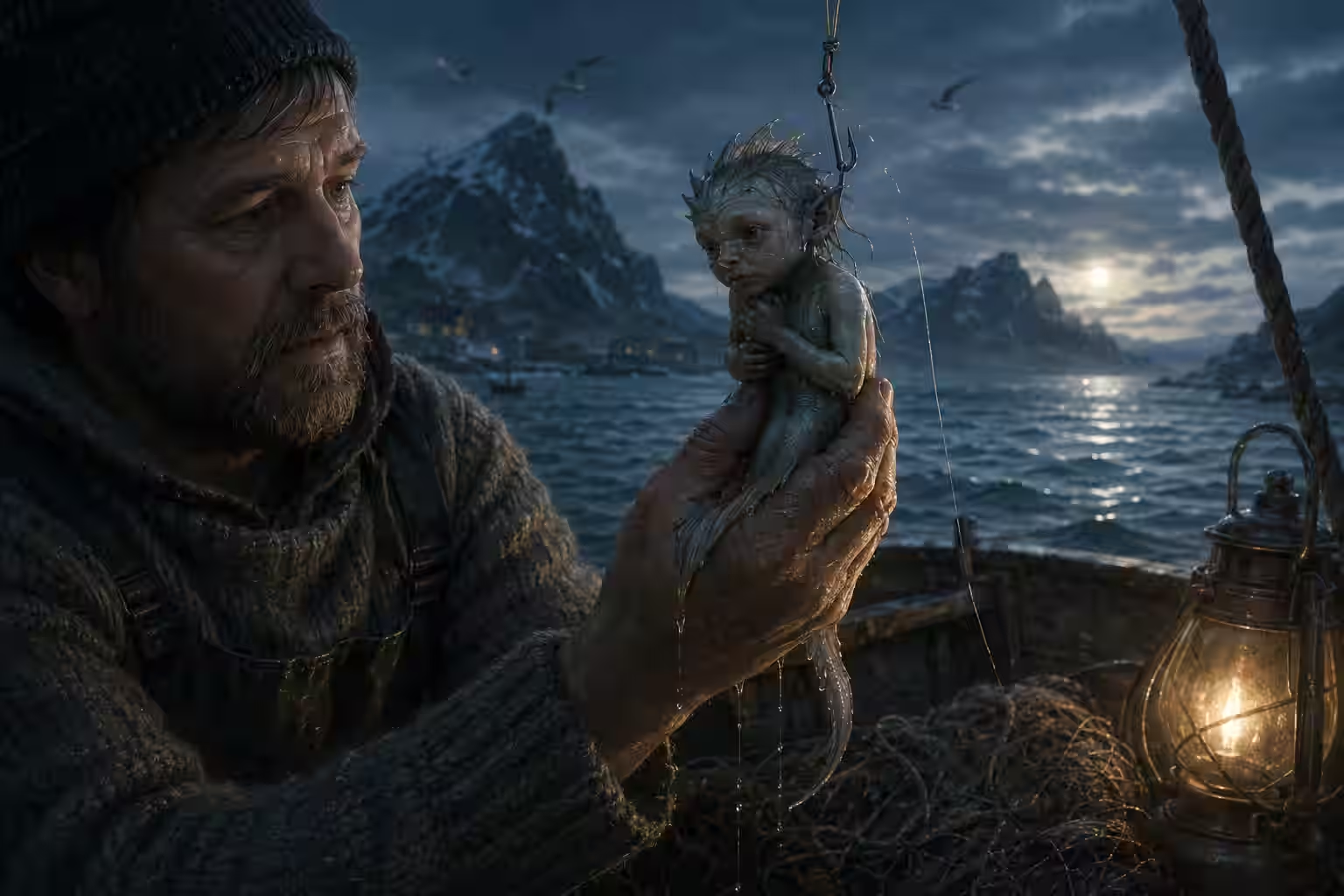
One winter evening, far out on the Helgeland coast, a fisherman sits drawing his line through the icy water. Suddenly the line stops. Something has taken hold of it – something that is neither a cod nor a saithe. When he hauls up his catch, he stares straight into a face that is neither human nor entirely fish: a small, naked creature, no bigger than a thumbnail at its smallest, shivering with cold and clinging on with its toes. He has found a marmæl – the sea's little oracle, one of the most fascinating and least known figures in Norwegian folklore.
A creature between two worlds
The marmæl, also known under the Old Norse forms marmennill, marmandill and margmelli, belongs to the sea spirits – the supernatural creatures that populate the sea in the Nordic world of imagination. The name itself tells the story of its origin: it stems from Old Norse mar, meaning sea, and mennill, a diminutive form of "little man". The marmæl is, literally, "the little sea man" – a description that captures both his physical smallness and his belonging to the sea's hidden realm.
Unlike the draug, the fearsome ghost of drowned sailors, the marmæl is not evil. He is described as a mixture of human and fish – sometimes with a fish tail like a mermaid, other times with feet like a small human. His size varies enormously between the tales: the smallest are so tiny they can sit in the bend of a fishing hook, while other legends claim he can grow to half a metre. The one thing that recurs in the descriptions is that he is cold. He is not made for the Nordic chill, and he is almost always naked when he is drawn up from the depths of the sea.
Prophecies from medieval Iceland
The marmæl's history is far older than the oral fishermen's tales from Nordland. His origin can be traced back to medieval Iceland, to the very founding account of the island: Landnámabók, "The Book of Settlements", written down in several versions between the 1100s and 1300s.
There we meet Grímr Ingjaldsson, a man who sails to Iceland to find a place to settle. One autumn day he is out fishing with his servants, while his son Þórir lies in the bow, well wrapped in a sealskin bag. Then Grímr hauls up a marmæl. In his despair over the future, he asks the creature directly: "What do you foretell of our fate, or where shall we settle in Iceland?" The marmæl's answer is cool and cryptic: "I need not foretell anything for you, but for the boy lying in the sealskin bag. He shall settle and take land where Skálm, your mare, lies down beneath her load." The marmæl says no more. Later that same winter, Grímr and the entire crew drown on a new fishing trip – only the son, who this time had stayed on land, survives and founds his settlement precisely where the mare lay down, just as foretold.
This episode is not merely an exciting anecdote – it establishes a pattern that follows the marmæl throughout the entire Nordic storytelling tradition: he knows things people do not know, and he reveals them only on his own, often enigmatic terms. In the Icelandic sagas, the marmennil consistently functions as a seer with insight into both the hidden and the future, while the Faroese version of the creature is quite a different figure – mute and more animal-like, a figure one must interpret through behaviour rather than words.
Riddles, oracle speech and forbidden questions
When the marmæl appears in the Norwegian fishermen's tales from Nordland and Helgeland, he rarely speaks plainly. He prefers verse, riddles and a kind of oracle speech that demands interpretation – a linguistic fog that mirrors the sea's own nature: shifting, opaque, and never quite to be trusted. He is also sparing with his answers. One may ask him at most two or three questions before he grows impatient, and if one asks foolish or meaningless questions, he answers with scorn rather than wisdom.
One question is strictly taboo among all who meet a marmæl: to ask how long one will live oneself. In one legend, precisely this question is put to him, and the marmæl's answer is as bleak as it can be: "If you live until tomorrow, you will be an old man" – a phrase that lets death lurk between the lines without ever being named. It is a reminder that knowledge from the depths of the sea always comes at a price, and that whoever asks too much may not like the answer.
The gift of clothing and the fisherman's salvation
What makes the marmæl tradition so unique among Norwegian sea spirits is the recurring theme of mutual care. The rules are clear and repeated in legend after legend along the entire coast: if one catches a marmæl on the hook, one must never throw him back into the sea – that brings misfortune upon the whole catch. Instead, the fisherman must ask the small, freezing creature whether he would like to come aboard, and whether he needs clothes. If one gives him a warm mitten, a cap, a jumper or a pair of trousers, a reward is due.
Two legends from Ytre Helgeland illustrate this pattern beautifully. In the first, a fisherman catches a marmæl who "shivers with cold" and "stands with his big toe on the hook" as he clings to the line. The fisherman takes off his own jumper and wraps it around the small body. The reward comes at once: the boat quickly fills with fish. But the truly decisive gift comes later. The next time the fisherman is out, the marmæl appears hanging on the gunwale with a warning shaped as verse:
"Row to land, row to land, you man who gave the jumper,
the sea rumbles and the waves swell."
The fisherman follows the advice and reaches land just in time before the storm breaks loose. In a parallel tale, another fisherman has given away his long trousers, and the marmæl calls out to him:
"It whitens over land, it blackens at sea,
go home now, you man who gave the long trousers."
He then vanishes suddenly beneath the water, and the fisherman is saved just in time.
Slørvpål – the man who became a great fisherman
Among the best-known marmæl legends from Nordland is the story of Slørvpål from Vefsn, recorded by the teacher and folklore collector Ole Tobias Olsen in the work Norske folkeeventyr og sagn samlet i Nordland (1912). Slørvpål is drifting out by the mountain Toven with his nets when a marmæl suddenly jumps up into the boat and sits down right on the thwart. The creature calls out in its characteristic, cryptic style: "Fuf, fuf! Bælg i hav! Knapt bergand baat!" – a warning that the sea is about to rise, and that the boat will barely survive.
Slørvpål grasps the danger at once. He hauls in his nets in great haste, takes off his own warm cufte (traditional coat) and wraps it around the shivering marmæl, before seizing the oars and rowing towards land with all his strength. The marmæl, grateful for the warmth, wraps the coat snugly around himself and sits still until the boat is safely inside a sheltered cove. There he rises and sings a blessing in return: "Thanks, kind-hearted man. Ever in fortunate stead. Blessed on sea and land" – before he jumps overboard with the coat and vanishes into the depths. The storm that follows is so violent that Slørvpål would never have survived had he not heeded the marmæl's hint. From that day, he was known throughout Nordland as one of the district's finest fishermen.
The deeper meaning of clothing
Why is clothing precisely the recurring gift in these legends? The answer lies in the historical reality the fishermen lived in. Sturdy, warm clothes were, in earlier times, not something to be taken for granted, but the result of time-consuming labour – often carried out by women who carded, spun and wove wool through long winter months. To give away a jumper or a cap to a strange creature from the sea could feel like a genuine sacrifice, not a cheap gesture. Precisely for this reason, the tradition suggests, the act was rewarded so richly. The core of the marmæl legends is thus not merely superstition about the sea's whims, but a moral tale of reciprocity: whoever is good to the weak and vulnerable is themselves saved when the storm comes.
This dynamic clearly sets the marmæl apart from other, more feared sea spirits. Where the draug brings death and the nøkk lures people to their ruin, the marmæl represents a rarer figure in Norse and Norwegian folklore: a creature that, treated rightly, becomes an ally. He does demand respect, admittedly – one must not ask foolish questions, one must not ask about one's own day of death, and one must never simply throw him back into the sea – but within these bounds, he is a benevolent force.
Elf on land, marmæl in the sea
One of the most poetic variants of the creature is found in Ole Tobias Olsen, where the marmæl merges with another figure from folklore: the elf. In this version, the being lives a double life following the seasons. In autumn and winter, he dwells in the sea as a marmæl, speaking and oracle-like as usual. But in spring and summer, he becomes an elf on land – small as a newborn child, with fine and well-shaped hands and feet, and with a love of music that makes him follow the nøkk on his wanderings from the sea and inland.
In this form, however, he is mute. In the evenings he dances on the waves to the nøkk's playing, and in the morning dew one can see the traces of elf-tread where he has been. To disturb him during the dance was considered dangerous – his breath could produce a so-called "elf-gust", a poisonous or disease-bringing draught. This blending of sea and land spirit illustrates how porous the boundaries between folklore's creatures could be – the marmæl is not an isolated figure, but part of a larger network of spirits that move between the elements according to their own, mysterious laws.
A creature for the entire North Atlantic
The marmæl is not an exclusively Norwegian invention. The mythological figure is known along the entire coastline of the North Atlantic and has been part of the Nordic storytelling tradition for at least a thousand years. In Iceland, he lives on in modern form as marbendill, still known as a seer one can catch on the hook. In the Faroe Islands, as mentioned, we find a more animal-like and mute variant. The English encyclopaedia from 1911 draws parallels even further afield: to the German Meriminni, the Danish Hafmand or Maremind, the Irish Merrow, the Breton Marie-Morgan and the Welsh Morforwyn – an entire network of sea-spirit beliefs stretching across north-western Europe.
This widespread distribution suggests that the notion of a small, prophetic sea creature that could be caught on a hook answered a universal human longing among coastal populations: the need to find meaning and predictability in a sea that was as life-giving as it was deadly. Fishing life was filled with uncertainty – about the catch, about the weather, about life and death on the open sea. A creature that could warn of storms, show the way to rich fishing grounds, and save whoever treated him with respect provided a form of security in an otherwise unpredictable existence.
A forgotten figure that deserves its place
Today the marmæl is far less known than his more dramatic relatives in Norwegian folklore – trolls, huldre and the draug dominate the tales we learn as children. The Norwegian folklorist Ørnulf Hodne does indeed mention the marmæl alongside other lesser-known spirits such as the deildegast, dradokka and lindorm in his overview of Norwegian folklore, as one of the figures "not quite as well known" as trolls and the huldre-folk. Nevertheless, the tales about him have survived in local collections from Nordland and Helgeland – in Ole Tobias Olsen, in O. Nicolaissen's Sagn og eventyr fra Nordland from 1879, and in Finn Myrvang's articles in Håløygminne.
Perhaps it is precisely the marmæl's discreet nature – his smallness, his quiet wisdom, his demand for mutual respect rather than fear – that has made him less visible in the folkloristic canon. But in these tales from the coast lies one of the most human stories in the whole of Nordic folklore: of how the smallest and most vulnerable creature, if one only takes the time to see it and help it, can become the one who saves your life when darkness falls over the sea and the storm finally comes.
Sources
Helgeland Museum, Marmælen – den lille hjelperen fra havet
Wikipedia (English), Marmennill
heimskringla.no, Overnaturlige væsener i havet
Cleasby & Vigfusson Old Norse Dictionary, Mar-mennill
Wikipedia (Norwegian Bokmål), Landnåmabok
1911 Encyclopædia Britannica via Wikisource, Mermaids and Mermen
Cappelen Damm, on Ørnulf Hodne's book Vetter og skrømt i norsk folketro
In addition, these printed sources are mentioned on the Helgeland Museum's page (without their own URLs, as they are not available digitally):
Ole Tobias Olsen, Norske folkeeventyr og sagn samlet i Nordland (1912/1987)
Olav Bø, Trollmakter og godvette (Det Norske Samlaget, 1987)
Arnold Farstad, Havuhyre – mystiske vesen i havet (Det Norske Samlaget, 2002)
A. Faye, Norske Sagn (1833)
Finn Myrvang, Marmælen og havmannen (Håløygminne, 1963) and Marmelen (Håløygminne, 2019)
O. Nicolaissen, Sagn og eventyr fra Nordland (1879)
Eli Anker Petersen, Overnaturlige væsener i havet (2003)
Tromsøposten, 26 November 1873