Metal has always been a central material in human culture, and in Nordic and Norse tradition it played a particularly important role in mythology, folk belief, art and religious rituals. Through archaeological finds, literary sources and oral tradition, we can gain a picture of how important metal was – not only for its practical value, but also for its magical and symbolic significance.
The dwarves' workshop
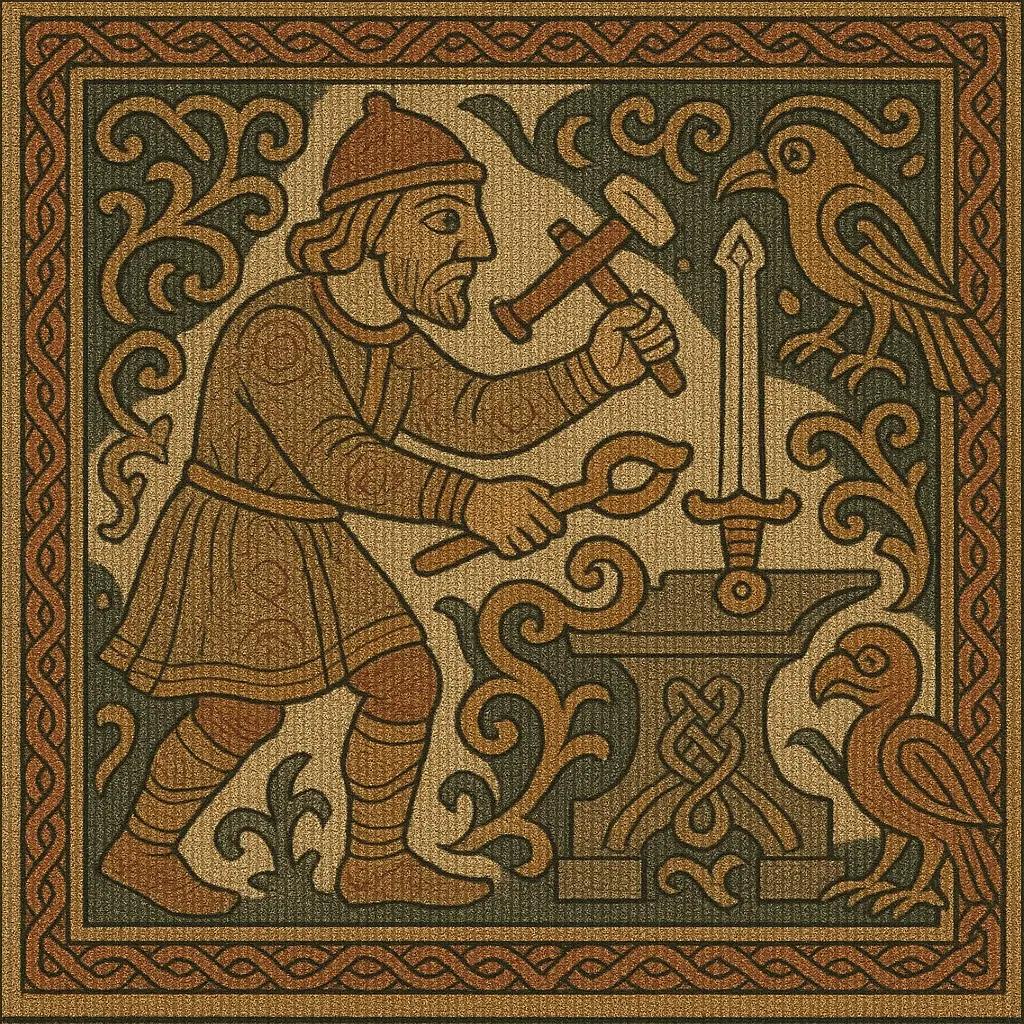
In Norse mythology, it was the dwarves, the underground smiths, who were responsible for creating the most magnificent and magical metal objects. According to Snorri Sturluson's Edda, the dwarves created objects such as Draupnir, Odin's gilded ring that every ninth night dripped eight new gold rings, and Mjölnir, Thor's hammer, which could strike down enemies and always returned to its owner. These objects were not just practical tools, but also symbolized the power and protection of the gods.
Since the dwarves were also known for their sorcery and wisdom, objects made by them could be both blessings and curses. One example is the sword Gram, which Sigurd Fåvnesbane used to slay the dragon Fåvne. Such swords could have names and a will of their own, and were often associated with both good fortune and tragedy for their owners.
The gods and the metals
Even the gods were connected to the magic of metals. Thor, who protects humankind against giants and the forces of chaos, used his hammer of metal to keep evil at bay. Frøy, the god of fertility, had a ship of gold that could be folded up and carried in his pocket, and that always found wind for its sails. These objects emphasize that metal was not just a tool, but a source of power and protection.
Metal in folk belief and protection
Protection against evil powers
In folk belief, metal, especially steel and silver, was important for protection against evil powers. Trolls, wights and changelings feared metal, and steel in particular was used to ward off their influence. To protect children against being swapped out, parents often placed a piece of steel or an open pair of scissors in the cradle, preferably in the shape of a cross. This was a simple but effective way of using the magic of metal.
Silver, with its sheen and rarity, was also used as protection. Silver crosses, silver rings and other jewelry could be worn as amulets. In the transition between paganism and Christianity, such symbols were often interpreted in two ways: a cross could be both a Christian symbol and a reference to the old gods.
Amulets and magic
Amulets of metal, such as Thor's hammers and crosses, were common in Norse society. They could be worn as jewelry or attached to clothing and weapons. Such objects were believed to provide protection against illness, misfortune and evil spirits. There are many examples of such amulets in archaeological finds, and they show that belief in the magic of metals was widespread.
Metal in art, status and daily life
Jewelry and status
Metal, especially gold and silver, was an important material in Norse art. Jewelry such as arm rings, neck rings and brooches was worn by the higher levels of society to display wealth and prestige. This jewelry could be decorated with intricate patterns and mythological motifs, such as dragons, griffins and other fantastic creatures. Such symbols emphasized both the owner's status and their connection to the gods and the supernatural world.
Craftsmanship and society
Metalworking was an important industry in Norse society. Weaponsmiths, shipsmiths and goldsmiths had high status, and their knowledge was both valued and feared. To be able to work metal was an art form, and the best craftsmen could receive commissions from chieftains and kings.
Weapons of metal, such as swords, axes and spears, were not just tools for war, but also status symbols. A good sword could accompany its owner throughout life and be inherited from generation to generation, often with a name and a history of its own.
Metal in religious rituals and sacrifices
Sacrifices in water and bogs
Metal objects, especially weapons and jewelry, were often sacrificed in water and bogs as part of religious rituals. We see this in finds such as Illerup Ådal in Denmark, where thousands of weapons and personal objects were placed in the lake as offerings to the gods or as war booty. Such sacrifices were a way of securing the gods' favor, marking victory or asking for protection.
Sacrifices could also be a way of thanking the gods for a good harvest, good fortune in war or protection against illness. Metal objects were often chosen as offerings because they were valuable and symbolized both power and wealth.
Magic and rituals
Metal was also used in magical rituals. For example, a sword could be forged under particular astrological conditions to give it extra power. Amulets and jewelry could be blessed or invoked with magical formulas to strengthen their protective effect.
In some traditions, metal objects were used to communicate with the dead or with supernatural beings. For example, a piece of metal could be placed in a grave to give the deceased protection in the realm of the dead.
Magical use of metals even after Christianity
The use of metals in folk belief and folk magic continued to play an important role even after Christianization, although society gradually became more Christian and the church gained increased influence. The transition from Norse to Christian belief was rarely a sudden and complete process. Instead, a kind of dual religiosity often arose, in which people combined Christian customs with old, pagan ideas and magical practices.
Continuity in belief and practice
After Christianization, many continued to use metal as protection against evil forces, illness and misfortune. Metal objects, especially jewelry and amulets, were worn on the body or placed in the home to provide a sense of safety. This was not a new phenomenon, but the practice took on new expressions and was often adapted to the Christian traditions. For example, old Thor's hammers could be replaced or combined with crosses, and metal amulets were often shaped as Christian symbols, but with an understanding that they also had magical power.
Metal amulets in the Middle Ages
In the Middle Ages, it was common to wear magical amulets made of metal, often thin lead plates or jewelry of silver and bronze. These were usually covered with inscriptions of prayers and incantations meant to protect against illness, misfortunes and evil forces. The amulets could be worn around the neck, attached to the belt or hidden in the clothing. Many of these amulets were made by priests or monks, who were often the only ones who could read and write. Thus it was not unusual for Christian symbols and magical formulas to be mixed together on the same amulet.
Controversy over magic and metal
Although magical amulets were widespread, there was no agreement within the Christian church about where the boundary lay between the permitted and the sinful when it came to magic. Some theologians, such as Isidore of Seville and Augustine of Hippo, condemned the use of amulets, while others, such as Thomas Aquinas, held that one could well accept them. This meant that the use of metal amulets could vary greatly from place to place, and that the practice could be both accepted and condemned, depending on local attitudes and the influence of the church.
The magical power of metals in daily life
The magical power of metals was not only associated with jewelry and amulets. In folk belief, for example, steel or silver could be placed in the cradle to protect children against changelings and evil spirits, a practice that continued far into Christian times. Metal objects could also be used in various forms of magic, such as incantations, curses and protection against witchcraft. This shows that the significance of metals as protective and magical tools persisted, even as the religion changed.
Archaeological traces and written sources
Archaeological finds of metal amulets from the Middle Ages show that the use of magical objects was widespread across large parts of the Nordic region. In Denmark alone, more than 300 examples of such amulets have been found, and several dozen have also been found in Norway and Sweden. Written sources, such as the saga literature and legal texts, emphasize that belief in the magical power of metals was part of daily life, and that this belief did not disappear with Christianization, but was adapted to the new religious conditions.
Sources
Knutson, S. A. (2019). The Materiality of Myth: Divine Objects in Norse Mythology. Temenos, 55(1), 29–53. https://journal.fi/temenos/article/download/83424/42534
Orfanou, V., et al. (2021). The evolution of metalwork expertise and craftsmanship developed by Viking craftspeople in Denmark in the 8th and 9th centuries. Archaeological and Anthropological Sciences. https://www.medievalists.net/2021/04/study-examines-the-evolution-of-viking-metalwork/
Smith, K. P. (2005). Ore, Fire, Hammer, Sickle: Iron Production in Viking Age and Early Medieval Iceland. In R. O. Bork (Ed.), De re metallica: the uses of metal in the Middle Ages (pp. 25–42). Ashgate.