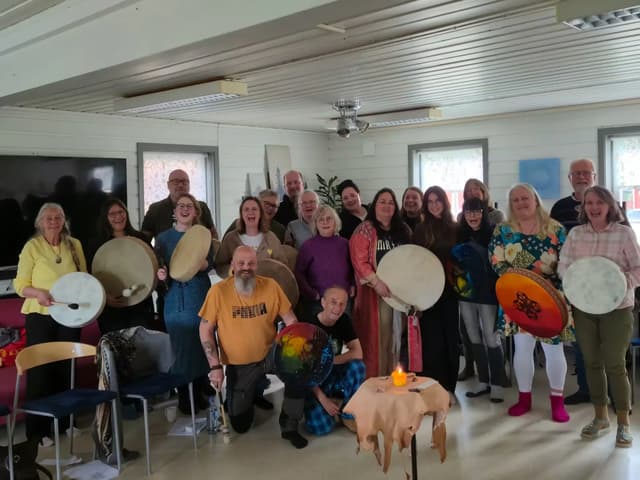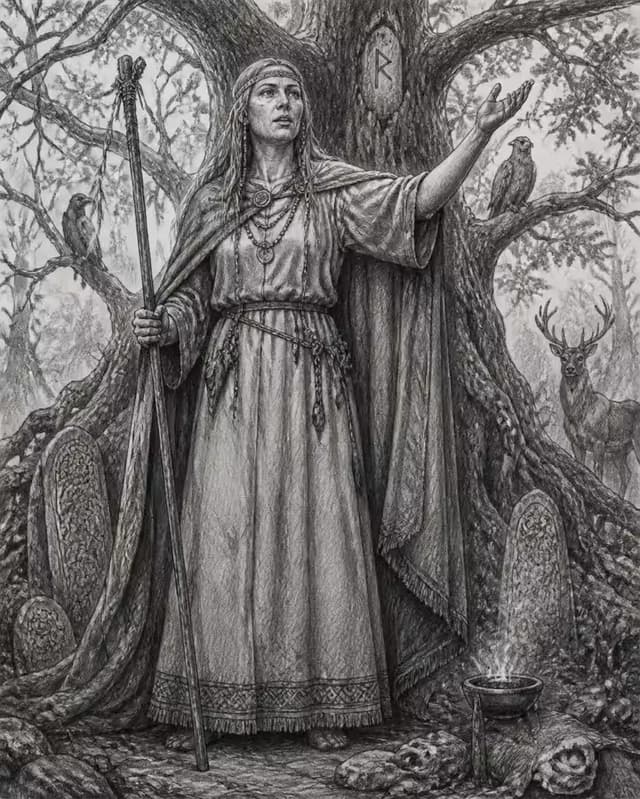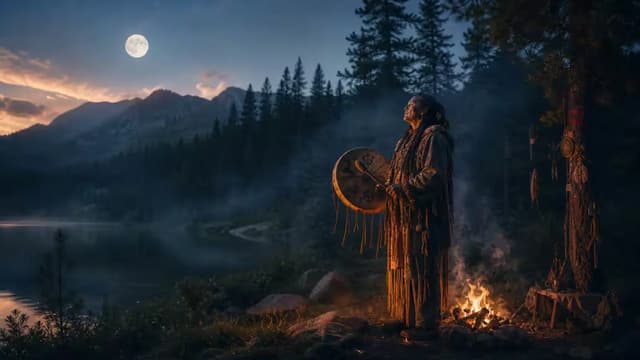
Imagine us sitting around a fire after a drum journey. One of the people sitting there tells us she met her grandfather. It was his hands that made her recognise him. She had almost forgotten what they looked like, she says, but when he took off his mittens, she had no doubt. On the other side of the fire sits someone who saw nothing at all. He heard the drum, then eventually heard the wood crackling, and towards the end his feet grew cold. Now he feels like putting another log on the fire. Both of them have something true to tell about that last half hour.
He might ask what her grandfather used to do with his hands. Perhaps he will hear about a man who could carve a useful ladle from a piece of wood that nobody else would have bothered to keep. But he could also tell her that she has merely brought a memory to the surface. She might reply that her grandfather was there for both of them, and that he would have noticed if he had been more open to the experience. In a remarkably short time, they have gone from telling their own stories to explaining each other to themselves.
I often encounter something like this in discussions among people who practise or take an interest in shamanism. It is rarely the disagreement itself that surprises me. On the contrary, things often become interesting precisely when someone has experienced something that does not fit with what I know myself. What surprises me is how quickly curiosity can come to an end. One person describes how she learned to use the drum. Another learned differently. Before anyone gets around to asking who taught them, where they learned, or what the drum was meant to be used for, the discussion has already turned into a question of who learned it incorrectly.
But the question of who is right around the fire is really only half the matter. Before we sat down to share our stories, someone beat a drum and invited us to set out on a journey. Why journey at all if we assume beforehand that the world can only be the way it appears from where we stand?
The One Who Can Also See You
Think of a raven sitting on a fence post. From the road, you can see it tilting its head to one side. You stop, perhaps hoping to get close enough to take a picture. Then it takes flight. In your story, the raven appeared, and the raven disappeared. If the raven were telling the story, you might have been the one who walked into a morning it had until then enjoyed undisturbed. It sounds like a small difference, until you ask which of you actually interrupted the other.
Here lies what I believe is a central principle for understanding shamanic and animistic philosophy: The human standpoint is one among several, and some of the others belong to beings that are not human. This is about more than you and I disagreeing about a raven. The raven also has a place from which to see the world. In his study of perspectives among Indigenous peoples of Amazonia, anthropologist Eduardo Viveiros de Castro describes precisely this kind of shift: An animal that a human regards as prey may itself experience the human as a dangerous predator, while a large predator may, in turn, see the human as prey («Cosmological Deixis and Amerindian Perspectivism», pp. 469–472). “I am the hunter” and “I am the prey” can therefore both be true of the same human being in the same forest. It depends on who has spotted whom.
What does this have to do with journeys to other worlds? In the Amazonian traditions discussed by Viveiros de Castro, the shaman's specialised knowledge includes the ability to enter another being's perspective, address it, and return to their own people with what has been experienced (Viveiros de Castro, pp. 472 and 483). Calling this empathy would be insufficient. I can sit at home and imagine what another person might say. Setting out on a journey to ask is something else entirely: Then it is no longer a given that I am the one who determines the answer. In this sense, a plurality of perspectives can be a prerequisite for shamanic work. The one who journeys seeks knowledge or help precisely because there are others to visit, and because something may become known there that was not known here.
A Sámi account gives the journey another, more familiar form. Francis Joy recounts John T. Solbakk's description of how a noaidi, at the beginning of their work, called upon their noaideloddi, the noaidi's bird. The bird's task was to fetch helpers from the world of the dead (Francis Joy, «Sámi Shamanism, Fishing Magic and Drum Symbolism», p. 85). Notice who has something to do here. It is the bird that is supposed to travel and bring someone back with it. In the same article, Joy also recounts descriptions of animal helpers assisting the noaidi on their own soul journeys, including occasions when help had to be sought for someone who was ill (Joy, p. 70). We would miss something essential here if we only asked what the bird symbolises to the human being. In the account, the bird has knowledge and a task on which the human depends.
I do not read these accounts as a single recipe for what happens during every drum journey. Entering another being's standpoint and asking a helper to travel somewhere one cannot go oneself are different actions. But both make clear why a world with several standpoints is also a world in which journeys make sense. Some know the way better than you do. Some can meet you from the other side. And the one you meet is not obliged to want the same thing as you.
A Night on a Construction Site
In Karasjok, the Sámi Parliament was planning to build a new office wing in 2014. Before construction began, representatives of Statsbygg, the Norwegian government agency responsible for public construction, were invited to do something not usually associated with a building project: They were to spend the night on the site. In Tore Johnsen's account of the overnight stay, the then director of the Sámi Parliament explains that one should not simply take possession of a place when wishing to establish oneself there. There had been activity at the site before, and showing consideration for the place also carried spiritual significance for people who maintained the custom (Johnsen, pp. 4–5).
With measuring tapes and drawings in hand, one asks questions of one's own choosing: Where should the wall stand? How wide should the road be? The person who lies down to spend the night must wait until morning to know whether they were able to sleep in peace. There is something quietly serious about the idea that someone who intends to remain in a place for many years first spends a few hours there as a guest.
The Statsbygg representative gave a rather different reason for taking part. “I personally have no need to characterise the ritual; I am simply curious,” she said (Johnsen, p. 4). She did not claim to know what others encountered at the site. Nor did she need to pretend that she expected to encounter the same thing herself. To me, that is precisely where the significance of her response lies. It was possible to accept the invitation without making the hosts' reasoning one's own.
Nor was there agreement among the Sámi who commented on the overnight stay. One objection was that if the intention really was to ask permission, it should have been done earlier in the building process (Johnsen, pp. 5–6). This is an objection worth dwelling on. The person who questioned the timing raised a more difficult issue than whether the night had been successful: What does it mean to ask permission if the decision has effectively already been made? Here, a neat conclusion about everyone having their own truth would have impoverished the conversation. Sometimes the person who refuses to let a disagreement rest is the one taking the tradition most seriously.
In another Sámi area, in Tysfjord, an elderly woman referred to as Gahte in Marit Myrvoll's dissertation spoke about her experiences with the gadniha, the subterranean beings. To Gahte, they could be a nuisance and create extra work for her. Myrvoll, who was her neighbour, writes: “For Gahte, the subterranean beings were real experiences, on a par with me as her neighbour” (Myrvoll, chapter «Naboskap», pp. 203–205). I find myself lingering over one word: extra work. It is a long way from the solemn tone that so easily emerges when we discuss what exists between heaven and earth. A neighbour does not have to be a mystery. A neighbour can simply be someone whose mess you would rather not have to clean up.
The Moon as Seen by Humans
In the Old Norse Eddic poem Alvíssmál, Thor asks the dwarf Alvíss a question about the moon. He does not ask how large it is, what it is made of, or why it changes shape. He asks what the moon seen by humans is called in each of the different worlds (Alvíssmál, stanza 13, in Edward Pettit's edition of The Poetic Edda). It is worth reading the question once more before moving on to the answer. The moon as seen by humans. The human gaze is the starting point, but human words are not enough.
Among humans it is called máni, Alvíss answers; in Hel it is called the turning wheel, among dwarves skín, and the elves have a name that can be rendered as “the year-counter” (Alvíssmál, stanza 14, with explanatory notes). Try taking that last name with you outside one evening. A gleam is something you can notice the moment you open the door. A year-counter only becomes visible if you remember the moon from other evenings, when it stood somewhere else above the rooftops and less of it was visible. You have not changed the moon. Yet the new name has made you look for something you might otherwise have walked past.
It would be reading too much into Alvíss's words to make him an advocate of the idea that everyone is equally right. The poem is, among other things, a work of poetic art that gathers poetic names, and Thor has his own reason for keeping the dwarf occupied with questions until sunrise (Pettit's introduction and the poem's final stanza). But precisely as a poem, it gives us something that a doctrinal statement would struggle to provide. If Alvíss had simply answered “moon”, he would have used a perfectly valid human word and still given a poor answer. There was more to know than what could be expressed from the human standpoint.
Sometimes I think that the urge to organise the world into true and false, real and imagined, is a particularly Western habit. But where would that leave Thor and his question? And what am I to make of the moment when I myself, in the middle of a conversation about spiritual openness, feel the strongest urge to interrupt because I think someone is thoroughly wrong? I believe we get further by noticing what we do in such moments than by dividing the world into two kinds of people: those who divide the world in two, and those who supposedly have stopped doing so.
The One Who Sleeps Sees the Dream
“Nukkuja unen näkkee, kalastaja kalan.” In Tellervo Laine's Norwegian translation, the proverb reads: “It is the one who sleeps who sees the dream, and the one who fishes who sees the fish.” It comes from Olav Beddari's collection and is reproduced in Folkefortelling i Ruija, p. 12. I like that the final word is fish. A dream can set off a long discussion about what a person has actually experienced. A fish brings us rather abruptly back to the riverbank.
Imagine the fisherman coming through the door. He has seen a fish so large that he needs both hands to show its size. How frustrating would it be if the person who stayed home and slept started using their hands to demonstrate how small the fish really was? But the fisherman was not in the dream either.
This is my interpretation of the proverb, not a claim that it contains a distinct Kven teaching about truth. It gives me a question to take back to the fire: Where was I when this happened? If the answer is that I was sitting on the other side of the flames with cold feet, then I have good reason to put another log on the fire. I have far less reason to make statements about the hands of a grandfather I have never known.
There is a philosophical term that helps me clarify precisely this point. In Jain philosophy, anekāntavāda refers to the idea that reality has multiple aspects, meaning that a description can be true without being exhaustive (Stanford Encyclopedia of Philosophy, «Jaina Philosophy»). There is a difference between saying “everyone is right” and saying “there may be more to see than what I have seen”. The first statement can end a conversation just as effectively as a dismissal. The second gives me a reason to remain seated and listen.
When Someone Asks What the Raven Means
Let us return to the drum. Someone new to the circle tells us she saw a raven. “What does it mean?” she asks the person who led the journey. Perhaps she asks him precisely because he has spent many years learning to recognise signs that she does not yet know. If he simply answered, “You know best yourself”, he might miss what she is actually asking for. She has not asked to have the experience handed back to her. She has asked for help in understanding it.
Reading and interpreting signs are part of the shaman's work in a number of traditions, and their significance becomes particularly clear when someone seeks help because of illness. In his work with older Sámi sources, Ola Graff explains that in cases of illness, people could consult the drum to find a remedy (Graff, p. 348). He also describes one method of seeking guidance: A brass ring moved across the drum skin while it was being beaten, and the figure at which it came to rest was interpreted as an answer to the question that had been asked (Graff, pp. 349 and 351). It was not enough simply to see where the ring had landed. Someone had to understand what the sign had to do with the question. In healing work, this may have been precisely the kind of judgement people sought: What did the signs tell them, and how should the shaman proceed in seeking help for the sick person?
The woman who saw the raven has asked a different question. The person leading the circle could begin by asking: “What did it do?” Not to push the interpretation back onto her, but because a raven that waits until you follow it offers something different to interpret from one that moves away every time you approach. Perhaps she tells him that eventually she stood still, and that it was only then that the bird returned. Now the leader might say: “I would pay attention to the fact that the raven came to you when you stopped following it.” That is an interpretation, and it adds something: What she herself understood as the end of the journey may have been the beginning of the encounter.
To me, the ability to recognise several truths is precisely what makes good interpretation possible. The woman may have understood the raven correctly both times: First, she was supposed to keep her distance. Later, she was allowed to come closer. If the person interpreting her account immediately calls the bird a guide, it becomes difficult to see that it actually moved away. If he calls it a warning to turn back, he is left without an explanation for why it returned. What matters may lie in what happened between those two moments: She stopped, and the raven was then free to decide for itself whether it wanted to approach.
This is also how I understand part of the shaman's judgement in healing work. The person who comes seeking help knows something about what has happened that the shaman does not know. The shaman, in turn, may recognise a sign that the other person has not been in a position to interpret. This does not mean that every explanation is equally good, or that the shaman should refrain from saying what they believe the sign indicates. But if they overlook what the other person knows, they may recognise the sign and still misunderstand what it means on this particular occasion.
There is also a boundary here to the expression “my truth”. If I claim that a particular ceremony is documented as having been practised in a named village three hundred years ago, someone is perfectly entitled to ask where I got that information. If it turns out that I remembered incorrectly, the claim does not become more accurate simply because the ceremony means a great deal to me. But the correction does not work the other way around either: Being wrong about the date does not tell anyone what I experienced when I took part. I can correct the year without giving up the experience. In fact, I owe it to both those who came before me and those who are listening to do precisely that.
What I want from shamanic conversations, therefore, is not less disagreement. I want to hear the person who says: “That is not something I recognise from what I learned at home.” That could be the beginning of a long evening in which we discover who used to do what, which words they used, and what has changed along the way from them to us. But the next sentence must then be a question. If instead it sounds like “therefore you cannot have experienced that”, there is not much more left to tell.
There is still someone sitting by the fire with cold feet. Let him put another log on. Let her finish telling us about the hands, if she wishes. Perhaps it is only when he no longer has to confirm that her grandfather was there, and she no longer has to defend the fact that she met him, that he finally gets to ask what he actually wants to know: What did you do when you recognised him?
My truth does not threaten yours. To me, this is connected to the reason for setting out on the journey in the first place: I do not go there to hear my own voice answering from the other side. I go because it is possible to meet someone there who knows something I do not. I should therefore also be able to allow the person sitting beside me around the fire to return home with a different story from mine. There is a difference between seeking truth and demanding ownership of it.