It's Wednesday. It's 12 August 2026. And somewhere out there, in a corner of the universe that couldn't care less what your calendar says, the Moon has decided to do three things at once, seemingly just to see if anyone notices. Spoiler: We notice. We notice very well indeed.
For those of us who find the sacred in nature (and those who simply think shooting stars are cool, which is also a perfectly legitimate outlook on life), today is nothing less than the cosmos clearing its desk three times over.
The universe hits pause
At 13:37 today, nothing happens. That's the point. The new moon occurs, the moment we call the dark moon (Time and Date), and the Moon vanishes so thoroughly from the sky that you'd think it had called in sick to work. No crescent, no glow, just a black hole in the darkness where it usually hangs about looking important.
As I've written before: the dark moon is a time for rest. Not rituals, not projects, not promising yourself you'll start that training programme tomorrow. The universe has posted "brb" as its status update, and the polite response is to do the same. We hold back, we breathe, we wait for the first thin crescent to creep out again before setting anything at all in motion. Try to force something big through today, and you'll notice nature looking at you rather like a cat regards a vacuum cleaner it never asked for.
But this year, the Moon isn't content with merely hiding itself. It's decided to bring the sun into hiding too.
The sun clears space in its calendar
Coinciding with the dark moon, today brings a total solar eclipse, the first mainland Europe has experienced since 1999, which is long enough for an entire generation to have grown thoroughly tired of hearing their parents go on about the last one (Wikipedia). The Moon's shadow strides with great confidence across Siberia, Greenland, Iceland and Northern Spain, extinguishing the sun completely for a few minutes in the middle of broad daylight, like a cosmic power cut nobody asked for but everybody stops to watch (NASA Science).
Here in Norway we're not granted total darkness, the universe apparently only offers us a partial discount, but around 83 per cent of the sun disappears behind the moon between 18:40 and 20:49 this evening (NASA Science, though it depends a little on where you live). That's enough to confuse the dogs and to leave the rest of us with the vague sense that someone has dimmed the universe's light switch without asking permission first.
When the sun, our external power, our daily dose of the feeling "I know where I stand in the world", suddenly decides to take a coffee break on the very day of the dark moon, it's hard not to read that as a rather bold underline from nature's side. As though the universe didn't trust us to take the hint the first time, and so sent the same message twice, in slightly larger letters: REST. Even the sun, which otherwise behaves as though it holds a permanent job and never takes a day off, shows us today that even the most reliable forces in existence are allowed to vanish behind something greater for a while.
So do as the sun does. Slip behind your own cloud this evening. No one will judge you for it. The universe is doing exactly the same.
And just when we thought the day had finished showing off, meteors
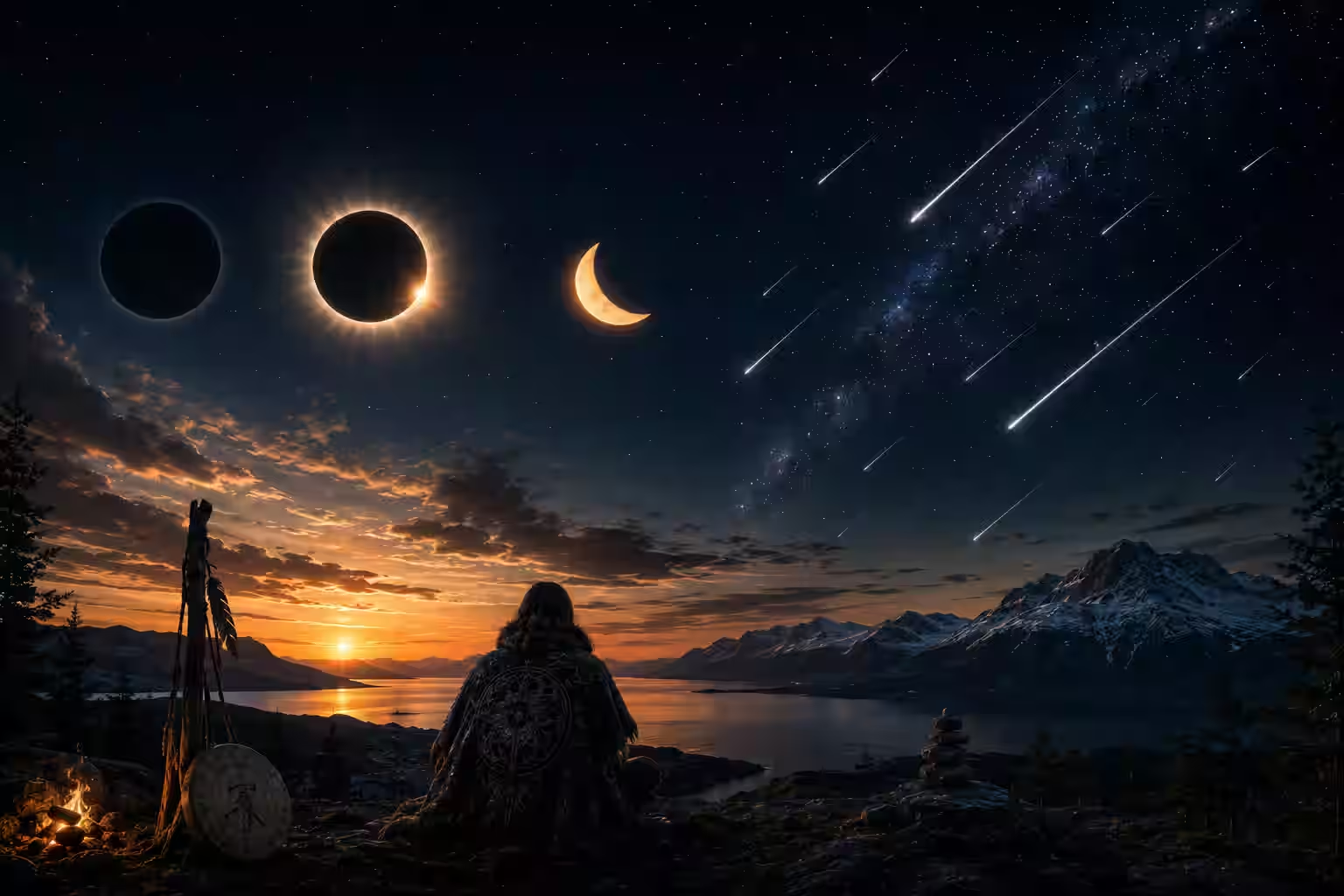
But no. The cosmos wasn't done. As evening falls and the eclipse has packed up its things and gone home, the sky throws yet another little trick our way: the Perseids, the year's most reliable meteor shower, peak on the night of 13 August (EarthSky, NASA Science). And because the Moon is still pretending it doesn't exist, being in its dark, resting phase, the sky tonight will be darker than it has been in an entire decade during this particular show (Wired). No moonlight interfering with the constellations. Just a full, undisturbed stage for debris from a comet burning up as it strikes our atmosphere at considerable speed.
Where the solar eclipse and the dark moon have spent the whole day urging us to take it easy, the Perseids turn up in the evening like that friend who insists you come out anyway, just for a bit, just to see something cool. The shooting stars plunge from the constellation Perseus at a rate of up to 100 per hour under good conditions (NASA Science), as though the universe decided that pure silence was getting a touch dull, and so threw in some fireworks at the end, purely for the mood.
They say you can make a wish when you see a shooting star. Tonight you'll get the chance roughly a hundred times, which statistically ought to be enough for at least one of your wishes to come true, though the universe has historically proven somewhat unreliable on delivery times.
My summary of a day that clearly couldn't make up its mind
As I see it, these aren't three random events that happened to land in the same calendar slot by accident, this is nature staging a proper little play for us, in three acts with no interval:
Act one: The dark moon asks us to stop. Act two: The solar eclipse underlines the point by actually switching off the light, in case we missed the hint in act one. Act three: The Perseids turn up in the evening and remind us that even in the deepest darkness, something beautiful keeps falling towards us, entirely free, without our even having to subscribe to anything.
Use the day consciously. Let this evening's eclipse become a moment where you truly feel what's finished and may be allowed to fall away, rather like when you finally delete an app you haven't opened in three years. And when darkness falls and the shooting stars begin streaking across Perseus, go outside, lie down somewhere with a clear view towards the north-east, let your eyes adjust to the dark for twenty minutes (yes, it really does take that long, the universe has no "skip intro" button), and look up (Space.com).
Don't perform rituals just yet, that's not for now, not until the first crescent moon reappears in a day's time. But let the shooting stars remind you of what you wish to carry with you into the next cycle.
Nature rarely calls out so loudly, or with such dramatic timing, as it does today. So whatever you believe: bring a blanket, go outside this evening, and look up. The universe has clearly put quite some effort into tonight's programme, and it seems a shame not to at least show up.
Sources: Time and Date, new moon; NASA Science, solar eclipse 12 August 2026; Wikipedia, Solar eclipse of August 12, 2026; EarthSky, the Perseids 2026; NASA Science, Prepare for Perseids; Sjamanistisk Forbund, the Moon