There are figures in Nordic folk belief that cannot be placed in clear categories. They belong neither wholly to the dead nor to the living, neither to the spirits of nature nor to the world of humans. They wander in the borderlands, in the twilight between night and day, between body and soul. Nattramn is one such figure.
The name alone carries darkness within it. “Natt” – the time when the boundaries between worlds grow thinner – and “ramn” – the raven, the bird that for millennia has been linked to death, wisdom and transformation in Nordic tradition. Together they form an image of something more than a mere creature; it is a phenomenon, a warning, a state of being.
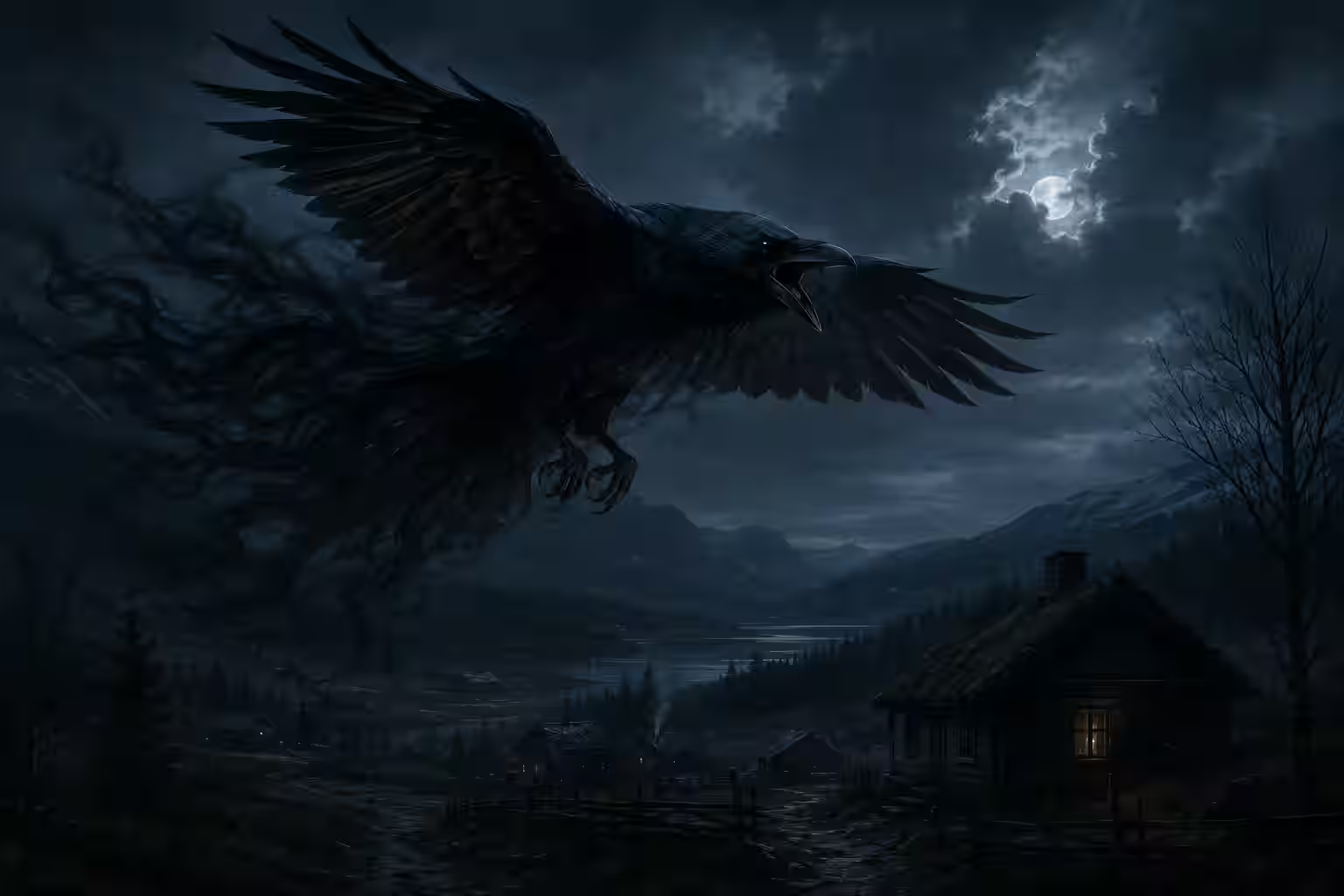
In Norwegian and Swedish folk belief, Nattramn is described as a soul in the form of a bird, often a raven, but not an ordinary bird. It is larger, darker, heavier in its presence. Its flight is not merely physical; it is an expression of a restless spirit. Nattramn is said to be a person who, in life, committed grave sins, or who has not found peace after death. In some tales it is a cursed soul, in others one who has chosen to break the laws of nature and society.
One could hear it before one saw it. A cry in the night, sharper than the raven's usual call, more piercing. Not merely a sound, but a feeling that settles in the body. People described it as a cold that came from within, as though something in one's own being answered the call. When Nattramn cried out, it often meant that something was about to happen. Misfortune, death, illness, or a disturbance in whatever held the world together.
It is in such beliefs that we find the core of Nattramn's role: not merely as a creature, but as a sign. In a world where nature, spirit and humankind were woven closely together, such signs were not random. They were part of a greater pattern. To hear Nattramn was to be reminded that the world is not stable, that there are forces moving beyond human control.
The tales vary from region to region. In some areas, Nattramn was linked to specific individuals: someone who had taken their own life, someone who had committed murder, or someone who had broken sacred laws. These souls found no rest, and instead had to wander in the shape of the night. The raven became their body, but not their home. They were trapped in a state of in-between.
Elsewhere, Nattramn was more closely tied to illness and madness. It was said that anyone who saw a Nattramn too closely, or upon whom its gaze fell, could fall ill. Not merely physically, but in mind. As though the encounter with this creature opened something in the person that should not be opened. Perhaps a reminder of how fragile the balance is between order and chaos, between reason and what lies beneath.
The raven has always held a dual meaning in Nordic culture. It is Odin's bird, Huginn and Muninn, thought and memory. It is messenger and observer. But it is also a carrion eater, one that lives off death. In Nattramn, these meanings merge into something more disquieting. Here, the raven is no longer a divine servant, but a disturbed manifestation of human suffering.
It is interesting to note how Nattramn differs from other creatures in folk belief. It is not like the draug, bound to the sea and drowned souls. It is not like the hulder, tied to nature's hidden realms. Nor is it like the revenant, which returns to particular places or people. Nattramn is more elusive, more unpredictable. It belongs to movement, to transition, to night itself.
In some traditions it was said that Nattramn could seek out people, not only as a threat, but as a kind of desperate contact. It could perch on the roof, by the window, or near the farmstead. Not always to cause harm, but to be seen. This opens up another interpretation: that Nattramn is not only a sign of evil, but also of suffering. A soul that finds no rest, that seeks recognition or reconciliation.
It is here that the tales become more human. For behind the notion of Nattramn lies a deep reflection on guilt, shame and consequence. What happens to a person who breaks the community's norms? What happens to one who is denied a grave, ritual or memory? In a society where rites of passage were essential, the absence of these could create unease, not only among the living, but also in the conception of the dead.
Nattramn can therefore be understood as a cultural way of processing the unresolved. It gives form to what cannot be explained: sudden deaths, mental afflictions, accidents without clear cause. It also offers a moral: actions have consequences, not only in life, but also after death.
But there is also a more esoteric reading. In certain traditions, particularly where shamanistic beliefs have had influence, Nattramn can be interpreted as a form of soul journey gone wrong. In many indigenous cultures there exists the idea that the soul can leave the body in dreams or rituals. This is a controlled process, guided by knowledge and intention. But what happens when this process is not controlled? When a person loses connection to the body, or cannot find the way back?
From this perspective, Nattramn may be a warning of the dangers of moving through the unseen worlds without sufficient insight. It becomes an image of a soul that has lost its anchoring. The raven, which can otherwise be a guide, here becomes a sign that something has gone wrong.
This also offers an interesting parallel to modern understandings of mental health. Many descriptions of Nattramn, the feeling of being trapped, of being divided between worlds, of not finding peace, can be read as metaphors for deep psychological unease. Folk belief gives these experiences an outer form, a story that can be shared and understood together.
Nevertheless, one should be careful not to reduce Nattramn to mere symbolism. For those who lived with these beliefs, it was real. Not necessarily in a physical, measurable sense, but as part of reality. It shaped how one interpreted events, how one acted, how one related to the night.
There are also tales of how one could protect oneself against Nattramn. In some areas it was said that one should avoid answering its cry. To answer might be to acknowledge it, and thereby open a connection. Others believed that one should use particular words, prayers or rituals to keep it away. In a Christian context, the sign of the cross was used, while older traditions might include more local practices.
These protective strategies tell us something important: that humankind was not merely passive in the face of the unknown. There were ways to act, ways to create safety. Even faced with something as unsettling as Nattramn, there was a sense that one could do something.
Today Nattramn lives on, but in another form. It appears in literature, music and popular culture. It is used as a symbol of darkness, of alienation, of that which cannot be tamed. But it often loses some of its original complexity. It is reduced to a monster, a figure of horror.
Yet there remains a deeper resonance that can still be felt. When one stands alone in the forest at night, and hears a raven cry in the distance, it is not hard to understand how such beliefs arose. It is not only fear, but a feeling that one is part of something greater, something that cannot be fully understood.
Nattramn reminds us that humankind has always lived in relation to the unknown. It is an expression of a time when the world was more porous, more open to that which could not be explained. But perhaps it is also a reminder that this porosity has never entirely disappeared.
For even in a modern world, shaped by technology and science, there are moments when the boundaries feel thin. Dreams that feel more real than the day. Moments of intense unease without clear cause. The feeling of being watched, even when one is alone.
Perhaps it is in these moments that Nattramn still lives. Not necessarily as a bird in the night, but as an experience, a mood, a shadow in consciousness. It reminds us that there are aspects of humankind and the world that cannot be fully controlled or understood.
And perhaps that is precisely why it still fascinates. Not because we believe in it as people once did, but because it points to something that remains true: that we are not always master of our own boundaries. That there are states in which we lose ourselves, in which we become something else, something foreign.
Nattramn is not merely a creature from the past. It is a tale of humankind's relationship with darkness, both outer and inner. And as long as this relationship exists, Nattramn too will have a place in our world of imagination.
Sources
Gunnar Olof Hyltén-Cavallius, Wärend och Wirdarne.
Julius Ejdestam, Svenskt folklivslexikon.
Ørnulf Hodne, Norsk folketro.
Ørnulf Hodne, Mystikk og magi i norsk folketro.
Carl-Herman Tillhagen, Fåglarna i folktron.
Ingvar Svanberg, Fåglar i svensk folklig tradition.