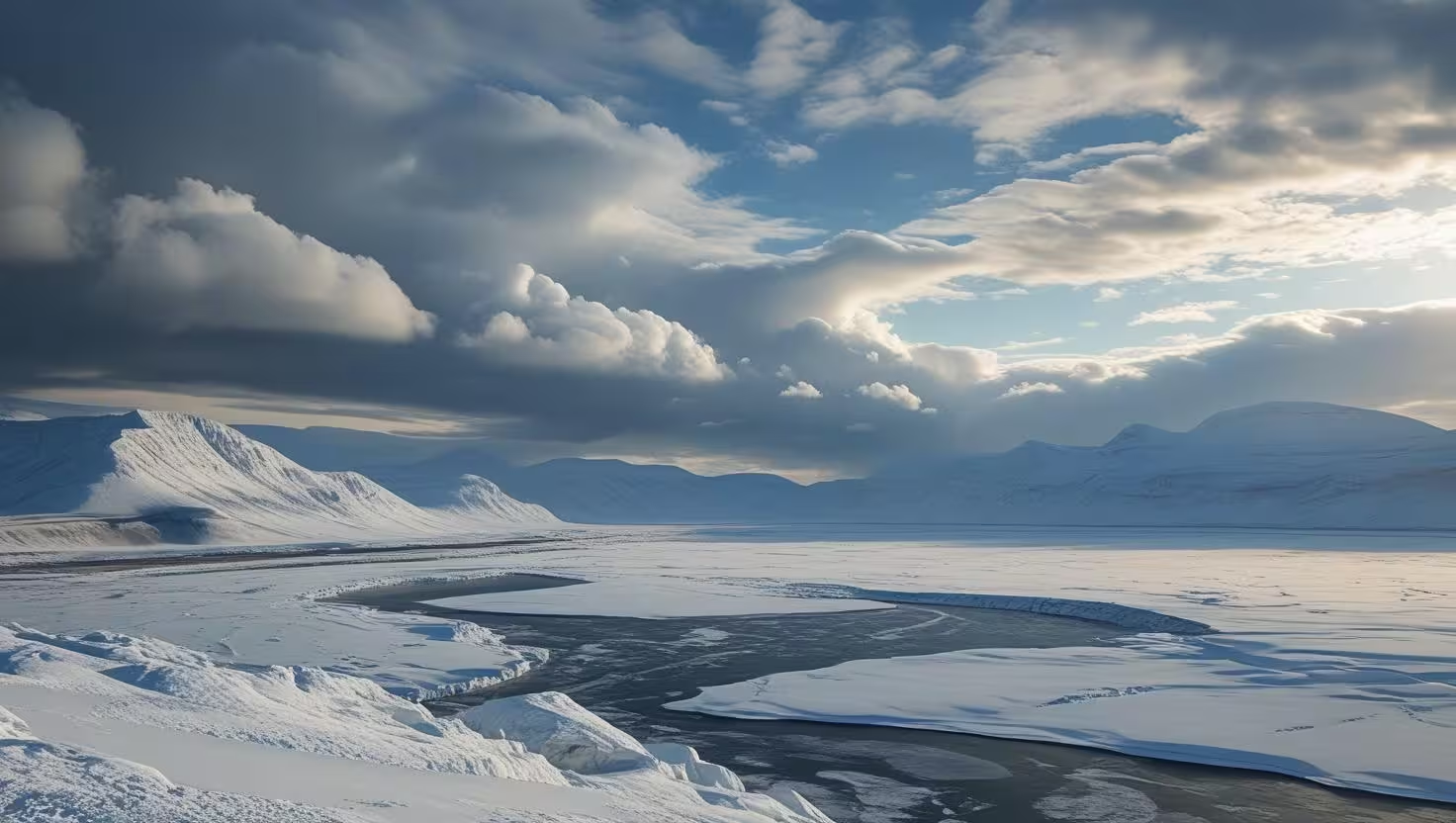
In the ice-cold north, where the sun leaves the sky for months at a time, the Nganasan people have survived and shaped their unique culture for thousands of years. The Nganasan are the world's northernmost living people, settled on the Taymyr Peninsula by the Arctic Ocean in Siberia. They belong to the Samoyedic branch of the Uralic peoples and have a long tradition of spiritual practices, in which the shaman stands at the center of society and mythology. At the same time, in modern genetics we find traces of a shared past with the Sámi – a kinship that also manifests itself in similar myths and beliefs, even though the distance is great both geographically and culturally.
The Nganasan people
The Nganasan have always been a people on the move – first as nomadic hunters and fishers, later as reindeer herders settled in permanent villages by the Soviet authorities. They traditionally lived off wild reindeer, but eventually had to adapt to a life with domesticated reindeer in order to survive in a changed society. Their language, Nganasan, belongs to the Uralic language family and is today severely endangered.
The Nganasan are divided into two main groups: the Avam on the western side of the Taymyr Peninsula and the Vadeyev on the eastern side and the tundra. Traditionally they have lived in close family groups, where cooperation and community have been necessary to survive in one of the earth's most inhospitable environments.
Shamanism – more than religion
Shamanism is more than a religion for the Nganasan – it is a living practice that binds together people, spirits and nature. The shaman, who in Nganasan is often called ngamta, is a bridge-builder between worlds. He or she has the ability to journey to the spirit world, heal illness, foretell the future and ensure that the community keeps balance with nature.
The shaman receives their power through visions, dreams and initiation rituals. It is said that a shaman is often chosen by the spirits themselves, often through illness or unusual events in childhood. During the initiation the candidate must undergo physical and spiritual trials, often with help from an experienced shaman as a mentor.
Rituals and spiritual practices
Nganasan shamans perform a range of rituals, from healing and divination to spiritual dances and offerings. A central element is the spirit dance, in which the shaman leads the community in a circle around a fire or in the tent. The drum is used to induce trance, and its rhythm resembles a heartbeat – a symbol of life and the connection between people and spirits.
During the dance the shaman enters a trance, in which he or she journeys to the spirit world to seek advice, heal or predict the future. The dance can last several hours, and the entire community takes part actively, creating a shared spiritual energy.
Offerings are also an important part of Nganasan shamanism. Animals, especially domesticated reindeer, are sacrificed to spirits and gods to ask for prosperity, good weather or health. The offering is often carried out in connection with important life events such as birth, illness or before an important hunt.
Myths and beliefs
The Nganasan have a complex mythological universe, in which spirits and gods play a central role. They believe in several Mothers – such as Mother Earth, Mother Sun, Mother Water and Mother Fire – who created the world and govern its cycles. These Mothers are so powerful that humans cannot communicate directly with them; instead the shaman uses lesser spirits as intermediaries.
A central myth concerns the Sun Spirit, who leaves the sky during the long polar night and returns when spring comes. The return of the Sun Spirit is celebrated with great joy and rituals, and the stories about the Sun Spirit are important for explaining the passing of the seasons and humanity's place in nature.
The Nganasan also have a number of taboos and prohibitions, especially tied to hunting and the role of women. Women are considered magically dangerous because of menstruation and must avoid touching hunting equipment or entering the sacred part of the tent where the shaman's objects are kept.
A day in the life of the shaman
A typical day for a Nganasan shaman might begin by consulting the spirits about an upcoming hunt or illness in the family. The shaman uses the drum to come into contact with the spirit world, and during trance can journey to the underworld or the sky to seek advice.
When someone in the community is ill, the shaman is called upon to heal. He or she may use song, dance, drumming and offerings to drive out the spirit of the illness. The shaman can also use small dolls dressed in shaman's clothes, called koyka, to divine or receive messages from the spirits when the shaman is not present.
The shaman also has the responsibility of maintaining the community's moral and spiritual balance. He or she must ensure that taboos are not broken, and that the community lives in harmony with nature and the spirits.
DNA and mythological parallels
DNA research has shown that the Sámi and the Nganasan share a common genetic background from Siberia. The Nganasan have the largest proportion of "Siberian genes" among all European peoples, but the Sámi too have a significant share of this heritage. This is because the Uralic peoples, including the Sámi and the Nganasan, have a common origin in Siberia, and because there has been migration and exchange between these groups over thousands of years.
The genetic kinship is also reflected in language and mythology. Both the Sámi and the Nganasan belong to the Uralic language family, and their mythologies have many features in common, such as the belief in several parallel worlds, central sun deities and important spiritual intermediaries – shamans.
Worldview and spiritual worlds
Both the Nganasan and the Sámi believe in several parallel worlds. For the Nganasan it is first and foremost the Mothers (Mother Earth, Mother Sun, Mother Water, Mother Fire) who govern the world, while the Sámi have a complex universe with gods for the sun, thunder, wind, hunting and death. Both peoples have an animistic faith, in which nature is ensouled by spirits and gods.
The sun god and the passing of the seasons
For the Nganasan, the Sun Spirit is a living force who leaves the sky in winter and returns in spring. The return of the Sun Spirit is celebrated with rituals and stories. The Sámi also have a central sun god, Beaivi, who gives life and growth. The reindeer, which is vital for both peoples, is said in Sámi mythology to have come to the earth along the sun's rays.
The shaman as intermediary
The shaman plays a central role in both cultures. For the Nganasan the shaman is a bridge-builder between people and spirits, with the ability to journey to the spirit world and heal illness. The Sámi have their noaide, who can also journey to the spirit world, divine and heal. Both use the drum and dance to enter trance and communicate with the spirits.
Offerings and rituals
Offerings are important in both cultures. The Nganasan sacrifice domesticated reindeer to the Mothers to ask for prosperity and health. The Sámi also sacrifice animals, especially reindeer, to the gods to ask for prosperity and luck. Both peoples have rituals tied to important life events such as birth, illness and death.
Taboos and prohibitions
Both the Nganasan and the Sámi have strict taboos tied to hunting, the role of women and sacred places. For the Nganasan, women are magically dangerous during menstruation, and must avoid touching hunting equipment or entering the sacred part of the tent. The Sámi also have taboos tied to hunting and the role of women, and respect sacred places and objects.
Nganasan mythology
Nganasan mythology concerns the Mothers who created the world and govern its cycles. The journey of the Sun Spirit is a central myth, and the stories about her explain the passing of the seasons and humanity's place in nature. There are also myths about animals, especially the reindeer, the wolf and the bear, who have supernatural qualities and can communicate with humans.
Sámi mythology
Sámi mythology concerns gods such as the sun god Beaivi, the thunder god Horagállis, the wind god Bieggolmmái and the hunting god Leaibolmmái. There are also female gods such as Máttaráhkká, who creates the human body, and her daughters Sáráhkká, Juksáhkká and Uksáhkká, who help with birth and life in the home. The Sámi also have myths about the creation of the world, animals and mythical beings.
Shared features and differences
Both peoples have an animistic faith, in which nature is ensouled by spirits and gods. They have central sun gods, important spiritual intermediaries (shamans/noaide) and rituals tied to the seasons and life's important events. The differences lie in the details: the Nganasan have a more hierarchical system with Mothers who govern the world, while the Sámi have a more diverse universe of gods with both male and female deities.
References
Nganasan people – Wikipedia https://no.wikipedia.org/wiki/Nganasanere Provides background on the Nganasan people, their history, society and contact with the outside world.
Nganasan Folklore: Tribes And Tales Beyond The Polar Circle https://memorycherish.com/nganasan-folklore/ Describes Nganasan folklore, shamanic rituals and myths.
Ancient DNA shows the Sámi and Finns share identical Siberian genes https://www.helsinki.fi/en/news/life-sciences/ancient-dna-shows-sami-and-finns-share-identical-siberian-genes Presents genetic research showing kinship between the Sámi, Finns and Nganasan.
Genetic studies on Sami - Wikipedia https://en.wikipedia.org/wiki/Genetic_studies_on_Sami Reviews genetic studies of the Sámi and their relationship to other Uralic peoples.
The Nganasans. Spiritual Culture (Mythologies, Traditional Beliefs) https://atlaskmns.ru/page/en/people_nganasany_spirit.html Provides a detailed description of Nganasan mythology, belief and rituals.
Samisk religion - Religion og etikk - NDLA https://ndla.no/r/religion-og-etikk/samisk-religion/940fbcf754 Describes Sámi religion, myths, gods and rituals.
Samisk religion - Religioner.no https://religioner.no/ressurser/fagartikler/samisk-religion/ Reviews Sámi religion and mythology.
Samiske mytiske fortellinger https://samiskeveivisere.no/article/samiske-mytiske-fortellinger/ Presents Sámi myths and creation stories.
Reconstructing the Genetic Relationship between Ancient and Modern Siberian Populations https://pmc.ncbi.nlm.nih.gov/articles/PMC10999361/ Reviews genetic kinship between the Nganasan and other Siberian peoples.
The Western and Eastern Roots of the Saami—the Story of Genetic "Outliers" https://pmc.ncbi.nlm.nih.gov/articles/PMC1181943/ Reviews genetic kinship between the Sámi and Siberian peoples.
Samisk religion/Sami religion - Travel-North https://travel-north.no/samisk-religion/ Reviews Sámi religion and mythology.
Ancient Fennoscandian genomes reveal origin and spread of Siberian ancestry in Europe https://www.nature.com/articles/s41467-018-07483-5 Reviews genetic kinship between the Sámi, Finns and Siberian peoples.
Nganasan people - Wikipedia https://en.wikipedia.org/wiki/Nganasan_people Provides background on the Nganasan people, their history, society and genetics.