Niflheim, the foggy and ice-cold world of Norse mythology, is a place filled with mystique and symbolism. As one of the nine worlds in the Yggdrasil cosmology, Niflheim plays a decisive role both in the creation of the universe and as a resting place for souls. Through the sagas and the Eddic poetry, this realm has been portrayed as a source of both life and death, with a dualistic nature that mirrors the balance between destruction and regeneration. Niflheim is not necessarily a gloomy place – it is rather a manifestation of nature's cyclical processes, where cold and fog function as metaphors for introspection and transformation.
Niflheim's geography and cosmology
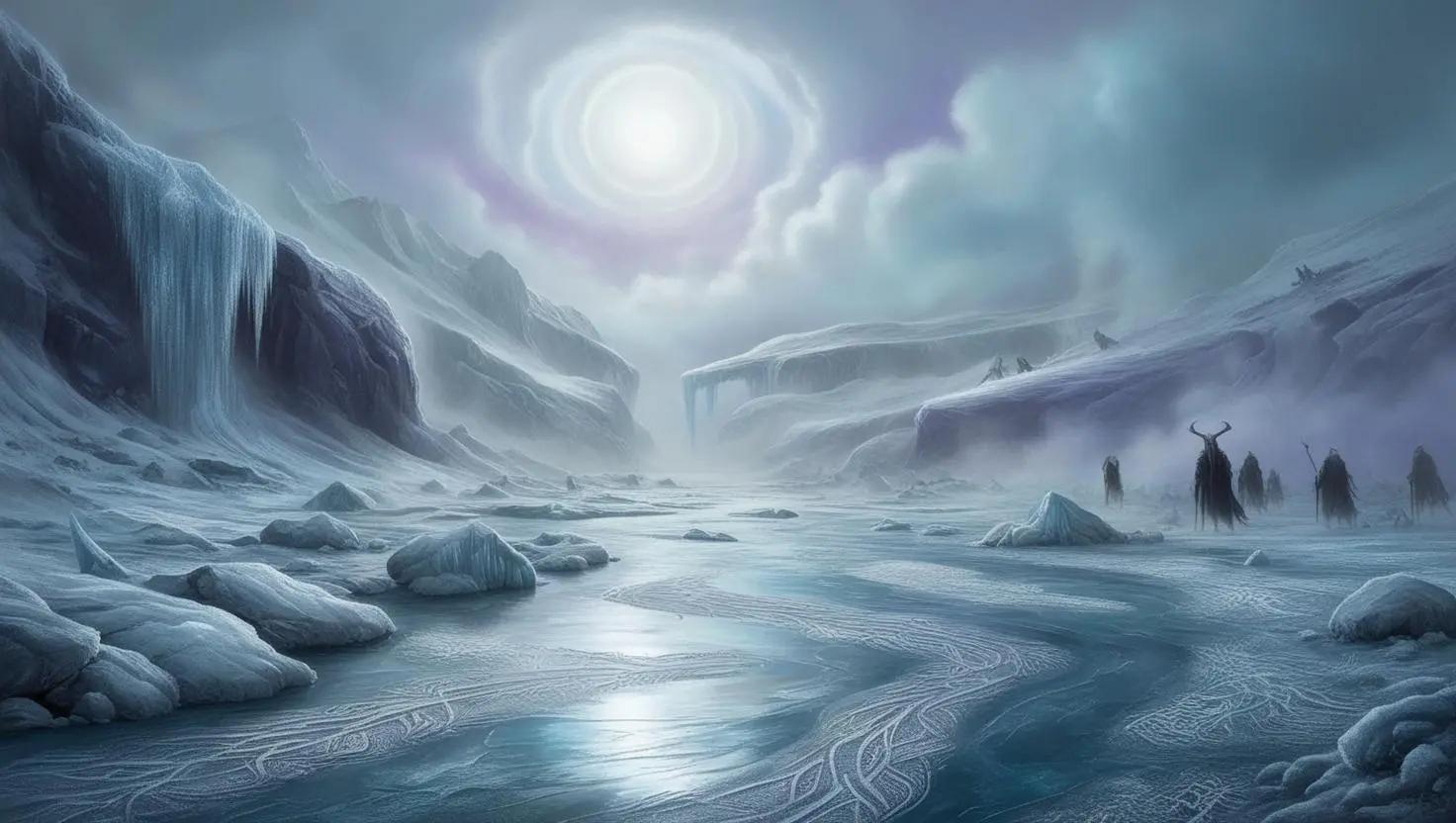
Niflheim is the oldest of the Norse worlds, created before time itself. In Gylfaginning it is described as a world filled with fog and ice, located north of Ginnungagap – the vast emptiness between worlds. In contrast to the flaming heat of Muspelheim in the south, Niflheim represents cold, stillness and the primordial darkness. These two opposing forces met in Ginnungagap, where their interplay created the first being of life: Ymir, the primordial giant.
Hvergelmir, the boiling spring in Niflheim, is a central part of this world. From Hvergelmir flow eleven rivers known as Élivágar, whose waters are filled with ice and frost. These rivers have names such as Svol, Gunnthra and Fimbulthul, and their streams nourish the roots of Yggdrasil, the world tree. Hvergelmir symbolizes the source of life in a world marked by cold – a paradox that underlines Niflheim's dualistic nature.
Beings and deities in Niflheim
Under the root of Yggdrasil that stretches into Niflheim we find the dragon Nidhogg. This creature gnaws tirelessly at the roots of the world tree, an act that symbolizes the constant presence of destruction in the cosmos. Nidhogg also feeds on the corpses of the dead who have committed serious sins, which shows how Niflheim also functions as a place of karmic balance.
Another important figure in Niflheim is Hel, the goddess of death who rules over the realm of the dead. Hel is the daughter of Loki and has a dualistic appearance: half of her body is beautiful and living, while the other half is dead and rotting. This makes her a perfect representation of the cycle between life and death. In her halls she receives the souls who did not die honorably in battle – those who fell to illness or old age. Hel's realm is not necessarily a gloomy place; it is rather a resting place where souls can find peace after the hardships of life.
Hel herself reflects nature's cyclical processes: she represents both ending and beginning, the stillness of death and the potential for new birth. This makes her a deeper and more complex figure than the demonized character she is often portrayed as under Christian influence.
Niflheim's role in the cosmos
Niflheim's role in creation goes far beyond being a passive ice desert. Through the interplay between the ice from Niflheim and the fire from Muspelheim arose not only Ymir, but also the cow Audhumla, whose milk nourished the primordial giant. Audhumla licked the salt from the blocks of ice in Ginnungagap, whereupon Buri – the forefather of the gods – emerged from the ice.
This creation myth illustrates how opposing elements can lead to new life through conflict and interplay. Niflheim thus becomes a symbol of creative destruction – a necessary process for the universe to be able to develop.
Shamanic perspectives on Niflheim
From a shamanic standpoint, Niflheim can be interpreted as a metaphor for the inner landscape the shaman explores during trance or spiritual journeys. In Norse practice, techniques such as útiseta (meditation under the open sky) were crucial for coming into contact with worlds such as Niflheim. Practitioners of Seidr used the elements of nature – the cold, the fog and the sound of trickling water – to open portals to other dimensions.
Niflheim's fog was seen as a veil between worlds, where the Volva or the Seidman could communicate with the spirits of the ancestors or draw wisdom from the springs of primordial time. Hvergelmir was interpreted as a metaphorical source of collective memory; here one could "drink" of the wisdom of the past.
An important part of shamanic work was to confront the darkness represented by figures such as Nidhogg or Hel. This was seen as a form of psychological integration – meeting one's own shadows in order to achieve balance. Hel's dualistic nature mirrors this process: she shows how the end of life can also be the beginning of something new.
Modern interpretations of Niflheim
In modern times, scholars have begun to reconsider the traditional perception of Niflheim as a gloomy place marked by suffering. Under the influence of Christianity, both Hel and her realm were often demonized, but more recent studies show that these mythological elements had far more complex roles in Norse culture.
Niflheim can be understood as a place of introspection and regeneration – a space where souls are given time to rest before they continue in the cycle between life and death. This resonates with modern therapeutic methods that use cold exposure for mental strength or isolation for reflection.
Hel also appears in a new light: she is not only the mistress of death, but also a guardian of balance between the various stages of life. Her dualistic face reminds us that death is not necessarily the end; it is rather a transition to something else.
Niflheim is far more than just a world filled with ice and fog; it is a symbolic landscape where the cycles of life play out through the balance between destruction and regeneration. Through its role in creation, Niflheim shows how opposites can lead to creativity, while its connection with Hel underlines the importance of accepting both the light and dark sides of life.
From a shamanic perspective, Niflheim functions as a metaphorical space for introspection and healing, where one can confront one's own shadows and find balance. Modern interpretations show how this realm still has relevance – not only within mythology, but also within psychology and spirituality.
Snorri Sturluson: Gylfaginning (13th century)
Hrafnagaldr Óðins (probably a younger Eddic poem)
Brink, N.: Shamanism in Norse Myth and Magic (2025)
Mitchell, R.: Niflheim in Norse Mythology (Ancient Origins, 2022)
Prose Edda (translated by Faulkes, 1987)
Lindow, J.: Norse Mythology (2001)
Poetic Edda (Anonymous, 13th century)