Nøkken: the guardian at the water's edge
There is something about still water that will not leave us in peace. A lake at evening, its surface lying smooth and dark, mirroring the sky as though it were another place, a place you cannot reach with your hands: there is something there that draws the eye downward, something that makes you instinctively hold your children closer and keep your feet upon dry land. In the Nordic world of belief, this unease had a name: Nøkken.
He has lived in the rivers, lakes, tarns and waterfalls for as long as there have been people to remember him. He was not created by one person's imagination or one nation's mythology, but by something far older: a shared inheritance from the Germanic peoples that stretched from Iceland in the north-west to the German lowlands in the south. The Norwegian nøkk, the Swedish näcken, the Danish nøkke, the Icelandic nykur, the Finnish näkki, and the German Nixe or Nix, the Anglo-Saxon nicor: all spring from the same root, as documented in the Wikipedia article on nixies. The Old Norse nykr leads us further back to the Proto-Germanic nikwus or nikwis(i), which, by all accounts, meant "to wash" or "to bathe", or perhaps simply "water monster", as set out on Nightbringer.se. Related to the Anglo-Saxon nicor and the Old High German nihus, the word carries within it an echo of something ancient and slippery, something that belongs to the depths.
The belief appears in Icelandic sources from the 1100s, among them Landnámabók, as Superprof.no points out. In Old Norse literature, the word nykr occurs rarely, but where it does, it is used, among other things, as a translation of the Latin hippopotamus: the great beast that rules the water. An old Old Norse treatise on verse states, as the Swedish Wikipedia article on Näcken records, that "Nøkken takes many forms". This is perhaps the shortest and most precise characterisation of this being: he is not a fixed form, but a possibility, a movement beneath the surface.
The terrifying and the enchanting
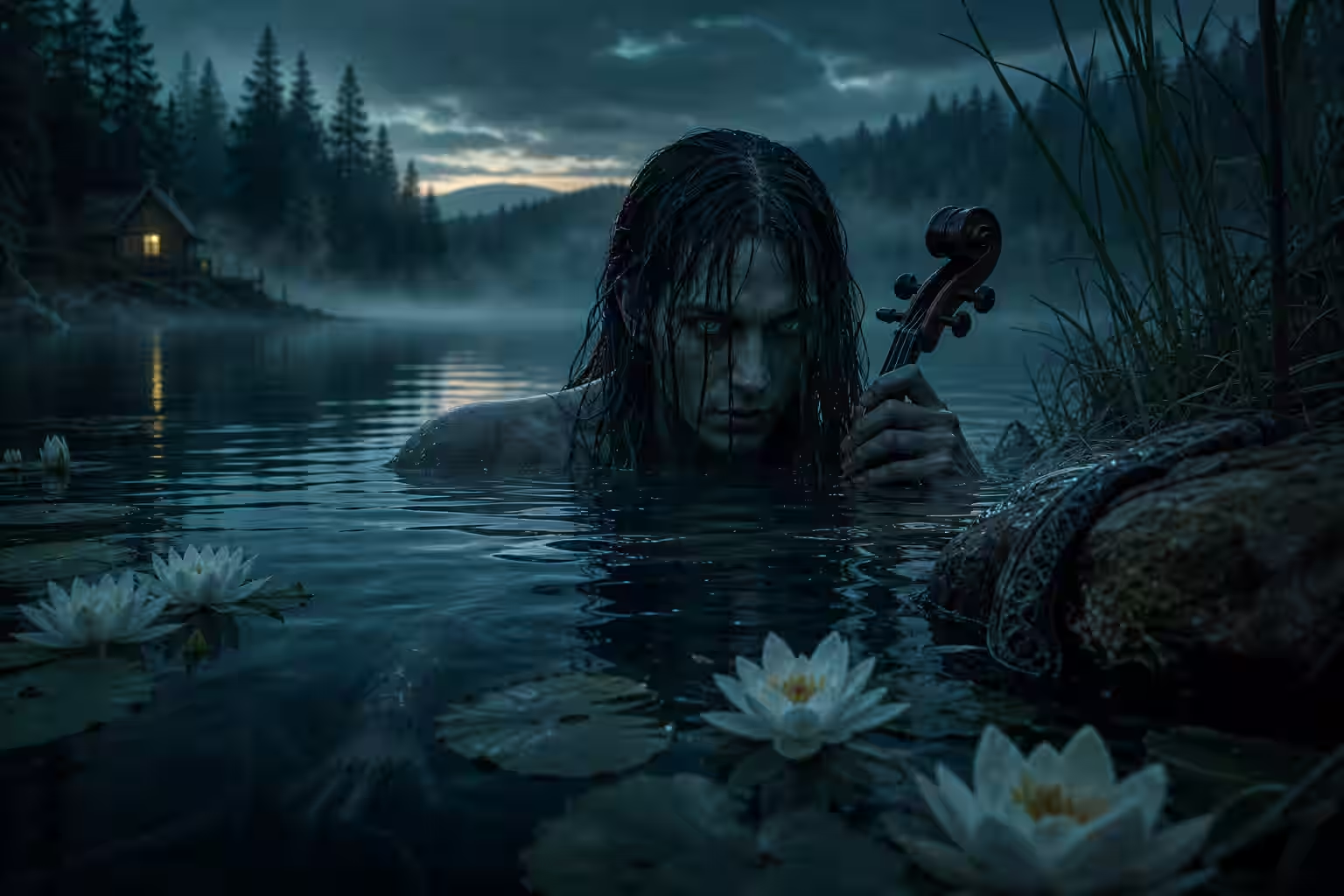
When one meets Nøkken in the oldest legendary traditions, it is not beauty one sees. Andreas Faye, the Norwegian priest and collector of folklore who published Norske Sagn in 1833 (Norway's first work of folklore) and later Norske Folke-Sagn in 1844, depicted him as a being to shudder at: long hair, a beard, eyes that stared as though they belonged to something not human, and water dripping from his entire body. He was always male, never female. He dwelt wherever fresh water gathered: in lakes, rivers, tarns, waterfalls, the dark streams that cut through the forest.
But Nøkken was not merely frightening. He was alluring in a way that is difficult to separate from danger. He played the fiddle, or the harp, or the flute, depending on which tradition one listens to, and his music was of a different order than that which human hands could produce. According to the Institute for Language and Folklore (isof.se), he could play in such a way that people could not stop dancing until the sun rose again. The music was a trap disguised as pleasure, a promise of something unearthly beautiful that made the feet forget they belonged to a human being.
It was especially dangerous to approach water after sunset. As Faye recorded in Norske Folke-Sagn (1844), Nøkken was harmless in daylight; it was night and dusk that were his hour. Women and children were most at risk, but male fiddlers might nonetheless choose to seek him out. This required courage and sacrifice. According to isof.se, anyone who wished to learn Nøkken's art of playing had to meet him by a stream on three consecutive Thursday nights and bring something of value: a black cat, three drops of one's own blood, or spirits. After completing the ritual, one had become a master of the fiddle, but rumour would forever whisper that one "had been with Nøkken". The price of the music was never simply the music.
He who changes shape
What makes Nøkken something more than an ordinary figure of fright is his ability to become something else. He is not confined to one body or one appearance. Faye describes in Norske Folke-Sagn (1844) a range of forms he can take: a handsome young man, a floating log, gold jewels glittering in shallow water, a half-sunken boat, or water lilies drifting quietly on the surface. As the Norwegian Wikipedia points out, it is precisely this ability to change shape that is most dangerous about him, for you never know what you are looking at.
One of his best-known forms is the bäckahästen, the brook horse: the beautiful grey or white horse that suddenly appears at the water's edge, looking tame and peaceful. In Iceland this form is called hnikur, and the Wikisource article on Nøkken tells us that the beautiful grey horse tries to lure people onto its back before racing them out into the depths. There is a grotesque logic to how the horse form works: children, in particular, do not need to be asked twice. According to isof.se, Nøkken's back always grew long enough for every child who wanted to climb on to find room, however many there were. The back simply grew longer, and longer, and longer, and none of them had any idea what awaited them as the horse broke the surface and vanished beneath it.
There is a term in Norwegian-Nordic tradition called nøkkabitt: wounds attributed to an attack by Nøkken. These wounds, people told one another, never fully healed. As isof.se documents, something always remained after an encounter with the water, an unease that could not be cured.
Protection and boundaries
People who lived near water never lived without fear of it. But the fear was not passive; it was equipped with rituals and formulas. As Faye records in Norske Folke-Sagn (1844), it helped to call out Nøkken's own name, to throw steel or a knife into the water, or to spit ahead of oneself when passing a tarn after nightfall. The best-known protective phrase runs:
Nyk! Nyk! Needle in water! The Virgin Mary cast steel into water! You sink, I float!
The formula is fascinating for several reasons. It blends pagan and Christian worlds of belief: Nøkken's ancient name and the Virgin Mary's intervention in a single breath. It tells us that Nøkken was not merely a stranded medieval memory, but a living part of the daily reality of the Christian peasant population, adapted and reshaped, but never entirely driven out.
Every year Nøkken demanded his sacrifice. According to Faye (1844), as recorded on Wikisource, he warned of an approaching drowning by calling out hollowly and dreadfully across the water: "Sæt over!" ("Cross over!") It was a call that was never answered. He was especially greedy for unbaptised infants, those who had not yet found their place in the Christian order of the world, and for small children who played too close to the edge.
The Swedish folklorist Jochum Stattin has argued, in research published in the journal Temenos and reproduced via journal.fi, that water beings such as Nøkken are not primarily expressions of supernatural belief, but of something far more socially concrete: they mark and enforce boundaries in the landscape. Water was dangerous: people drowned in it, animals disappeared into the bogs, crops were destroyed by flood. Nøkken was the cultural tool that translated this danger into a form people could relate to, tell stories about, and protect themselves against.
Water as a threshold place
To understand Nøkken fully, one must understand what water meant in the Nordic world of belief. As research reproduced via folklore.ee and in studies connected to Stefan Brink's work at the University of Aberdeen shows, water was regarded as a liminal space: a threshold place, a borderland between the world of the living and the world of the dead. The surface of a tarn was not merely a physical boundary between air and water. It was the boundary between here and somewhere else, between the known and that which lay beyond the human.
Nøkken was the guardian of this threshold. He existed where the human world met something other and inexplicable. This is why it does not suffice to think of him merely as a monster; he is something more precise than that. He is the personification of the fact that water does not belong to us, that we are guests at the water's edge, and that the depths have their own laws.
Kittelsen, Faye and romanticism's transformation
No one has depicted Nøkken more unforgettably than Theodor Kittelsen. His famous portrayal from 1904, a being with luminous eyes slowly raising its head out of a tarn, surrounded by the white flowers of the water lilies, has become the very icon of the belief, as the National Museum and theodorkittelsen.no document. But Kittelsen was not merely an illustrator; he was an interpreter. In Troldskab from 1892, which drew directly on Faye's collection of legends, he added a new and chilling element: Nøkken may lie hidden within a shining water lily, and as theodorkittelsen.no quotes Kittelsen's own words: "scarcely have you touched it before the floating bog sinks beneath you, and then he seizes you with his wet, slimy hands."
It is a sentence that lingers. It renders the flower dangerous, beauty itself a trap. And it is no coincidence that it is precisely the water lilies, the white tarn lilies of the genus Nymphaea, that bear Nøkken's name. They received their Norwegian folk name from him. The flower was scientifically described by Richard Anthony Salisbury in 1805, under the family Nymphaeaceae, as theodorkittelsen.no points out, but in the poetry of the Norwegian name Nøkken lives on: the nøkkerose is Nøkken's rose, the beauty that conceals the abyss.
In Sweden, Nøkken, there called näcken, underwent a remarkable romantic transformation in the 1800s. Where folklore's terrifying figure with dripping hair and piercing gaze met the artists, he was transformed into something else: a naked, handsome young man sitting on a stone in a stream, playing the fiddle against the evening light. As the DIVA portal documents in the study Näcken och nationalromantiken, this transformation was not merely aesthetic; it was ideological. Romanticism took a folk figure of fright and turned it into a symbol of nature's wild, free power, something that escaped the grip of civilisation. He became beautiful because nature was meant to be beautiful, because the wild and untamed became an ideal.
But the disquiet within Nøkken did not vanish; it was merely reshaped. The naked violinist is not safe. He is still Nøkken.
What Nøkken tells us
Nøkken is not gone. He lives in the unease we feel by still water, in the instinct that tells us we do not quite know what lies beneath the surface. He lives in the Norwegian water lily, in Kittelsen's eyes staring up at us from the darkness of the tarn, in the vague dread many feel when swimming alone and their feet no longer touch the bottom.
But he also tells us something important about the relationship between people and nature, something we may need to hear. He reminds us that nature is not a backdrop or a resource, but a force with demands of its own. That the rivers and lakes and tarns were places where people encountered something unpredictable, something that would not bend to human will. That those who lived near water had to live with it in a different way than we do today: not as masters, but as guests who knew they might lose their footing at any moment.
Nøkken is a portrait of that fear, and of the respect that grows out of fear. He is the watchdog of the Nordic landscape, the invisible boundary between what we own and what we shall never own. And he sits there still, silent, beneath the white flowers of the water lilies, waiting for someone to come too close.