In June, Pride is celebrated all over the world as a marking of love, freedom, and diversity. Sjamanistisk Forbund has a concrete commitment to understanding and including LGBTQ people, and to building a faith community where everyone can be fully themselves, both spiritually and as human beings. This is in keeping with shamanism's fundamental respect for the diversity of nature and of humanity, and conveys a strong message that everyone has a natural place in the community.
Shamanism reminds us that we are all a part of nature, and that nature itself is diverse, creative, and boundless. This message is just as relevant today, both for spiritual seekers and for everyone who wishes to celebrate Pride and the diversity of human life.
Diversity in shamanic traditions
Shamanism is one of the world's oldest spiritual practices and exists in various forms across the globe. Common to most shamanic traditions is the belief that everything in nature has a spirit or energy, and that human beings are part of a larger, living network. This worldview opens the way for an inclusive understanding of diversity, including when it comes to gender and sexuality.
Gender and sexuality in shamanic practice
In many Indigenous cultures, shamans have often held roles that break with society's usual gender norms. For example, in several traditions it has been accepted, or even seen as particularly powerful, for shamans to be what we today would call queer or gender-nonconforming. This is especially true in societies where there are concepts such as "two-spirit" (among certain North American Indigenous peoples), which describes people who unite both masculine and feminine qualities, and who have often held important spiritual roles.
In Norse shamanism, known as seiðr, it was particularly women (vǫlva and spákona) who practiced magic, but there were also men who practiced it. These men could be seen as "unmanly" or feminine, something that could both give them status as magical and also make them outsiders in an otherwise masculine Viking society. This shows that gender-transcending roles have existed in shamanic practices, and that these have often been associated with spiritual power.
Modern shamanism and LGBTQ
In more recent times, shamanism has been taken up by many who seek alternative spiritual paths, including LGBTQ people. Artists and spiritual leaders such as Desire Marea from South Africa have used shamanic expression to explore and celebrate queer identity, and to create space for healing and freedom. Marea describes their music and shamanic practice as explicitly queer-political, and believes that spiritual freedom and sexual freedom are connected.
Sjamanistisk Forbund's work for inclusion
Since its founding, Sjamanistisk Forbund has been clear about wanting to be a faith community for the whole person, regardless of gender or sexual orientation. As early as 2013, the association was granted the right to marry same-sex couples (at that time, permission was required), and the following year it conducted its first wedding of a same-sex couple. Even so, it has acknowledged that the theme of gender and sexual diversity has not always received enough space in its work and communication.
To strengthen its understanding and practice around LGBTQ issues, Sjamanistisk Forbund took the course Rosa kompetanse (Pink Competence) in 2021, offered by FRI – the Norwegian Organisation for Sexual and Gender Diversity. The course provides insight into the challenges LGBTQ people face in society, and focuses on how to meet all people in an inclusive and respectful way. This includes, among other things, preventing discrimination, creating safe spaces, and respecting people's own choices of pronoun and identity.
Shamanic perspectives on gender and sexuality
In shamanic traditions around the world, there has often been room for gender and sexual diversity. Many Indigenous peoples have recognized people who break with traditional gender roles as bearers of special spiritual power, for example through concepts such as "two-spirit" in certain North American cultures. Norse shamanism, too, contains examples of both women and men holding roles that challenged the gender norms of their time.
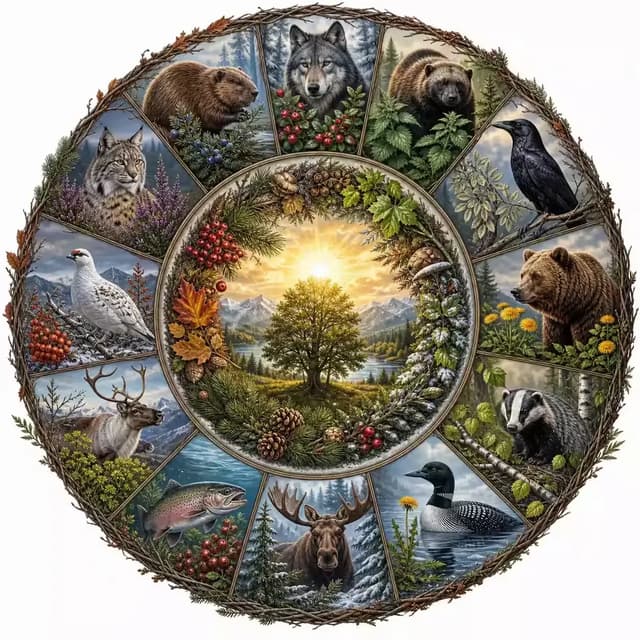
Shamanism sees nature as a diverse and living system, in which variation is a strength. This applies to gender and sexuality as well, nature itself shows us that diversity is natural. In the animal and plant worlds there are many examples of non-binary gender expression and homosexual behavior, which in shamanic thinking is interpreted as a confirmation that all forms of identity have their place in the whole.
LGBTQ and the mirror of nature
Shamanism teaches us that we are a part of nature, and that nature's diversity mirrors the diversity among human beings. Animals and plants that break with familiar gender roles or live in same-sex pairs are often seen as symbols of wisdom, strength, or balance. This gives LGBTQ people a natural place in the spiritual community, and many modern shamanic circles work actively to include and lift up queer voices.