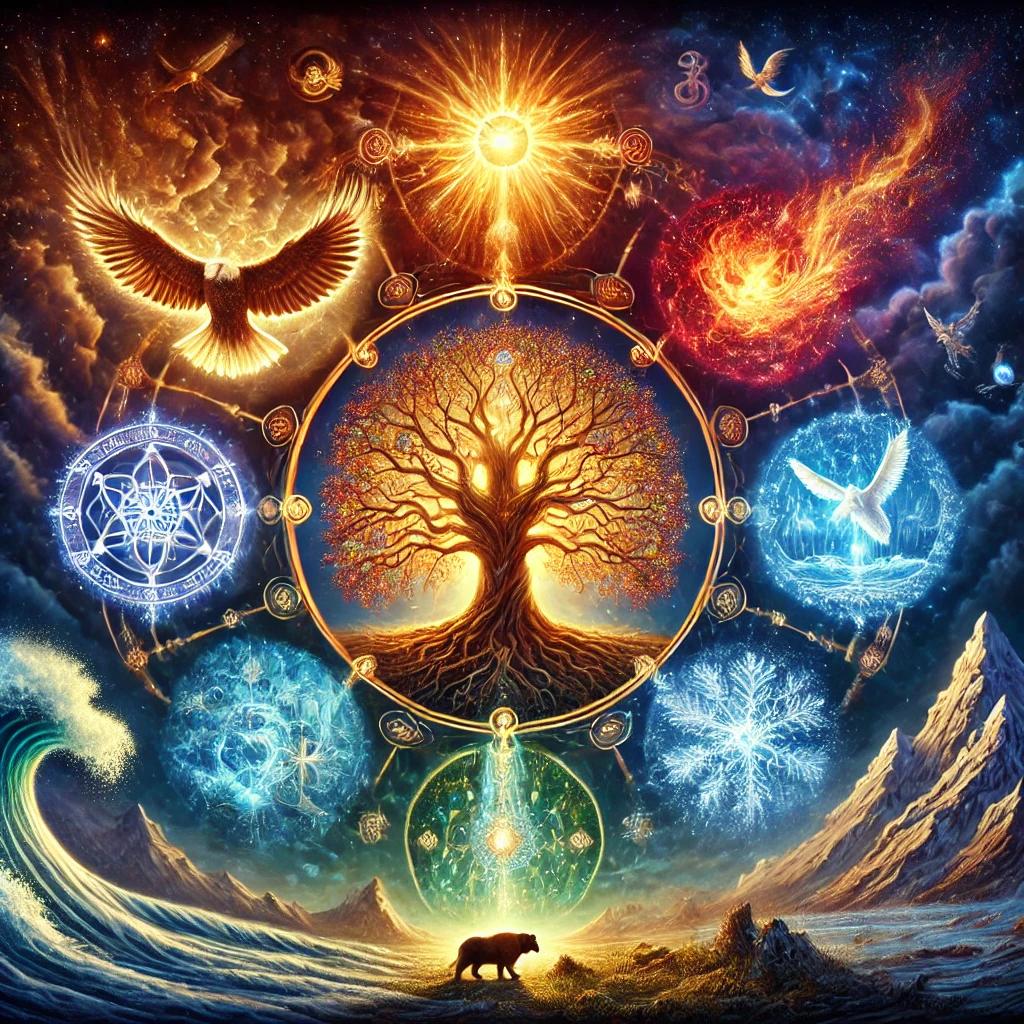
At the heart of shamanic practice lies a deep understanding of the structure and energies of the universe. This understanding manifests through the concept of the seven sacred directions and the five elements. These serve as a cosmic map that guides shamans on their spiritual journeys and healing work. Let us explore these fascinating aspects of shamanism and how they weave together into a rich tapestry of wisdom and practice.
The seven sacred directions
In many shamanic traditions, seven sacred directions are recognised, each with its own unique energy and meaning. These directions form a sacred circle, or medicine wheel, that represents the cycle of life and the wholeness of the universe.
East
The east is the direction of new beginnings, awakening and inspiration. It is associated with the sunrise and represents birth and renewal. In the east we find the element of air, which symbolises clarity, communication and intellect. The east is the place where visions are born and ideas take form.
In many shamanic traditions, ceremonies begin by turning towards the east and greeting the new day. Animals often associated with the east include the eagle, which represents vision and perspective. The colour yellow is often linked to this direction, symbolising the light of the sun and enlightenment.
South
The south is the direction of growth, passion and transformation. It is associated with the midday sun and represents youth and vitality. The element of fire belongs to the south, symbolising energy, creativity and transformation.
In the south we find the power to manifest our visions and dreams. It is a time for action and flourishing. Animals such as the deer or the coyote are often connected to the south, representing grace and adaptability. The colour red is often associated with this direction, symbolising passion and life force.
West
The west is the direction of introspection, emotional healing and the inner life. It is associated with the sunset and represents adulthood and wisdom. The element of water belongs to the west, symbolising emotions, intuition and cleansing.
In the west we find the opportunity to reflect on our experiences and learn from them. It is a time for forgiveness and for letting go of what no longer serves us. Animals such as the bear or the whale are often connected to the west, representing inner strength and deep emotional insight. The colour black or dark blue is often associated with this direction, symbolising the mysteries of the night and the unconscious.
North
The north is the direction of wisdom, structure and spirituality. It is associated with midnight and represents old age and ancestors. The element of earth belongs to the north, symbolising stability, grounding and manifestation.
In the north we find the deep wisdom that comes from life experience and the connection to our ancestors. It is a time to integrate all of life's lessons. Animals such as the buffalo or the wolf are often connected to the north, representing endurance and community. The colour white is often associated with this direction, symbolising purity and spiritual wisdom.
Up (the Sky)
The direction up represents the connection to the divine, higher consciousness and the spiritual realm. It symbolises aspirations, ideals and transcendence. In some traditions, this direction is associated with Father Sky or the masculine divine energy.
The up direction reminds us of our connection to the cosmos and our place in the larger picture of existence. It encourages us to reach beyond our limitations and seek higher truths. Birds, especially the eagle, are often associated with this direction, symbolising freedom and spiritual insight.
Down (the Earth)
The direction down represents our connection to Mother Earth, the physical realm and our roots. It symbolises grounding, nourishment and manifestation. In many traditions, this direction is associated with the feminine divine energy.
The down direction reminds us of our connection to nature and all living beings. It teaches us the importance of being grounded and in balance. Animals that live underground, such as snakes or badgers, are often associated with this direction, symbolising wisdom from the depths and the ability to navigate the unknown.
Centre (the Heart)
The centre is the seventh direction, representing the integration of all the other directions. It symbolises balance, wholeness and the true self. The centre is the place where all energies meet and are harmonised. In Sjamanistisk Forbund we associate this with our own heart.
At the centre we find our own inner wisdom and connection to all that is. It is the place of personal transformation and the realisation of our true nature. In some traditions, the centre is associated with the fifth element, ether or spirit, which binds all the other elements together.
The elements and their placement among the directions
The five elements – earth, air, fire, water and ether (or spirit) – play a central role in shamanic cosmology and practice. Each element has its own unique energy and teaching, and they are often associated with specific directions on the shamanic medicine wheel.
Earth (North)
The earth element is connected to the north in many shamanic traditions. It represents stability, grounding, fertility and manifestation. Earth teaches us about patience, endurance and the importance of being grounded in our physical reality.
In shamanic practice, the earth element is often used for healing related to the physical body, material prosperity and connection to nature. Rituals that involve planting seeds, working with crystals or walking barefoot on the earth are ways of connecting to the energy of the earth.
Air (East)
The air element is usually associated with the east. It represents intellect, communication, clarity and new ideas. Air teaches us the importance of open and honest communication, as well as the ability to see things from different perspectives.
In shamanic practice, the air element is often used for mental healing, inspiration and for cleansing negative energies. Rituals that involve incense, feathers or breathing exercises are ways of working with the energy of air.
Fire (South)
The fire element is typically connected to the south. It represents transformation, passion, creativity and action. Fire teaches us about the courage to follow our dreams and the power of personal transformation.
In shamanic practice, the fire element is often used for energetic cleansing, motivation and for breaking through blockages. Rituals that involve candles, bonfires or sun meditation are ways of connecting to the energy of fire.
Water (West)
The water element is usually associated with the west. It represents emotions, intuition, cleansing and flow. Water teaches us the importance of being flexible, of emotional healing, and the power of the subconscious mind.
In shamanic practice, the water element is often used for emotional healing, intuitive work and for dissolving stagnant energies. Rituals that involve sacred water, moon meditation or working with mirrors are ways of connecting to the energy of water.
Ether/Spirit (Centre)
The fifth element, often called ether or spirit, is usually associated with the centre of the medicine wheel. It represents the all-pervading life force that binds all things together. Ether teaches us about our connection to all that is and about our own divine nature. In ceremony, it is the fire that is the centre, but at the same time our own heart.
In shamanic practice, the ether element is often used for spiritual healing, connection to higher consciousness and for integrating all aspects of the self. Meditation, drum journeys and working with sacred objects are ways of connecting to the energy of ether.
The three shamanic worlds
In addition to the seven directions and the five elements, shamanism operates with a concept of three distinct worlds or realities. These worlds form the foundation for the shaman's journeys and work with spiritual forces.
The lower world
The lower world is often described as an underground world, filled with caves, tunnels and subterranean landscapes. This is not a dark or frightening place, but rather a rich and living world full of wisdom and power.
In the lower world, the shaman often meets power animals and nature spirits. These beings serve as guides and teachers, offering protection and insight. The lower world is often associated with instincts, deep emotions and the connection to the earth and our ancestors.
Journeys to the lower world are often used for healing related to physical or emotional problems, for finding personal power, and for restoring lost soul energy. It is a place for transformation and the rediscovery of one's true nature.
The middle world
The middle world is the spiritual counterpart to our physical reality. It exists in parallel with our ordinary world and contains both positive and negative energies. Unlike the upper and lower worlds, which are purely spiritual realms, the middle world has both ordinary and non-ordinary aspects.
In the middle world, the shaman can interact with nature spirits and other beings that exist in our physical reality but are usually invisible to the naked eye. This is also the place where the shaman can perform healing at a distance or gather information about events in the physical world.
Work in the middle world often requires more caution and protection, as it can contain both benevolent and less benevolent energies. It is in this world that much of the practical shamanic work is carried out, such as healing land and places, communicating with plant and animal spirits, and cleansing negative energies.
The upper world
The upper world is often described as a luminous, ethereal realm filled with celestial landscapes. This is the place of higher consciousness, divine wisdom and transcendent experiences.
In the upper world, the shaman often meets exalted spiritual beings, divine teachers and ancestral spirits. These beings offer guidance at a higher level, often related to life's greater questions and one's spiritual development.
Journeys to the upper world are often used to seek wisdom and insight, for spiritual healing, and to gain access to higher levels of consciousness. It is a place for inspiration, vision and connection to the divine.
Integration and practice
The understanding of the seven directions, the five elements and the three worlds forms a complex and rich framework for shamanic practice. These concepts are not merely theoretical constructs, but living principles that shamans actively work with in their daily practice.
A shaman may, for example, use knowledge of the directions and elements to create sacred space for rituals and ceremonies. By invoking the energies of each direction and each element, the shaman creates a balanced and powerful space for their work.
In healing work, the shaman can draw on specific elemental energies based on the client's needs. For example, the stabilising energy of earth can be used to help someone who feels rootless or unstable, while the clarifying energy of air can be used to help someone struggling with mental confusion or difficulty making decisions.
During shamanic journeys, the practitioner consciously navigates between the three worlds, each with its own unique purpose and teaching. A journey to the lower world may be appropriate for restoring personal power, while a journey to the upper world may be sought for spiritual guidance and insight.
The integration of these concepts allows the shaman to work on multiple levels at once – physical, emotional, mental and spiritual. This holistic perspective is at the core of shamanic healing and transformation.
Modern applications and relevance
Although these concepts have deep roots in ancient traditions, they continue to be relevant and powerful in our modern world. Many people find that an understanding of the seven directions and the five elements provides a framework for personal growth and self-understanding.
For example, meditating on the various directions and elements can help a person identify areas of life that need attention or balancing. A person who feels overwhelmed by emotions can find calm and clarity by working with the air element, while someone who feels disconnected can find grounding and stability through the earth element.
The concept of the three worlds can provide a model for exploring different aspects of consciousness and the self. The lower world can represent our subconscious mind and deep instincts, the middle world our daily consciousness and interactions, and the upper world our highest aspirations and spiritual potential.
In a time when many feel disconnected from nature and from their own inner wisdom, shamanism's teaching about directions, elements and worlds offers a path back to wholeness and balance. It reminds us of our place in the larger cosmic picture and our deep connection to all aspects of life.
The seven directions, the five elements and the three worlds form a rich and complex cosmological map in shamanic tradition. This map is not merely a theoretical construct, but a living, dynamic understanding of the cosmos that shamans actively navigate and work with in their practice.
By understanding and working with these concepts, the shaman opens doors to deeper insight, healing and transformation. The seven directions teach us about the cycles of life and the various aspects of our existence. The five elements give us a language for understanding and working with the forces of nature, both in the outer world and in our inner landscape. The three worlds offer a framework for exploring different levels of consciousness and reality.
Together, these concepts form a holistic worldview that recognises the deep interconnectedness of all aspects of life. They remind us that we are part of a larger whole, connected to nature, the cosmos and one another in ways that often go beyond our everyday understanding.
In our modern world, where many feel disconnected and out of balance, shamanism's teaching offers a path back to wholeness and harmony. By understanding and working with the directions, the elements and the worlds, we can rediscover our place in the cosmic web and find a deeper meaning and purpose in our lives.
Shamanism's wisdom teaches us that each direction, each element and each world has its own unique gift to offer. The east brings new beginnings and inspiration, the south brings growth and transformation, the west brings introspection and healing, and the north brings wisdom and structure. Up connects us with the divine, down grounds us in the earth, and the centre integrates all these aspects in our true self.
In the same way, the elements teach us about different aspects of our nature. Earth teaches us about stability and manifestation, air about clarity and communication, fire about passion and transformation, water about emotions and intuition, and ether about the all-pervading life force that binds everything together.
The three worlds – the lower, middle and upper – give us a map for exploring different aspects of reality and consciousness. They remind us that there is more to our existence than what we see with our physical eyes, and invite us to explore these realms for wisdom, healing and insight.
In shamanic practice, working with these concepts is not merely an intellectual exercise, but a living, experiential process. Through rituals, ceremonies, meditation and shamanic journeys, the practitioner actively engages with the energies and beings of these various aspects of the cosmos.
For example, a shaman may begin a ceremony by invoking the energies of each direction, creating a sacred space that is balanced and powerful. In healing work, the shaman can draw on specific elemental energies based on the client's needs – perhaps using the stabilising power of earth for someone who feels rootless, or the flowing energy of water to dissolve emotional blockages.
During shamanic journeys, the practitioner consciously navigates between the three worlds, each with its own unique purpose and teaching. A journey to the lower world may seek guidance from power animals or nature spirits, a journey in the middle world may be about cleansing negative energies from a place or situation, while a journey to the upper world may seek wisdom from exalted spiritual teachers.
It is important to remember that although these concepts are universal in many shamanic traditions, the specific details and interpretations may vary between different cultures and traditions. Some traditions may have more or fewer directions, different associations between elements and directions, or different descriptions of the three worlds. This diversity reflects the rich variation in human culture and experience, and reminds us that shamanism is a living tradition in constant development, adapting to different contexts and needs.
In our modern world, these ancient concepts can still offer valuable insight and guidance. They give us a language for understanding and working with energies and forces that are often overlooked in our daily, rational approach to life. They remind us of our deep connection to nature and the cosmos, and invite us to live in greater harmony with these forces.
For many people today, understanding and working with the seven directions, the five elements and the three worlds can be a path to personal growth and transformation. It can help us find balance in our lives, understand our strengths and challenges, and discover new resources for healing and growth.
For example, a person who feels overwhelmed by stress and responsibility can find calm and clarity through meditation on the air element in the east. Someone struggling to manifest their dreams can find strength and stability through work with the earth element in the north. A person seeking spiritual insight can explore the upper world through guided meditations or shamanic journeys.
However we choose to engage with these concepts, they offer a rich and diverse set of tools for self-exploration, healing and spiritual growth. They remind us that we are part of a larger whole, connected to all aspects of life in an intricate web of relationships and energies.
In a time when many feel disconnected from nature and from their own inner wisdom, shamanism's teaching about directions, elements and worlds can offer a path back to wholeness and balance. It invites us to see the world with new eyes, to acknowledge the sacred in all aspects of life, and to live in greater harmony with nature's rhythms and forces.
Shamanism's wisdom teaches us that each direction, each element and each world has its own unique gift to offer. By opening ourselves to these gifts, we can enrich our lives, expand our understanding, and find deeper meaning and purpose in our existence. In this process, we may discover that we are not merely passive observers of the cosmos, but active participants in a living, breathing reality full of magic and possibility.
References
Eliade, M. (1964). Shamanism: Archaic Techniques of Ecstasy. Princeton University Press.
Harner, M. (1990). The Way of the Shaman. HarperOne.
Vitebsky, P. (2001). Shamanism. University of Oklahoma Press.
Tedlock, B. (2005). The Woman in the Shaman's Body: Reclaiming the Feminine in Religion and Medicine. Bantam.
Narby, J., & Huxley, F. (2001). Shamans Through Time: 500 Years on the Path to Knowledge. Tarcher.
Kehoe, A. B. (2000). Shamans and Religion: An Anthropological Exploration in Critical Thinking. Waveland Press.
Walsh, R. (2007). The World of Shamanism: New Views of an Ancient Tradition. Llewellyn Publications.
Ingerman, S. (2004). Shamanic Journeying: A Beginner's Guide. Sounds True.
Cowan, T. (1996). Shamanism: As a Spiritual Practice for Daily Life. Crossing Press.
MacEowen, F. (2002). The Spiral of Memory and Belonging: A Celtic Path of Soul and Kinship. New World Library.