(Image borrowed from Wikipedia)
Runes have long been a source of fascination and wonder for historians, linguists and those who seek to understand the profound symbolic meaning behind the writing system of the ancient Germanic cultures. These ancient signs, carved into stone, wood and other materials, contain not only linguistic messages, but also a layer of deep symbolic meaning that sheds light on the cultural and spiritual beliefs of the peoples who used them.
Historical background
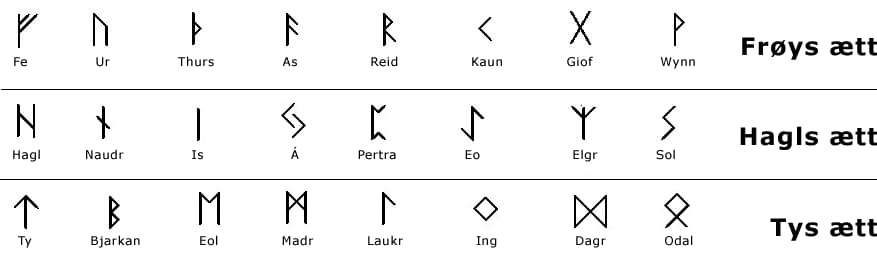
The runes were first developed and used by the Germanic tribes in northern European regions such as present-day Scandinavia, Germany and Britain. The Proto-Norse runic alphabet, also known as the "futhark" (a term composed of the first six runes), consists of 24 signs, organized into three "ætter" or groups. The oldest form, the Elder Futhark, consisted of 24 signs (100-700), while later versions such as the Younger Futhark were reduced to 16 signs.
The symbolic meaning of the runes
Each rune in the Proto-Norse alphabet had its own symbolic meaning, which went beyond the merely phonetic. These meanings were often linked to nature, cosmology, and the daily life of the ancient Germanic peoples. For example, the first rune, "Fehu", was associated with prosperity, cattle and material wealth. "Algiz", with its shape like an outstretched hand, symbolized protection and safety.
But the symbolic meaning of the runes went beyond their individual properties. Combinations of runes, known as bind runes, were used to create even deeper layers of meaning and magic. These combinations could form talismans, protective symbols, or even guides for ritual practices.
Fehu: Prosperity, cattle, material wealth.
Uruz: Strength, vitality, change.
Thurisaz: Bravery, protection, control.
Ansuz: Wisdom, communication, divine inspiration.
Raido: Journey, travel guidance, spiritual direction.
Kenaz: Knowledge, illumination, controlled burning.
Gebo: Gift, reciprocity, partnership.
Wunjo: Joy, happiness, harmony.
Hagalaz: Unforeseen changes, trials, transformation.
Naudiz: Need, necessity, constraint.
Isa: Stagnation, ice, limitation.
Jera: Harvest, reward, cycles.
Eihwaz: Strength, resistance, transformation.
Perthro: Fate, mystery, obscurity.
Algiz: Protection, safety, outstretched hand.
Sowilo: Success, the sun, victory.
Tiwaz: Justice, honor, warfare.
Berkano: Fertility, rebirth, beauty.
Ehwaz: Partnership, movement, cooperation.
Mannaz: Humanity, community, self-realization.
Laguz: Intuition, emotions, water.
Ingwaz: Fertility, inner growth, transformation.
Dagaz: Awakening, clarity, new beginning.
Othala: Inheritance, home, cultural heritage.
These interpretations are based on both historical and modern understanding of the runes and their symbolic meaning in Proto-Norse culture.
Runes in culture and belief
For the ancient Germanic peoples, the runes were not only a writing system, but also a means of communicating with deities and forces in nature. Runic inscriptions could be found on gravestones, weapons, jewelry and other objects, and were often seen as a way to secure protection and guidance from the divine.
In addition to their practical uses, the runes were also used in rituals, divination and healing practices. Shamans and seers would use the runes to read fate, seek guidance and heal illness or injury.
Revitalization
In modern times, interest in runes has not diminished. On the contrary, scholars, historians and enthusiasts have continued to explore and interpret the symbolic meaning behind these ancient signs. Through comparative studies of Proto-Norse and Norse mythology, archaeology and linguistics, modern researchers have gained a deeper understanding of how the runes were used and what they meant to the ancient Germanic peoples.
At the same time, the runes have continued to inspire artists, writers and those seeking a deeper connection with the beliefs and culture of their ancestors. Tattoos, artworks and literature based on the runes have become increasingly popular, reflecting their enduring appeal and symbolic depth.
The runes stand as a unique portal to the wisdom, beliefs and culture of the ancient Germanic peoples. Through their symbolic meaning and deep history, the runes continue to inspire and fascinate those who seek to understand the ancient mysteries of northern European culture and spirituality.