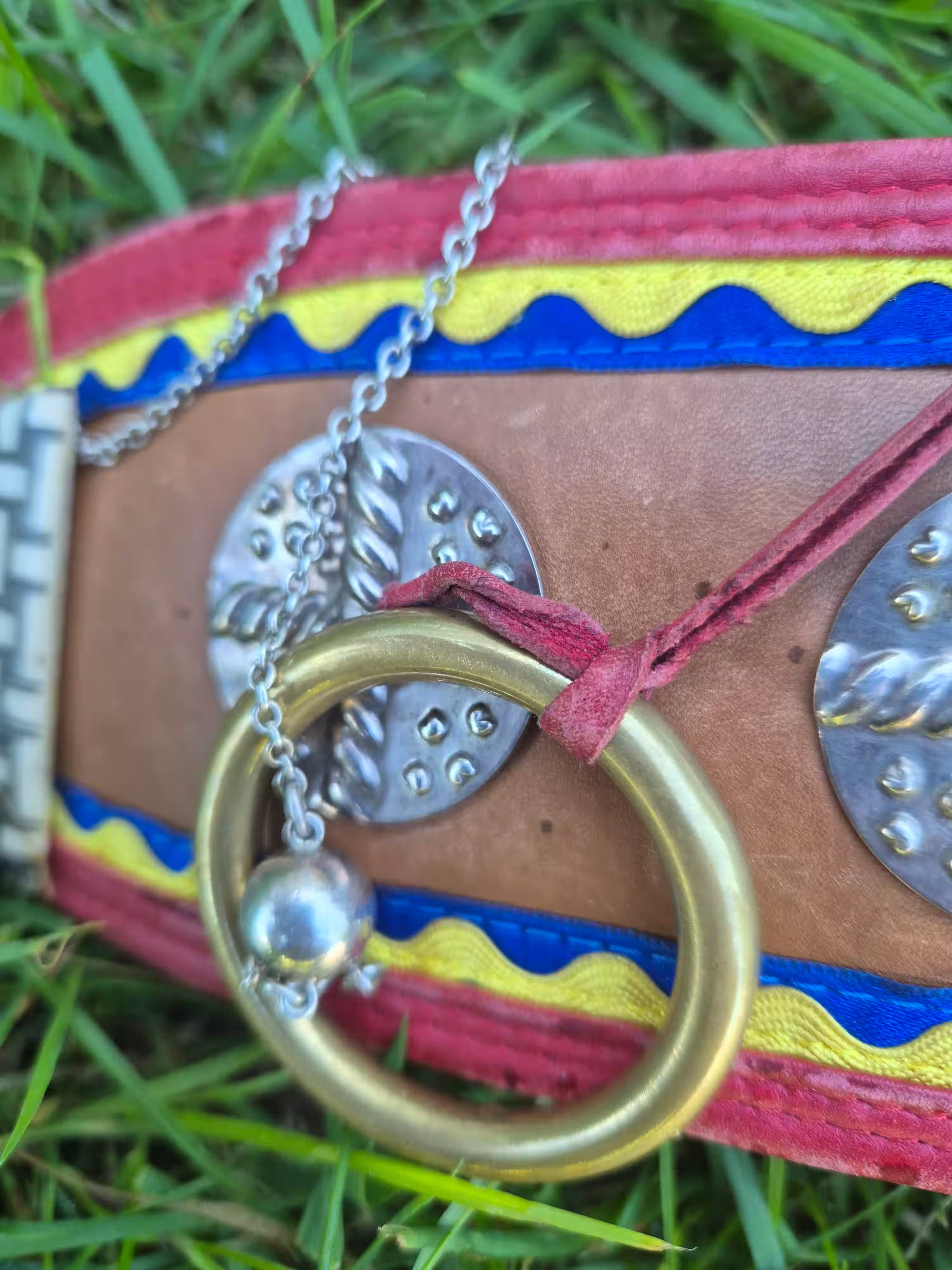
Šiella can be understood as small but charged objects in Sámi tradition: metal rings, brass pieces and other forms of protection and power that were part of a larger ritual field. In Steen's material, they emerge as things that were not only worn, but used when confronting illness, death, transition and contact with the unseen. Šiella is not merely an ethnographic term, but a trace of a world in which metal, body and spiritual protection were closely intertwined. The article is based on the book Sjiella by Adolf Steen, published in 1959.
When metal becomes protection
Imagine a winter in Kautokeino. It is tense, cold and marked by transitions that must be handled with care. A man dies, and what might at first seem a simple practical problem instead becomes a ritual question: how should the dead be led onward, and how should the living be protected? In this context, šiella enters as a small metal ring, tied to the wrist of the deceased. The ring is not adornment, nor merely a random object. It is part of a belief that death must be accompanied by something that can control, shield or dampen effects that might otherwise strike both the dead and the bereaved.
This use of šiella points towards an older Sámi understanding that transitions are dangerous. Death is not merely an endpoint; it is a rupture through which forces may be released. What accompanies the corpse must therefore have a function. The metal ring becomes a form of protection that can both hold something in place and mark a boundary. Here lies one of the clearest traces of a Sámi ritual practice in which material things function as bearers of protection.
Šiella as protection
Šiella could take several forms, but its most consistent use was as an amulet. It could be worn on the body, often on the finger or wrist, but could also be attached elsewhere where it took on a protective function. The essential thing was not always its shape, but the relationship between the object and the person who wore it. The šiella was something meant to avert, shield or bind away misfortune. It could protect against illness, against dangerous influences and against what, in older beliefs, was understood as harmful power.
This kind of use fits well within a broader pattern in Sámi tradition, where small objects are not merely decorative but part of an active understanding of the world. Metal held a particular place here. Brass, copper, silver and other metals were not treated as neutral materials, but as things with properties that could intervene in health, fate or contact with the unseen. The šiella therefore functioned as protection by virtue of both material, placement and social understanding.
Between life and death
What makes the šiella especially interesting is that it belonged not only to life, but also to the death ritual. When tied to the deceased, it moves into the borderland between worlds. The dead person is no longer an ordinary individual, but not entirely gone either. In such a phase, control and order must be established. The ring bound fast to the wrist can be understood as part of this arrangement. It marks that the deceased is to be treated in a particular way, and that the transition requires protection.
It is also worth noting that the text contains descriptions of how the rings could be collected, kept and later brought out again. This suggests that šiella was not always used once and then discarded. It could have a longer biography, in which a ring passed from hand to hand, from illness to protection, from everyday use to ritual. In this way, šiella becomes an object with memory. It carries traces of previous use and previous connections.
The drum and spiritual practice
One of the most central connections is the relationship between šiella and the Sámi drum, the runebomme (rune drum). Here, metal is not merely protection on the body, but an element in a broader shamanic practice. In descriptions of the drum, small metal rings, fittings or other objects appear, fixed to the skin, the frame or attached to the pointer. These parts were not incidental. They took part in the drum's function as a tool for contact, divination and travel between levels of reality.
In Sámi shamanism, the drum is an instrument of communication and insight. It is not merely sound, but a way of orienting oneself in a world where people, spirits, illness and fate stand in relation to one another. When metal rings or brass pieces are linked to the drum, it is because they too belong to this field of power. They might be connected to the pointer, to signs, to marked figures and to what is to be interpreted. Šiella is thus not only a personal amulet, but also part of the shaman's equipment.
What the ring did
The most important question is not just what šiella was, but what it did. Based on Steen's book, it appears as an object that could delimit, protect and bind together. When worn by a person, it could keep misfortune at bay. When bound to a dead person, it could accompany the transition and contribute to control in the face of death's uncertainty. When part of drum rhythm and ritual, it could become part of a wider communication with the unseen.
This points towards a fundamental Sámi mode of understanding in which action and object are not as sharply separated as in modern Western thought. A ring is not merely a ring. It is a relationship, an intention, a practice. It works in interplay with words, touch, placement and context. It therefore makes sense that the same type of object can appear in different ritual fields: as protection against illness, as an escort at death, or as part of a larger shamanic whole.
Metal, sound and power
Metal has its own place in these accounts. It shines, rings and carries light. It can be worn on the body, and it can be fastened to tools. In the older descriptions drawn upon, there are many variants: brass rings, silver rings, copper, tin, mixed metals and small fittings. It is as though the material itself mattered, but also the sound and the sheen. In ritual contexts, metal is not passive. It responds, marks and amplifies.
This is particularly clear in connection with the drum. A small ring or piece of metal could produce sound when the drum moved or was struck, and the sound could be understood as part of the sign system. It is not hard to see how such a thing would carry symbolic weight in a society where the shaman's work was tied to omens, health and communication with other powers. Šiella could thus become a small but effective part of a complex ritual apparatus.
In the face of illness
Illness is central in the material. Šiella is used not only against abstract evil, but in confronting concrete illnesses and afflictions. It could be placed on the body to prevent illness from taking hold, or used to protect the child, the sick person, or one who was particularly exposed. In this way, šiella becomes part of everyday religion, not only of the great rituals.
This is important because it shows that Sámi ritual practice cannot be reduced to dramatic shamanic rituals alone. It was also woven into daily life: into care, into pregnancy, into childcare, into the handling of vulnerability. Šiella thus appears as a small, practical and yet symbolically weighty object. It helps people move through a world experienced as full of influences.
Gifts, offerings and relation
Another feature in the material is the connection between šiella and offering. Some of the rings may have been given as gifts to the shaman, or served as payment or thanks for help. Others may have had a more direct sacrificial function, where the object was dedicated to a power, a spirit or a particular context. In such cases, šiella is not merely protection, but part of a relationship between human and the superhuman.
It is precisely here that šiella becomes closely tied to Sámi shamanism. Shamanism is not just about “having a belief”, but about working within a system of reciprocity, signs, gifts and actions. A metal ring can be given, received, worn, sacrificed or bound. Each action places the object in a new relationship. Šiella is therefore both object and action, thing and relation.
Misunderstandings and changes
In the older sources, šiella is often discussed in ways that may later seem simplified. Some sources are conflated, others interpret the phenomenon through their own religious lens. Nevertheless, it is clear that the use of metal as protection and ritual object was widespread in Sámi cultural history. Over time, the words also change. Šiella is today often written with modern orthography, but has older spellings and local forms. The practice itself also seems to have varied from area to area.
It is therefore important not to reduce šiella to a single fixed entity. In some contexts it is a ring. In others it is a piece of metal, a band, part of a drum, or an object linked to burial or protection. In some cases it is clearly described, in others we must read between the lines. This very variation shows that šiella was a living element within a larger tradition, not a museum definition.
A living tradition
Looking at the whole, a clear picture emerges: šiella was a small object in physical terms, but a great object in symbolic terms. It could be worn by a person in need of protection, accompany a dead person into the grave, hang within the world of the drum, or take part in rituals where health, fate and contact with the unseen were at stake.
This is what makes the story of šiella so powerful. It reveals a Sámi world of life and belief in which things were not dead objects, but active participants in rituals and relationships. The metal ring on the wrist, in the coffin, on the drum or in the belt was not chosen at random. It had function, memory and meaning. And when we read such descriptions today, we see not merely an object, but an entire culture of care, protection and spiritual practice.
The missionary's gaze
At the same time, the text must be read critically. Adolf Steen was a missionary, and this shapes his account both in language and interpretation.
He reads much of the practice through a Christian and missiological perspective, in which older Sámi rituals are often understood as superstition, fear, or the remnants of a pre-Christian religion. This does not mean that his observations are useless, but that they are always filtered through a particular attitude towards Sámi religious life.
The book is therefore valuable as a historical source, but it must be used as a source about Sámi practice, not as a neutral mirror of it. It tells us both about šiella and about how a missionary in the 1950s chose to understand šiella
Physical use
Worn on the body as an amulet. Šiella could be worn as a ring, a piece of metal or jewellery on the finger, wrist, belt or elsewhere on the body.
Attached to infants and children's equipment. In more recent and older traditions, šiella/komsekule is linked to children, particularly at the cradle, the komse (Sámi cradle), or as a gift to a newborn.
Used in connection with the deceased. In Steen's material, a brass ring was tied to the wrist of the deceased and accompanied the corpse in the coffin.
Placed by or on the drum. Šiella could be linked to the rune drum, the pointer or metal elements within the drum's structure.
Used as an offering at a sacrificial site. Small metal objects and coins could be offered at a sieidi or other sacred sites.
Collected, kept and reused. The rings could be preserved, sold, passed on, or reappear in new contexts.
Intention and function
Protection against evil and harmful powers. Šiella was meant to avert evil, protect against misfortune and keep dangerous influences at bay.
Protection against illness. The object was used as protection in cases of illness, weakness and vulnerability, both in children and adults.
Shielding the dead and the living. In a funerary context, šiella appears to have had a protective and delimiting role.
Creating a safe transition between worlds. In death, illness and rituals, šiella marked the boundary between the ordinary and the dangerous, between life and what lies beyond.
Functioning in a shamanic context. Metal and ring shapes were part of tools and practices linked to the noaidi, drum use, omens and contact with spiritual powers.
Giving luck, strength and social protection. In some traditions, silver and metal are also linked to luck, status, gift-giving and rites of passage.
Functioning as offering or payment. In certain contexts, šiella could be a gift to spirits, places or ritual specialists
Source
Sjiella by Steen, Adolf · Book · Bokmål · published 1959. The book can be read digitally at the National Library.