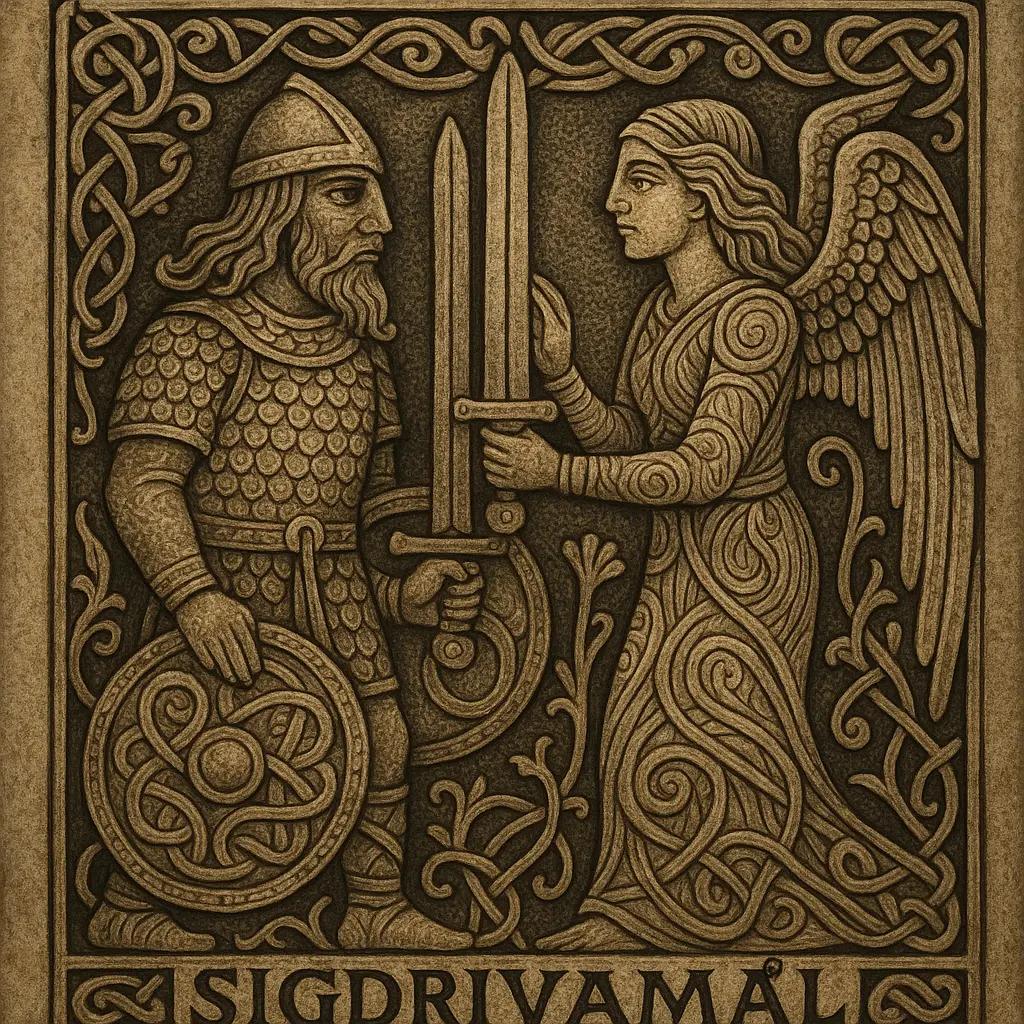
Sigdrivamål, a poem from the Poetic Edda, is one of the remarkable texts of Norse mythology. It combines elements of magic, wisdom and fate with a deeply spiritual undertone. The poem is part of Sigrdrífumál, which means "Sigrdrífa's speech", and tells of the meeting between the hero Sigurd and the valkyrie Sigrdrífa (often identified as Brynhild). Through her words we gain an insight into Norse cosmology, magical practices and the cycles of life. From a shamanic standpoint, Sigdrivamål can be interpreted as a guide to navigating between worlds, understanding the weave of fate, and mastering the power of the runes.
Plot and background
In Sigdrivamål Sigurd wakes up after having ridden through the mountains and found a sleeping valkyrie surrounded by flames. He breaks the curse that holds her captive by cutting through her armor with his sword. When Sigrdrífa awakens, she gives him a series of pieces of advice and teachings that include rune magic, cosmic wisdom and practical rules for living. These pieces of advice are not only meant for Sigurd as an individual, but also for anyone who seeks to understand the deep connections of the universe.
The poem is divided into several parts in which Sigrdrífa gives instructions on how to use runes for various purposes: protection, love, health, and victory in battle. She also explains how to honor the gods and maintain the balance between humanity and the divine forces.
The power and magic of the runes
The runes play a central role in Sigdrivamål. They are presented not only as a writing system, but also as magical symbols with the power to influence fate. Sigrdrífa mentions several types of runes:
Victory runes (sigrrúnar): Used to ensure victory in battle.
Ale runes (ölrúnar): Protect against poisoning when drinking.
Help runes (bjargrúnar): Used for healing and protection.
Love runes (málsrúnar): Promote harmony between people.
From a shamanic perspective, the runes can be interpreted as tools for manipulating energies in the cosmic landscape. The shaman uses the symbols to create a connection between the physical world and the spiritual world, something that resonates with the practice known from seiðr, the Norse form of magic.
The use of the runes requires knowledge of both their meaning and their place in the structure of the universe. This corresponds with the shaman's role as a bridge-builder between worlds – a person who can read the signs in nature and understand how they influence the fate of human beings.
Cosmology and fate
Sigdrivamål reflects the Norse understanding of fate as a weave spun by the three Norns: Urd (the past), Verdandi (the present), and Skuld (the future). Sigrdrífa gives Sigurd insight into how he can live in harmony with this fate by honoring the gods and using rune magic in the right way.
From a shamanic standpoint, this can be interpreted as an instruction in how to navigate the cycles of life. The shaman seeks to understand the weave of fate in order to help the community maintain balance – whether it concerns health, prosperity or spiritual development. Sigdrivamål thus functions as a spiritual manual for how to live a balanced life.
The valkyrie Sigrdrífa
Sigrdrífa herself can be interpreted as a shamanic figure. As a valkyrie she has the ability to move between worlds – she chooses who is to die on the battlefield and who is to live on. In her meeting with Sigurd she functions as a teacher or guide, which is typical of the role of the shaman in many cultures.
Her dualistic nature – both warrior and wise woman – mirrors the shaman's role as both protector and healer. She gives not only advice about practical things; she also gives insight into the deep structures of the universe. This makes her a key figure for those who seek to understand Norse spirituality.
Shamanic perspectives on Sigdrivamål
From a shamanic perspective, Sigdrivamål can be interpreted as a text that provides insight into rituals, magic, and energy work. The valkyrie's instructions about rune magic can be seen as metaphors for the shaman's work with symbols and energies. The runes represent cosmic forces that can be manipulated through intention and ritual.
The shaman often uses tools – whether drums, symbols or song – to change states of consciousness and gain access to spiritual dimensions. In Sigdrivamål we see how the runes function in a similar way: they are tools for communication with the divine and for influencing the physical world.
The text also emphasizes the importance of balance between the human being and the cosmos. This corresponds with the shaman's work to maintain harmony between the individual, the community, and nature.
Modern relevance
Although Sigdrivamål stems from a time marked by Norse mythology, its themes still have relevance today. Modern spirituality often draws on ancient traditions to find meaning in the cycles of life. Rune magic has gained new popularity among modern neopagans, where it is used for personal development and energy work.
From a therapeutic perspective, the poem can be seen as a guide on how to meet challenges with strength and wisdom. Sigrdrífa's advice about balance between the practical and the spiritual resonates with modern methods of stress management and self-development.
Sigdrivamål is more than just a poem; it is a portal to Norse cosmology, spirituality, and magic. Through the words of the valkyrie Sigrdrífa we gain insight into how one can live a balanced life with the help of rune magic, cosmic wisdom, and respect for the weave of fate. From a shamanic standpoint, the text functions as a manual for energy work and spiritual development.
Its relevance stretches far beyond the Viking Age – it offers universal principles about balance, transformation, and the connection between worlds. As readers we are invited to reflect on our own place in the universe and how we can use the wisdom of the past to navigate our own fate.
Sources:
The Poetic Edda (translated by Finnur Jónsson)
Lindow, J.: Norse Mythology (2001)
Price, N.: The Viking Way: Magic and Mind in Late Iron Age Scandinavia (2002)
Eliade, M.: Shamanism: Archaic Techniques of Ecstasy (1964)
Brink, N.: Shamanism in Norse Myth and Magic (2025)
Mitchell, R.: Runes and Magic in Norse Mythology (2023)