Shamanism is one of the oldest spiritual practices in human history, with roots reaching back to the Stone Age. This article explores the origins of shamanism in various Stone Age cultures, how the practice has developed over time, and how it has adapted to major religious and cultural shifts, such as the spread of Christianity in Europe and colonialism in the Americas. In particular, we will also look at the significance of shamanism in Sami culture and how it has survived and adapted to modern times.
Stone Age cultures and the origins of shamanism Shamanism is believed to have arisen in the Stone Age, a period that began about 2.6 million years ago and lasted until the end of the last ice age, around 10,000 BCE. Archaeological finds such as cave paintings, carvings and burial sites suggest that early humans practised forms of spiritual communication with nature and the spirit world.
The earliest forms of shamanism were probably linked to hunting and the natural environment. Shamans acted as intermediaries between the human group and the spirits that were believed to control the animals, the weather and the health of the tribe. Cave paintings such as those in the Lascaux caves in France, which date back to 17,000 BCE, show scenes that can be interpreted as shamanic rituals, in which figures appear to be in transformation between human and animal.
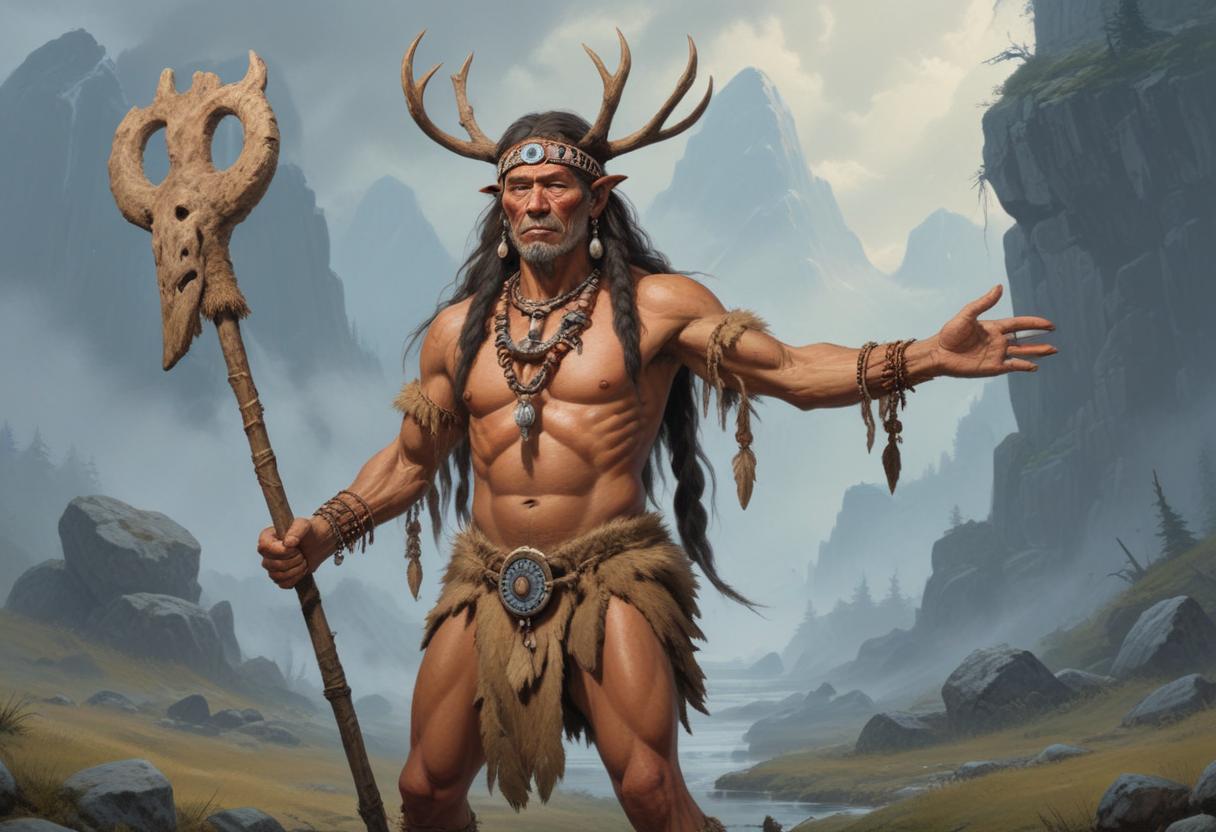
Shamanism in Sami culture In Sami culture, shamanism has played a central role for centuries, with the shaman, known as noaide (or nåejdde in South Sami), as a key figure in the community's spiritual and healing practices. The noaide acted as an intermediary between humans and the spirit world, and could perform ceremonies to protect against illness, foretell the future or ensure good hunting conditions. One of the best-known Sami shamanic practices is the joik, a form of spiritual song that was used both in rituals and as a way of telling stories.
With the arrival of Christianity in the Nordic region from the 10th century onwards, Sami shamanic traditions were severely suppressed. Missionaries tried to convert the Sami to Christianity, and many shamans were persecuted, and their sacred objects, such as rune drums, were confiscated or destroyed. Nevertheless, many of the shamanic elements survived in hidden forms or in combination with Christian practices.
After centuries of suppression, there has in modern times been a renewed interest in Sami traditions, including shamanism. Sami artists and cultural workers have helped to revitalise old customs, including the joik, which is now recognised as an important cultural and spiritual expression.
The development of shamanism and religious shifts With the development of agricultural societies and the rise of civilisations, the role and function of shamanism changed. In many early cultures, such as those of Mesopotamia, Egypt and Mesoamerica, shamanic practices were integrated into more complex religious systems. The role of the shaman could be absorbed by priests and religious leaders, but elements of shamanic traditions were often preserved, especially in folk religions.
The spread of Christianity in Europe from the first century CE had a profound impact on shamanic traditions. Many pre-Christian practices were either forbidden or reshaped to fit within the framework of the new religion. For example, many of the Norse rituals in Scandinavia, which had shamanic features, were gradually replaced or Christianised. Nevertheless, certain elements of shamanic practice survived in the form of folk belief and traditional healing rituals. In many cases, the original shamans were relabelled as witches or sorcerers, and the persecution of these individuals became common in medieval Europe.
In the Americas, colonialism had a similarly devastating effect on Indigenous shamanic traditions. Many Indigenous groups in North and South America, such as the Inuit in the Arctic and the various tribes of the Amazon, had long shamanic traditions before the Europeans arrived. Missionaries and colonial powers often tried to eradicate these practices, and forced conversion to Christianity was widespread. Despite this, many Indigenous groups managed to preserve their shamanic traditions, often in secret or in hidden forms.
Shamanism in modern times Despite the religious and cultural changes throughout history, shamanism has survived and adapted to modern times. Today we see a resurgence of interest in shamanic practices, both among Indigenous peoples and in Western societies.
Among Indigenous groups, many have revitalised their traditional practices as part of a broader cultural reawakening. For example, Sami shamanic traditions have received new attention and respect, both as a cultural identity and as a spiritual practice.
In Western societies we also see a growing interest in shamanism, often as part of new religious movements or alternative healing. Many seek to integrate shamanic elements into modern spirituality, as a way of restoring a sense of connection to nature and the spirit world. This includes the use of shamanic techniques such as drum journeys, meditation and herbal medicine.
Although this newfound interest in shamanism has helped to raise awareness of Indigenous cultures, it has also raised important ethical questions, particularly with regard to cultural appropriation and authenticity. It is important that modern practitioners of shamanism show respect for the cultural roots of these practices and understand their significance in the societies from which they originate.
Shamanism has a deep and complex history that stretches from the early cultures of the Stone Age to today's modern societies. Over millennia, shamanism has adapted to major religious and cultural shifts, including the spread of Christianity and colonialism, and it has survived by adapting to new contexts while preserving its core elements.
Today shamanism continues to evolve, both as a living tradition among Indigenous peoples and as a source of spiritual seeking in Western societies. To understand and practise shamanism in a respectful way, it is essential to recognise its historical roots and the cultural contexts from which it comes.
Sources: Hultkrantz, Åke. Shamanism and Traditional Belief Systems in the Arctic. 1973. Kjellström, Rolf. Samisk religion: Sjamaner, religion och folketro. 2004. Vitebsky, Piers. The Shaman: Voyages of the Soul - Trance, Ecstasy and Healing from Siberia to the Amazon. 1995.