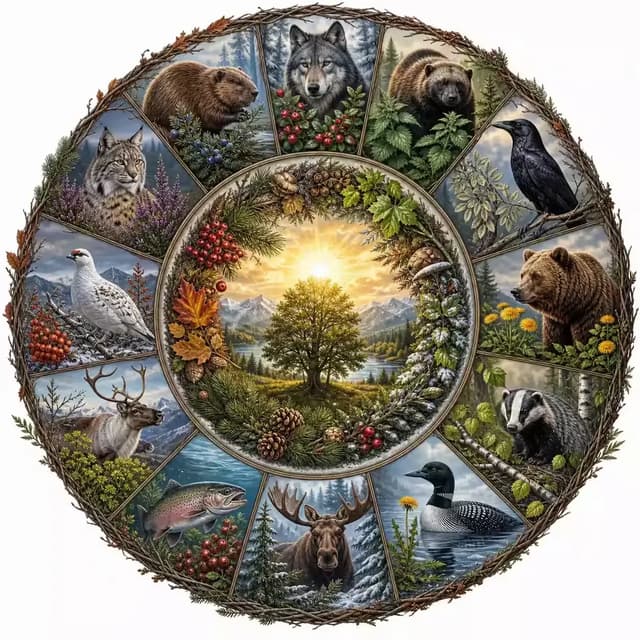
Dreams have fascinated people for millennia, and different cultures and traditions have developed their own methods for interpreting and understanding these nightly experiences. Among these, shamanic dream interpretation stands out as a distinctive and profound approach to the world of dreams. Let us take a closer look at what distinguishes so-called conventional dream interpretation from shamanic dream interpretation, and at what insights this practice can give us about our inner world and our place in the cosmos.
Shamanic dream interpretation
Shamanic dream interpretation is deeply rooted in the spiritual traditions and worldviews of indigenous peoples. Unlike more modern, psychologically oriented approaches to dream interpretation, shamanism sees dreams as something far more than mere products of our individual mind. For shamans, dreams are gateways to other realms of consciousness, meeting points between our physical world and spiritual dimensions.
In the shamanic understanding, dreams are not just passive reflections of our daily experiences or unconscious desires. They are active, transformative experiences that can provide direct insight, healing, and guidance. Shamans regard the dream world as just as real and significant as the waking state, and they see dreams as an essential part of our spiritual development and our relationship with the cosmos.
Key elements of shamanic dream interpretation
Dreams as spiritual journeys: Shamans often view dreams as journeys out of the body, in which the soul or consciousness can explore other dimensions and meet spiritual beings.
Communication with the spirit world: Dreams are considered a channel for communication with ancestors, nature spirits, and other spiritual entities.
Healing and transformation: Shamanic dream work often focuses on healing trauma, recovering soul parts, and personal transformation.
Collective significance: Dreams can have meaning not only for the individual, but also for the whole community or tribe.
Active participation: Shamans often learn techniques for conscious dreaming and how to influence and direct dream experiences.
Differences between shamanic and conventional dream interpretation
To understand what is unique about shamanic dream interpretation, it is helpful to compare it with more conventional approaches to dream interpretation, especially those rooted in Western psychology.
Conventional dream interpretation
Psychological focus: Modern dream interpretation, inspired by thinkers such as Sigmund Freud and Carl Jung, focuses primarily on dreams as expressions of the individual's psyche, unconscious desires, and conflicts.
Symbolic interpretation: Emphasis is placed on decoding dream symbols to uncover hidden meanings related to the person's life and experiences.
Individual significance: Dreams are seen mainly as relevant to the individual and their personal development.
Passive observation: Dreams are often regarded as passive experiences to be analysed afterwards.
Scientific approach: Modern dream research focuses on the neurological processes and cognitive functions connected to dreaming.
Shamanic dream interpretation
Spiritual focus: Dreams are seen as direct experiences of spiritual dimensions and entities.
Direct experience: Symbols and experiences in dreams are considered real encounters with spiritual forces, not just metaphors.
Collective and individual significance: Dreams can have consequences and insights for entire communities, not just for the individual.
Active participation: Shamans learn techniques to navigate and interact consciously in the dream world.
Holistic worldview: Dreams are integrated into a broader understanding of the cosmos, nature, and spirituality.
Shamanic dream symbolism
Shamanic dream symbolism differs markedly from conventional interpretations. Here are some examples of how shamanic traditions might interpret common dream symbols:
Animals:
Conventional interpretation: May represent aspects of the personality or instincts.
Shamanic interpretation: Animals in dreams are often seen as power animals or spiritual guides. Each animal has specific qualities and lessons.
Example: An eagle in a dream may be interpreted as a call to see things from a higher perspective or as an invitation to spiritual insight.
Falling:
Conventional interpretation: May indicate anxiety or loss of control.
Shamanic interpretation: May represent a soul journey to the underworld or a process of letting go of old patterns.
Example: A dream of falling through the earth may be interpreted as an invitation to explore deeper layers of consciousness or to meet ancestral spirits.
Water:
Conventional interpretation: Often associated with emotions or the unconscious.
Shamanic interpretation: May represent cleansing, transition between worlds, or communication with water spirits.
Example: Swimming in clear water may be interpreted as a spiritual cleansing process or an encounter with the healing powers of water.
Flying:
Conventional interpretation: May symbolise freedom or a desire to escape.
Shamanic interpretation: Often seen as an actual soul journey or astral projection.
Example: A dream of flying over the landscape may be interpreted as an exploration of other planes of consciousness or as guidance from air spirits.
Trees:
Conventional interpretation: May represent growth, stability, or family history.
Shamanic interpretation: Trees are often seen as living beings, gateways between worlds, or manifestations of the World Tree.
Example: Climbing a huge tree in a dream may be interpreted as a journey through different planes of consciousness or as communication with nature spirits.
Death or transformation:
Conventional interpretation: May symbolise change or the end of a phase of life.
Shamanic interpretation: May represent initiations, shamanic death and rebirth, or journeys to the spirit world.
Example: A dream of dying and being reborn may be interpreted as a deep spiritual transformation or a shamanic initiation.
Strange landscapes:
Conventional interpretation: May represent unknown aspects of the self or new situations.
Shamanic interpretation: Often seen as real visits to other dimensions or spiritual realms.
Example: Wandering in a strange, luminous landscape may be interpreted as a journey to the upper worlds in shamanic cosmology.
Encounters with unknown beings:
Conventional interpretation: May represent unknown sides of oneself or archetypes.
Shamanic interpretation: Often interpreted as actual encounters with spirits, guides, or other non-physical entities.
Example: An encounter with a mysterious figure who gives a gift may be interpreted as a meeting with a spiritual teacher or helper.
Practical aspects of shamanic dream work
Shamanic dream work is not just a passive process of interpretation, but involves active techniques and practices for engaging with the dream world. Here are some key elements of the practical approach to shamanic dream work:
- Conscious dreaming
Shamans often cultivate the ability to be conscious in the dream state, which resembles the modern concept of "lucid dreaming". This involves:
Developing the ability to recognise that one is dreaming while dreaming.
Learning to navigate and interact consciously in the dream landscape.
Setting intentions for dream experiences before falling asleep.
- Dream incubation
This is the practice of preparing oneself mentally and spiritually for meaningful dreams:
Performing rituals or meditations before going to bed.
Formulating specific questions or intentions for the dream experience.
Creating a sacred space or altar dedicated to dream work.
- Dream recall
Techniques for remembering and re-living dreams in detail:
Keeping a dream journal and writing down dreams immediately after waking.
Using visualisation techniques to re-live dream sequences.
Practising meditation to improve memory and awareness.
- Dream healing
Using dreams for healing and personal transformation:
Identifying and working with healing symbols or experiences from dreams.
Performing rituals or ceremonies based on dream experiences.
Integrating insights from dreams into daily life.
- Dream-sharing circles
Many shamanic traditions emphasise the importance of sharing dreams in community
Regular gatherings where members share and discuss dreams.
Collective interpretation and exploration of the dreams' significance for the community.
Using dreams as guidance for the tribe's or group's decisions.
- Dream journeys
Guided visualisations or drum journeys that resemble dream states:
Using drumming or other rhythmic sounds to induce altered states of consciousness.
Consciously "travelling" to other worlds or dimensions in a waking but altered state of consciousness.
Meeting power animals, spiritual guides, or ancestors in these states.
Challenges and criticism
While shamanic dream interpretation offers a rich and fascinating approach to dream work, it is important to acknowledge that it also faces challenges and criticism, especially in the face of modern science and psychology:
Lack of scientific evidence: The spiritual nature of shamanic dream interpretations makes them difficult to verify or test by scientific methods.
Cultural appropriation: There are concerns about how Western practitioners adopt and potentially misuse the traditions and practices of indigenous peoples.
Subjectivity and misinterpretation: The highly personal and intuitive nature of shamanic dream interpretation can lead to misinterpretations or over-interpretations.
Potential for self-deception: There is a risk that individuals may project their own desires or beliefs onto dream interpretations.
Conflict with modern psychology: Shamanic interpretations may conflict with established psychological understandings of dreams and mental health.
Ethical concerns: Some critics argue that relying too heavily on dreams for decisions or healing can be potentially harmful.
Integration and modern applications
Despite these challenges, elements of shamanic dream work have found their way into modern therapeutic and personal development practices:
Transpersonal psychology: This branch of psychology integrates spiritual and transcendent aspects of human experience, including shamanic perspectives on dreams.
Dream groups and workshops: Many modern dream-work facilitators incorporate shamanic techniques into their practices.
Creative and artistic expression: Shamanic dream techniques are often used by artists and writers as a source of inspiration and creative insight.
Ecopsychology and environmental awareness: Shamanic perspectives on dreams and nature have influenced modern ecological movements and environmental psychology.
Holistic health and alternative medicine: Some alternative health practices incorporate elements of shamanic dream work into their healing methods.
Shamanic dream interpretation represents a deep and complex approach to understanding dreams and consciousness. It offers a rich alternative to conventional, psychologically oriented dream interpretations, and invites us to see dreams not just as products of our individual mind, but as gateways to a broader, spiritual reality.
While this approach challenges many of our modern, scientific assumptions, it also offers unique insights and practices that can enrich our understanding of dreams and consciousness. Shamanic dream interpretation reminds us that dreams can be more than just nightly fantasies or psychological processes – they can be profound, transformative experiences that connect us to something greater than ourselves.
In an age marked by ecological crises and spiritual searching, shamanic perspectives on dreams can also offer valuable insights into our relationship with nature and the cosmos. They invite us to see dreams not just as personal experiences, but as part of a larger web of consciousness that connects all living beings.
Regardless of one's personal beliefs, exploring shamanic dream interpretation can open the way to a deeper understanding of the potential and role of dreams in our lives. It challenges us to engage more actively with our dreams, to see them as sources of wisdom and healing, and perhaps even as gateways to other realms of consciousness.
At the same time, it is important to approach this field with a balance between openness and critical thinking. Integrating shamanic insights with modern psychology and science could potentially lead to new, innovative approaches to mental health, personal growth, and our understanding of the nature of consciousness.
In conclusion, we can say that shamanic dream interpretation, with its rich symbolism and deep spiritual roots, offers a fascinating perspective on the world of dreams. It invites us to see our nightly journeys not just as random neurological events, but as meaningful experiences that can guide, heal, and transform us. In a world that constantly seeks deeper meaning and connection, shamanic approaches to dreams can offer valuable tools for self-discovery, healing, and spiritual growth.
References
Harner, M. (1990). The Way of the Shaman. HarperOne.
Tedlock, B. (2001). The Woman in the Shaman's Body: Reclaiming the Feminine in Religion and Medicine. Bantam.
Krippner, S., & Rock, A. J. (2011). Demystifying Shamans and Their World: An Interdisciplinary Study. Imprint Academic.
Ingerman, S. (1991). Soul Retrieval: Mending the Fragmented Self. HarperOne.
If you have read our articles and feel inspired by the wisdom of shamanism, you might consider becoming a member of Sjamanistisk Forbund. We are a faith community for those who find the sacred in nature.
Membership with us is free, but it does require you to leave any other faith communities. We offer an inclusive fellowship where you can explore nature-based spirituality, take part in ceremonies, and become part of a community that values the power and wisdom of nature.
With Sjamanistisk Forbund, you get the opportunity to:
Explore your spiritual path
Take part in fellowship with like-minded people
Learn about shamanic traditions
Contribute to cultural preservation and environmental awareness
Join us today and experience the magic of nature!