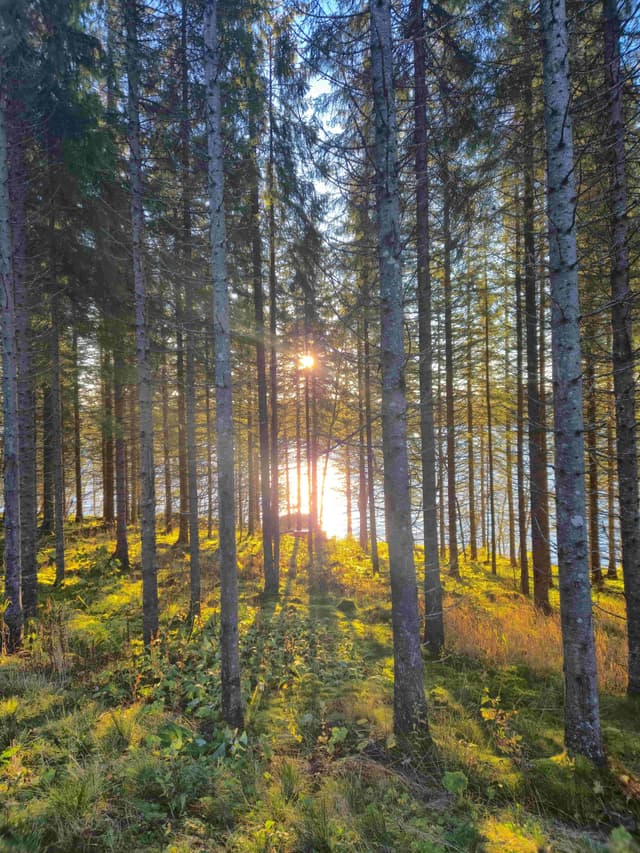
There are places in the forest where the light never quite falls as it should. Where the sunbeams stop as if hesitating, and the wind falls silent before it reaches you. You notice it before you see it: an unease in the body, a pull of something that cannot be explained. In such moments, it is said, she is near.
The Forest Wife.
She is not merely a figure in stories. She is a presence, a force, a voice that whispers in the foliage and moves between trunks that stood long before humans gave them names. She is both alluring and dangerous, familiar and foreign, close and unattainable. And she has followed humankind for as long as we have lived with the forest, not merely as a home, but as a living world with will and being.
She who lures
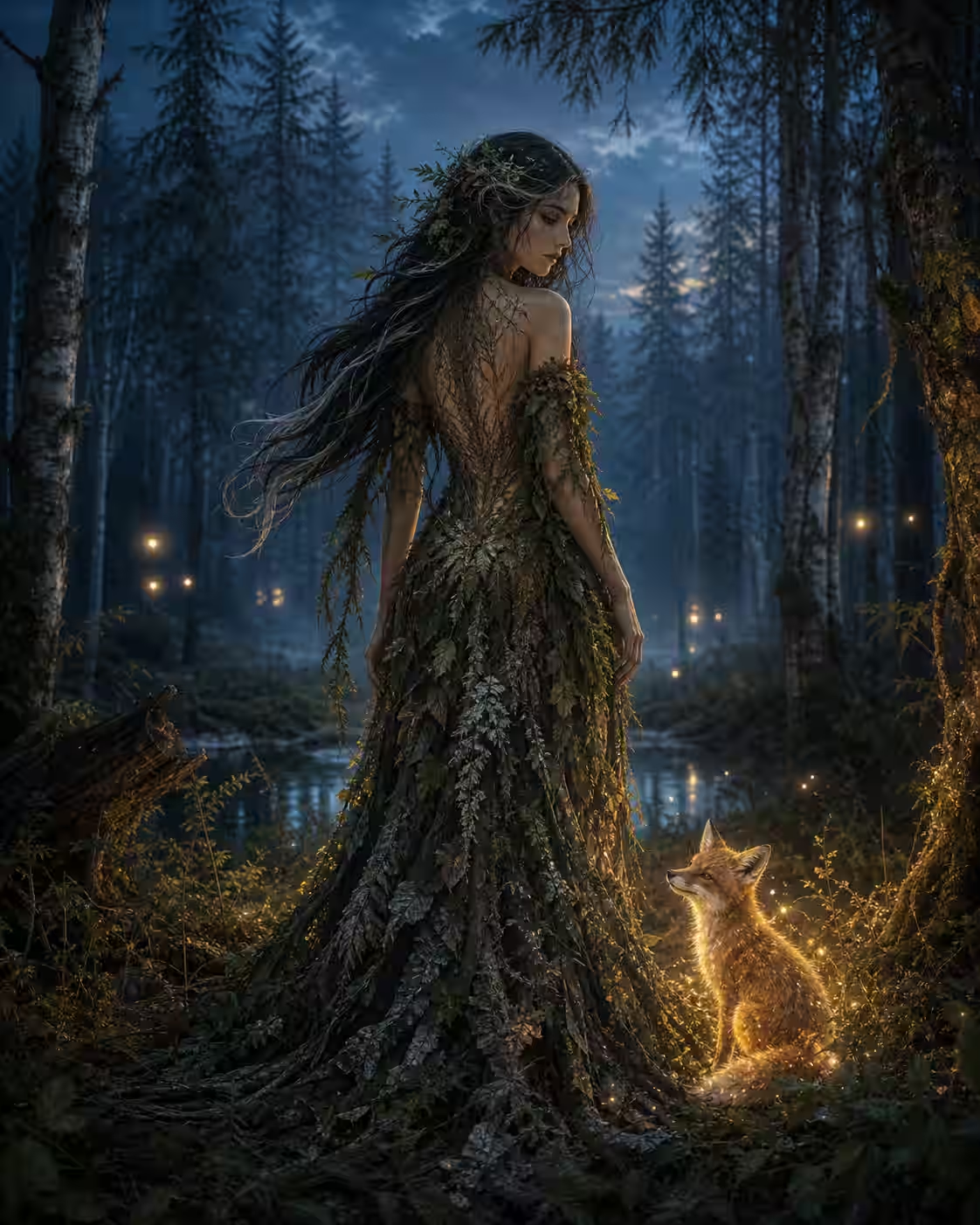
In the oldest tales, the Forest Wife is described as a woman of overwhelming beauty. She often appears alone, at the edge of the forest or along a path that seems more deserted than it should be. Her hair is long and dark, or as fair as sunlight through fir branches. Her eyes may be as deep as bog water or as clear as a stream. She smiles, and in that smile there is both warmth and danger.
But there is always something about her that breaks the illusion.
From behind, she is hollow. Like a rotten tree trunk, hollowed out and dark. Or she has a tail, like a cow or a fox, hidden beneath her skirt. Some tales say her back is covered in bark, as if she herself is part of the forest. This duality, the beautiful and the decayed, the human and the alien, lies at the very core of the Forest Wife's nature.
She is not human. And she does not try to be.
Men who encounter her, it is said, may be seduced. Not only in body, but in mind. They lose their sense of direction, forget time, and may wander for days without finding their way home. Some return, changed, with a look in their eyes that never quite comes back to the world. Others remain in the forest, as though swallowed by it.
Yet she is not only a seductress. She is also a guardian.
Mistress of the forest
The Forest Wife belongs to a wider tradition of nature beings in Nordic folklore: the rå, or ruling spirits. These beings are linked to particular places: the sea has its sjørå, the mountain its bergsrå, and the forest its skogsrå. They are not gods in the classical sense, but neither are they subordinate to humans. They are powers, bound to the landscape itself.
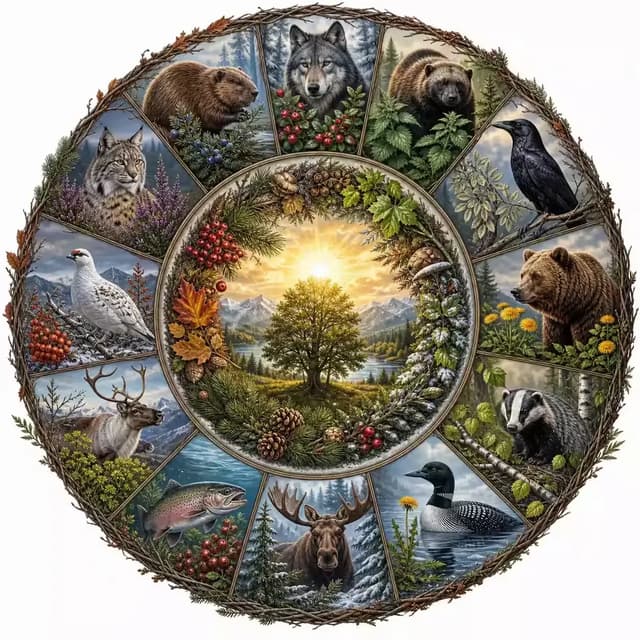
The Forest Wife rules over the animals. The hunter who enters her realm never does so alone. Every movement, every step, is seen. If the hunt succeeds, it may be due to her goodwill. If it fails, it may be because she has turned away.
In many traditions, the hunter had to show respect for the forest before hunting. This could be as simple as offering a greeting, or leaving a gift: tobacco, bread, a drop of spirits. Small acts, but with great meaning. For the forest was not merely a place. It was a community, a living web of relationships.
To offend the Forest Wife could have consequences. One might lose one's way in familiar terrain. Weapons could fail. Animals could vanish as if they had never been there. And in the worst case, one might become part of the forest oneself, not as a spirit, but as a human who never finds the way out.
Between eroticism and fear
The tales of the Forest Wife often carry a clear erotic undertone. She lures men, and encounters with her can be intense, almost otherworldly. But this eroticism is never separate from danger. On the contrary, it is precisely in the tension between desire and fear that her power lies.
This reflects a deeper understanding of nature in Nordic tradition. Nature is not merely beautiful or nourishing. It is also unpredictable, wild and at times destructive. It gives life, but can also take it. The Forest Wife is a personification of this duality.
She is the forest seen through humanity's need to understand what cannot be controlled.
In some tales, a man can bind her to himself, often by throwing steel over her or by using certain words or rituals. Then she loses some of her power, and may live as a kind of wife. But this is never a lasting solution. She longs to return. And sooner or later, she goes back to the forest, to what she truly is.
This motif, the attempt to tame the wild, recurs in many cultures. But in the Nordic tales, it is always clear that nature cannot be owned.
She who shows the way, or hides it
The Forest Wife is not only a temptress. She can also be a guide.
There are stories of people who have lost their way and meet her in a form that does not frighten them. She can offer advice, point out a direction, or lead them out of the forest. But this rarely happens without some form of exchange. Respect, humility, or a kind of offering is often required.
In other cases, she does the opposite. She confuses, turns paths upside down, and lets the landscape become a labyrinth. What was familiar becomes foreign. What was safe becomes threatening.
This phenomenon, of "losing one's way" in the forest, has a concrete side, but also a symbolic one. The forest represents the unknown, the inner self, that which lies outside the order of society. Encountering the Forest Wife can therefore also be understood as an encounter with what lies beyond human control, or within one's own psyche.
Traces in Sámi and northern tradition
In the northern regions, where forest meets tundra and mountain, similar beliefs exist, though often expressed differently. In Sámi tradition, there is a deep understanding that the landscape is ensouled. Although the Forest Wife as a figure is most clearly seen in Scandinavian folklore, parallels can be found in the notion of nature spirits and guardians.
These beings are not necessarily anthropomorphic. They are not always "she" or "he". They may be presences, energies, or relationships between person and place. But the function is related: to remind humans that they are not alone, and that there are rules not written by humans.
In this context, the Forest Wife can be seen as a cultural translation, a way of giving form to something otherwise difficult to grasp.
Christianisation and demonisation
With the Christianisation of the Nordic region, views of such beings changed. What had once been part of a living understanding of the world was gradually reinterpreted as superstition, or as demonic forces. The Forest Wife went from being an ambivalent, yet legitimate, part of nature, to becoming something dangerous in a more moral sense.
She became a temptress, one who led men away from God. Her sexuality became a sign of sin, and her connection to the forest became a sign of the uncontrolled and the pagan.
Yet the stories survived. Not merely as warnings, but as reminders of an older way of understanding the world. A way in which nature was not subject to humankind, but something one lived in relation to.
The Forest Wife today
What does the Forest Wife mean in our time?
For many, she is a figure from fairy tales and folk memory. Part of a cultural heritage that can be studied, but not necessarily experienced. But for others, particularly those who work with nature-based spirituality, she remains relevant.
Not as a literal woman in the forest, but as an archetypal force. A representation of the wild, the intuitive, that which cannot be reduced to rational understanding.
To encounter the Forest Wife today might mean entering nature without trying to control it. To listen, rather than to define. To accept that not everything can be explained.
In an age where nature is increasingly seen as a resource, such beliefs can serve as a counterweight. They remind us that there are other ways of being in the world. Ways that are not about ownership, but about relationship.
A whisper in the forest
Perhaps that is why she still lives.
Not necessarily as a figure one might meet face to face, but as a feeling. A presence. A moment when the forest seems more alive than usual. Where the silence is not empty, but filled with something.
You stand there, perhaps alone, and sense that something sees you. Not with hostility, but with a kind of attentiveness. As though you are a guest in a room that is not your own.
And somewhere, among the trees, something is moving.
Not necessarily a woman. Not necessarily something you can put into words.
But something that reminds you that the forest is not merely a place you walk into.
It is a place that can also walk into you.