The Secret Life of Trees in Norse Mythology and Shamanic Tradition
Imagine a dark winter landscape in the North a thousand years ago. The stars sparkle above ice-covered waters, and in the middle of the farmyard stands a tree. The children play around its trunk, while the elders regard the tree with reverence. To them this is not merely a practical shade tree or a shelter from the wind. It is a sacred centre, a link between humans, nature and the world of the gods.
In Norse mythology, trees are more than nature's backdrop. They are cosmic axes, shamanic portals and guardians of families and communities. Archaeology and literature give us glimpses of how trees were understood – and how they can still inspire us today.
Yggdrasill – the World Ash as the shaman's path of travel
The largest and most important tree in Norse mythology is Yggdrasill, "Yggr's steed," the World Ash. It stands at the centre of the cosmos, and its branches stretch across all nine worlds. Its roots reach down to Niflheim, Jotunheim and the gods' own world, Ásgard. At these roots we find Urd's well, where the norns spin fate, and Mimir's well, where Odin sacrificed his eye for wisdom.
For shamans in many cultures, a tree – often called a "world tree" or "tree of life" – is an axis along which they can travel in trance. Through drumming, song or ecstasy, the shaman can rise into the crown of the tree to the heavenly worlds, or descend into the dark realms of the roots. The anthropologist Mircea Eliade calls this the "axis mundi," the centre of the world, a universal symbol of the connection between the human and the divine. Yggdrasill fits perfectly into this tradition: a tree that is at once physical, mythic and spiritual – and a path of travel for the one who seeks insight.
The Eddic poem Grímnismál highlights Yggdrasill's role as the foremost of all trees. In this way the tree became the very structure that held the world together, but also a tool for gods and humans to move between dimensions. It is therefore not surprising that modern shamanic traditions in the North regard Yggdrasill as a symbolic map for the shaman's journeys.
Barnstokkr – the tree that guarded the family
In the Völsunga saga we meet another remarkable tree: Barnstokkr, "the child-trunk." It stood in the middle of King Völsung's hall. During the wedding of his daughter Signý, an old one-eyed man (Odin in disguise) came and thrust a sword into the tree. Only Sigmund managed to pull it out – an act of fate that set the heroic tale in motion.
According to H.R. Ellis Davidson, Barnstokkr can be interpreted as a guardian tree. Such trees were seen as living beings that guarded the family, gave fertility and protected the home. Women could grip the trunk during childbirth for strength. Barnstokkr was thus both physical support and spiritual guardian.
From a shamanic perspective, the tree can be understood as a spiritual ally. Many shamans have a "guardian tree" in their inner landscape – a tree one can seek out to ask for counsel, healing or power. Barnstokkr thus becomes more than a saga figure: it is an image of how Norse people lived within a shamanic cosmology, in which trees were co-participants in human lives.
Trees in archaeology – when myth meets landscape
It is easy to believe that the role of trees was merely poetry and storytelling. But archaeology tells another story.
In Frösö in Jämtland, it has been found that a medieval church was built directly over the root of an old birch tree from the Viking Age. The symbolism is clear: when Christianity arrived, the tree was not removed but integrated into the new religion. The tree continued to be sacred, now as the foundation for the church.
Elsewhere we find stone settings shaped like tree roots. At Bjärsgård in Skåne and on Karmøy in Norway, large stones stand in a triangle, and in the middle there once stood a pole or monolith representing the trunk. These places probably functioned as gathering sites for the thing assembly, law and ritual acts – in practice the community's cosmic centre (Andrén 2014).
Guardian trees – living spiritual centres
The tradition of guardian trees lived on long after the Viking Age. On farms in Sweden and Norway, a tree often stood in the yard that was regarded as the farm's guardian. People believed the spirits of the ancestors dwelt in the tree, and to harm it could bring misfortune. Douglas Forell Hulmes describes guardian trees as "moral reminders" to care for family and place (Hulmes 2009).
In Iceland you can still see farms with a solitary tree by the wall of the house. In shamanic understanding this is not just decoration, but a physical expression of the connection to the ancestors and to the cosmos. To sit by the guardian tree, to make offerings to it, or simply to listen to the wind in its leaves, can be a form of communication with both the spirits of nature and those of the family.
Trees as shamanic portals
When we consider Yggdrasill, Barnstokkr and the guardian trees together, it is clear that trees functioned as portals within a shamanic understanding of reality. The shaman – whether a seidr-woman or a völva – could travel in spirit up or down the tree. In the crown awaited gods and beings of light, while the roots led to the realm of the ancestors or the land of the dead.
The archaeologist Anders Andrén points out that such trees can also be seen in light of ritual structures: they mark places where people entered another reality, often in connection with law, sacrifice or divination (Andrén 2014).
In modern shamanism, the tree is still used as a symbol and a tool. Many shamans have an "inner tree" they return to in their journeys. The roots provide grounding, the trunk gives strength, and the crown offers contact with the spirit world. When we look back at Norse tradition, we see that this symbolism was already deeply rooted.
Why trees?
Why did trees in particular take on such a central role? Mountains and rivers were also sacred. The answer perhaps lies in the unique nature of trees: they live, grow, die and are reborn. They connect heaven and earth, light and darkness. They stand still, yet contain movement.
In Germanic tradition we find parallels to Yggdrasill in Irminsul, a pillar tree that Charlemagne destroyed in the 8th century (Orchard 1998). In Siberian and Sámi shamanic traditions we also encounter trees of life as axes between worlds. The tree is a universal symbol because it mirrors the human being itself: roots like feet, the trunk like the body, the branches like arms and head.
The relevance of trees today
In our time, marked by climate crisis and ecological challenges, the symbolism of trees can offer us new perspectives. Yggdrasill reminds us that everything is connected – nature, humans and the cosmos. The guardian trees remind us to take responsibility for family, place and community.
In shamanic practice, the tree can still be a medicine. To sit by a tree, to breathe calmly and to experience the connection between earth and sky, can give both peace and insight. Perhaps that is why we today see a growing interest in "communicating with trees" or using them in meditation and therapy. It is not a new trend, but a rediscovery of a very ancient insight.
The tree as a link
From the World Ash Yggdrasill to the guardian trees of the farmstead, from the sagas' Barnstokkr to runestones and churches: trees have always been more than mere nature in Norse tradition. They have been cosmic axes, guardians and portals to other worlds.
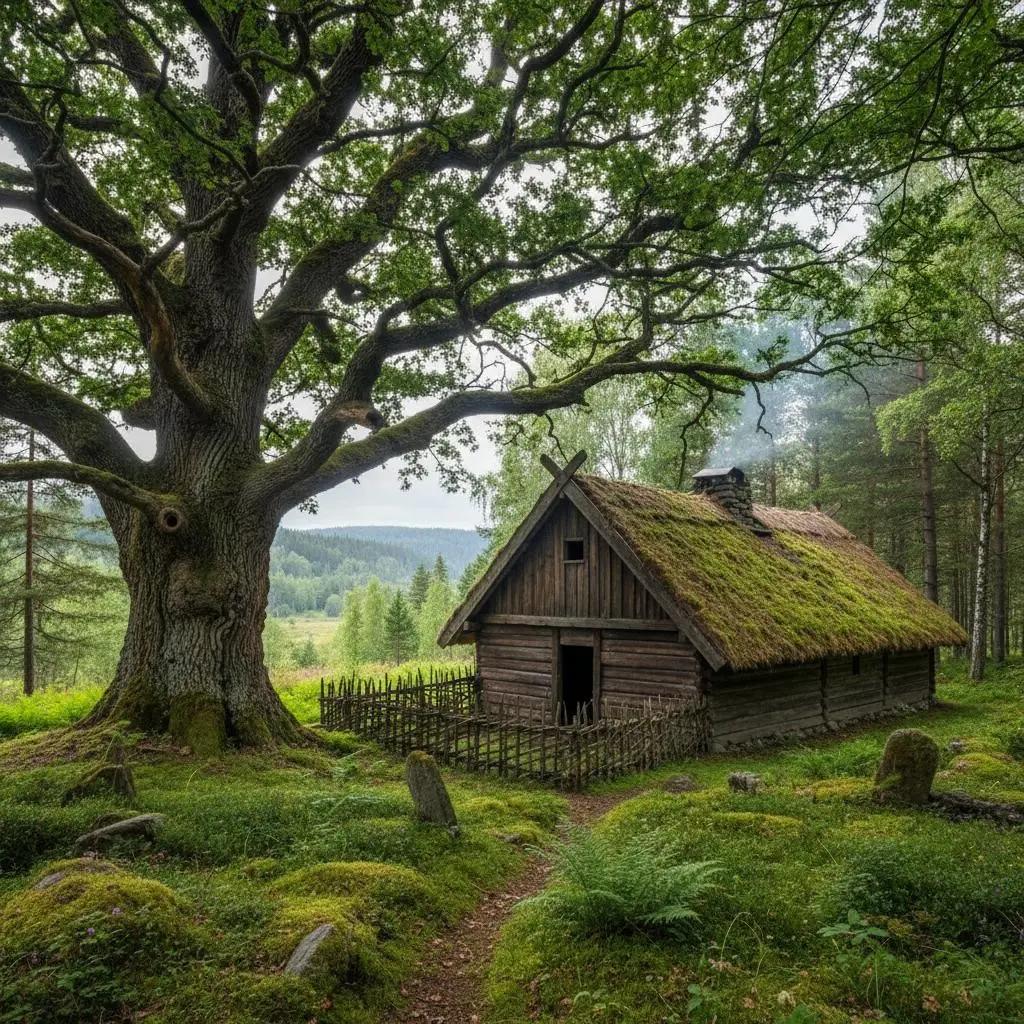
In a shamanic light, trees become bridges between human and god, between the present and the ancestors, between earth and sky. When we plant a tree today, or sit in the shade of an old oak, we continue to live within this tradition – even if we are not always aware of it.
And perhaps, the next time the wind rustles through the branches, we may remember that we ourselves are part of a great, invisible tree, in which all our roots and branches are woven together in a cosmic community.
Sources
Andrén, Anders. Tracing Old Norse Cosmology. Lund: Nordic Academic Press, 2014.
Byock, Jesse L. The Saga of the Volsungs. London: Penguin Books, 2012.
Crossley-Holland, Kevin. The Norse Myths. New York: Pantheon Books, 1980.
Cusack, Carole M. The Sacred Tree. Newcastle upon Tyne: Cambridge Scholars, 2011.
Davidson, H.R. Ellis. “The Sword at the Wedding.” Folklore 71(1), 1960: 1–18.
Gilmore, Amanda. “Trees as a Central Theme in Norse Mythology and Culture: An Archaeological Perspective.” Scandinavian-Canadian Studies 23 (2016).
Hedeager, Lotte. Iron Age Myth and Materiality. London: Routledge, 2011.
Kvilhaug, Maria. The Seed of Yggdrasill. 2nd ed. Helsinge: Whyte Tracks, 2013.
Orchard, Andy. Dictionary of Norse Myth and Legend. London: Cassell, 1998.
Stern, Marjolein. “Sigurðr Fáfnisbani as Commemorative Motif.” International Saga Conference, 2015.
Eliade, Mircea. Shamanism: Archaic Techniques of Ecstasy. Princeton: Princeton University Press, 1964.