A dairymaid listens
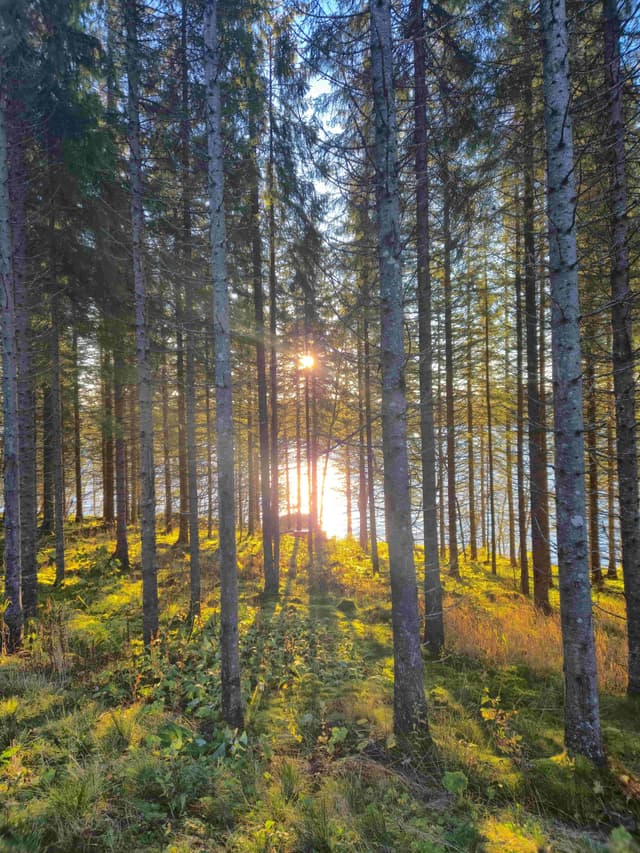
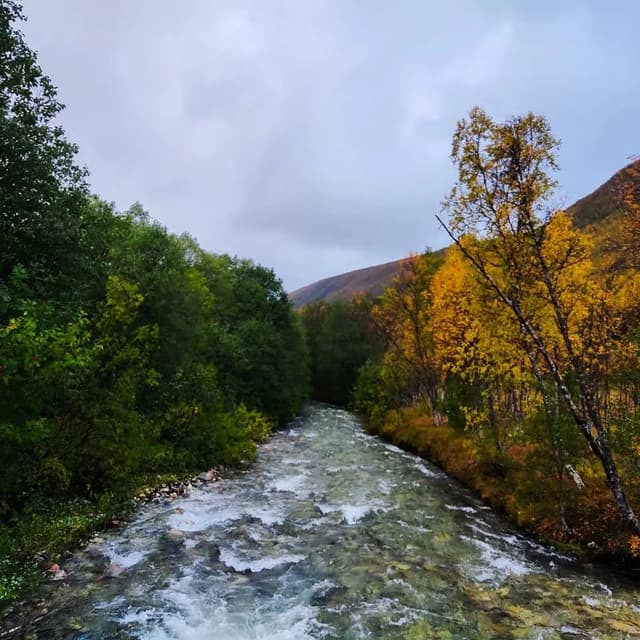
It is August, and the evening light lies long and yellowish over the Valdres mountains. The dairymaid Astrid has been at the mountain farm since Midsummer, and she now knows every single sound in the little valley: the cows' lowing, the brook's babbling, the wind in the birch thickets. But this evening something is different. From the edge of the ground down towards the bog rises a sound: a flute, clear and melancholic, with a melody unlike anything she has heard from human fingers. The melody swings up and down in a pitch that is neither major nor minor, and it does not end; it simply fades, as if sinking back into the ground.
Astrid sets down the milk pail. Her grandmother's words come back to her. When you hear the tusse flute, do not look for it, and do not say a word. She closes her eyes, waits, and the melody dies away. The next morning one of the cows is restless, but nothing is damaged. She has done the right thing.
Such moments are not literature: they are memoranda, personal accounts of experience, recorded in their hundreds from Norwegian mountain districts and written down by collectors such as Peter Christen Asbjørnsen from the mid-1800s. They are the traces of a world of imagination that for millennia lived alongside the Christian faith, beneath and next to it, in the layer of earth beneath the feet of the Norwegian farmer and mountain-farm dweller.
From þurs to tusse
The word tusse, in older Norwegian and in many dialects also tuss, is not an innocent diminutive form. It carries within it the Old Norse þurs (or þuss), an old word for troll, giant and hostile force of nature. The Norwegian Academy's Dictionary confirms this etymology and describes tuss in Norse mythology as "a giant, troll that dwells in the mountains and is the enemy of the gods and of humankind."
The connection to the world of giants is no coincidence. In Þrymskviða, the Eddic poem in which the giant Þrymr has stolen Thor's hammer, Þrymr is referred to as þursa dróttinn, "lord of the tusser", the ruler over the þursar. Here, then, þurs and tusse are the same word, denoting a people of overwhelming natural powers, dangerous and unpredictable. Over time, and especially through the Christian era, these notions sank from the cosmological to the popular, from the mythological struggle between gods and giants to the more intimate relationship between the farmer and his underground neighbours. The þurs became the tusse: no longer a world-spanning enemy, but a neighbour beneath the grassy bank.
Henrik Ibsen uses the form "thurs" in his early work; Henrik Wergeland writes of "the thursses' dominion restored in Norrig" (quoted from NAOB). Sigrid Undset has her characters in Kristin Lavransdatter refer almost unreflectingly to how "beneath every stone dwelt trolls and tusser and the elven folk" as a self-evident part of the world view. The word carries within it an entire cosmological layer.
What exactly is a tusse?
Wikipedia's article on Tusse defines them as "some of the most common supernatural beings or vetter in Norwegian folk tradition, namely the huldre folk, also called 'the underground ones' or 'the subterranean ones'." But this definition is too narrow if one wishes to understand what the tusser truly represented in the imaginative world of Norwegian peasant society.
The tusser are not individuals but a people, a parallel society. They live beneath the earth, in mounds, knolls, beneath mountain roots and thresholds, but they live a life that mirrors that of humans. They have men and women, weddings and funerals, barns and mountain farms. They have kings and priests. They work, fight, fear the sign of the cross and the sound of church bells, and they expect humans to respect their territory. Old Norse terms such as jardbu and jardbuar, "the people of the under-world", those who dwell in the home below, capture this cosmological dimension better than what later became folkloristic cataloguing, as Wikipedia's article on the underground folk describes.
The collective is central. A tusse is not primarily an individual; the tusser are a people. And this is what distinguishes them from a number of related figures.
Appearance and nature
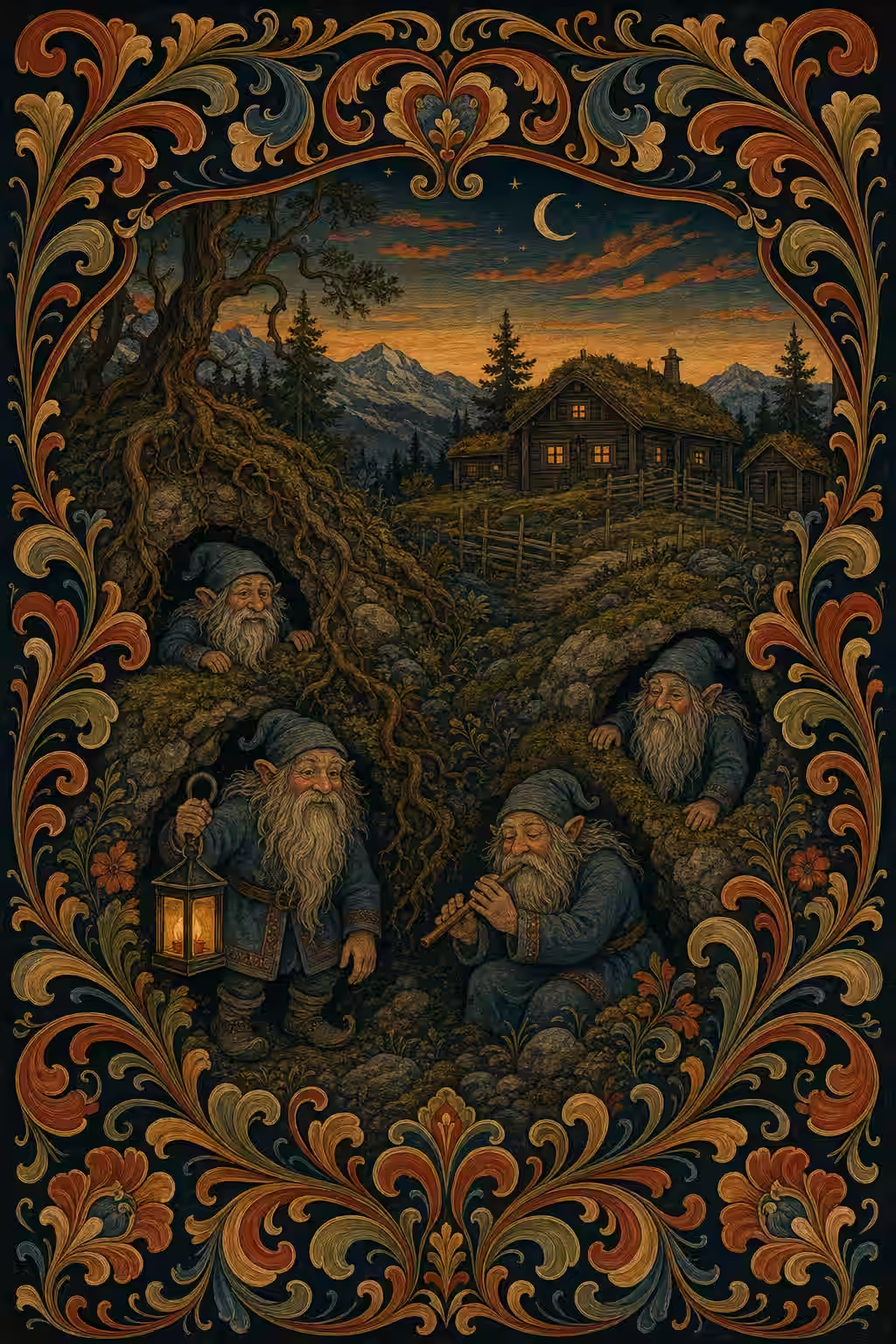
The males among the tusser are known in various regions as huldrekaller or tusseladder, short old men, often clad in grey or blue, with something old-fashioned and foreign about them. Some legends describe them as almost invisible, noticeable only as a shadow in the grass or a breath by the ear.
The tusse women, the huldre, appear in legend as inexplicably beautiful, often as dairymaids with golden hair, but they carry a giveaway: the cow's tail hanging beneath the skirt, or the hollow back. Wikipedia's article on Huldra points out that the cow's tail and the hollow back are "epic criterion motifs": in the accounts of experience, the narrator believes he is meeting an ordinary human woman until he catches sight of these signs and realises this is not a human being.
In some dialects the tusse is described as "a small furry ball", no bigger than a clenched fist, an almost abstract being, a force of nature without clear form, as NAOB quotes from Regine Normann's fairy tales. This shows how broadly the concept ranges, from the near-human huldrekall to something almost elemental.
Tusser from south to north
Norway is a long, stretched-out country with sharp local traditions, and the tusser change character from valley to fjord.
Setesdal is perhaps the fascinating exception. Here the tusser were considered Christianised: they went to church, built their own churches, and had their own priests. Wikipedia's article on Tusse relates that on Saturdays, beer, flatbread and first fruits were offered to tusser and vetter at the tusse mounds, mounds that were readily identifiable as older burial mounds. Both groups were regarded as guardian spirits for the prosperity and welfare of the home.
Valdres is known for the tusse flute, the strange melody that young musicians learned from the tusse folk at the mountain farm, often against their will, and which they could never afterwards quite forget. The music stood in a special, ambivalent relationship to the underground world. It was bridge and threat at once.
Gudbrandsdalen and Nordland used the term tuftekall for the corresponding being, a form that traces back to dialectal forms with strong ties to the tuft (the old homestead site) and thus to the ancestors who cleared the land.
Telemark is rich in huldre legends and stories of intercourse between the tusse folk and humans, with strong elements of music and dance.
Mountain-farm life and the double territory
The relationship between the tusser and humans was structured, almost contractual, around the cycle of the year and the use of the mountain farms.
Wikipedia's article on the underground folk states that the underground folk lived at the mountain farms during the part of the year when humans stayed in the village. In summer, when people drove their livestock to the mountains, the transition had to be marked ritually. One knocked on the mountain-farm door, asked permission to live there that summer, and consecrated the farm with fire, a marking of ownership before the beings who had kept house there through the winter. If one failed to do this, the huldre folk might take revenge by making the livestock ill or causing other harm.
A well-known migratory legend, referred to by Wikipedia's article on the underground folk, tells of the girl left alone at the mountain farm. The huldre folk come and try to make her marry one of their own. Her sweetheart arrives at the last moment and saves her, sometimes with a silver heirloom button in his rifle. The legend is not merely a tale of suspense. It is an exploration of the boundary between human society and the parallel folk, and what happens when that boundary is threatened.
The crucial distinction: tusse, haugbonde, nisse and huldra
Here it is necessary to pause and draw clear lines, for these four figures have been blurred together through popularisation and commercialisation.
The tusser/tusse folk
A collective underground people with their own society, their own norms, their own territory. They are not primarily tied to one farm or one family; they belong to nature and to the underground, with a broad sphere of activity.
The haugbonde/gardvord
In some places he is identified as the ancestral spirit, the named, identifiable man who cleared the farm and who, after his death, became its guardian. Emil Birkeli's Fedrekult i Norge (1938) documents this culture of offering in detail: it is personal, farm-specific, tied to lineage. The tusser are a people, a nature folk. The haugbonde is a specific ancestral spirit tied to one particular farm and its lineage. The one is nature religion; the other is kinship religion.
The nisse/fjøsnisse/tuftekall
The nisse is the farm's helpful household vette. He lives in the barn or beneath the threshold. He does night work, tends the horses, carries hay. He is a single figure, tied to one farm, and he demands payment: Christmas porridge, sour-cream porridge with butter on top, respect and punctuality.
The Huldra (individual figure)
The Huldra is the beautiful, alluring tusse woman's named form, a single figure from the tusse folk lifted out to individual, iconic status. Wikipedia's article on Huldra describes her as "a supernatural female being", but specifies that "the term hulder is also used as a collective term for underground beings". The Huldra is thus not separate from the tusse folk. She is its most famous public face: the localised, individual meeting point between humans and the underground folk.
The tusse flute and the tusse bride
The relationship between the tusser and humans was not merely a struggle over territory: it was also intercourse, dangerous and alluring. The tusse-suitor motif is widespread. A young man at the mountain farm meets a beautiful dairymaid, and it is only afterwards that he realises she was not of human descent. In some legends she marries him and loses her cow's tail at the church door. In others she is gone by morning, and the man is heartsick for the rest of his life.
Music is a central nerve pathway in this relationship. A young man heard the tusse flute's melody from a mound, learned it by listening through the ground or through a direct meeting, and brought it home with him, but the music came at a price. It was impossible to forget, it worked hypnotically, and the fiddler always lived a little between two worlds. Asbjørnsen and Moe's collections from 1845–48 are full of such accounts. Many of the older Hardanger fiddle tunes are said to have their origin among the tusse folk.
Religious and cosmological dimension
Behind the tusser and all the remaining folk belief about the underground folk lies an ancient notion which Wikipedia's article on the underground folk formulates thus: "Originally this concerns an ancient and globally widespread notion that human beings had a further life beneath the earth after death. One kept on good terms with the dead by making offerings to them to secure good living conditions."
The underground folk are, in this perspective, the dead who have not gone away. The living and the dead are not radically separated in this world view; they are neighbours in the same landscape. The Norwegian farmer's land also belongs to those who cleared it and were buried in it. The tusser's society is a mirror image of that of humans, but they are on the other side of the boundary that death constitutes, and this is what makes encounters with them so charged.
The encounter with Christianity changed these notions. The underground folk went "from being good and helpful beings" to something one had to be wary of. Crosses and the sound of church bells became the enemies of the underground folk. In Setesdal, the tusser were integrated into a Christian world view through a local theology that reconciled the old and the new without erasing either.
Place names, music and folk art
The tusser live on in place names: Tussevatnet, Tusseheimen, Tussefjellet, names that tell us they were given by people who had living conceptions of what dwelt there. They live on in music. The Hardanger fiddle repertoire is steeped in tunes connected to the tusser. In folk art, rosemaling, wood carving, national costume motifs, the huldra and the tusser continually appear as motifs that connect the present with an older understanding of the landscape.
The tourist industry has turned tusser and nisser into cute souvenir figures, but it is important to understand that this is a trivialisation of something that was genuinely serious in the pre-industrial peasant society: the belief that the earth was populated, that it had its own inhabitants with claims and rights, and that human welfare depended on this relationship being maintained.
Arne Garborg, who portrayed the late-modern encounter with the traditional Norwegian peasant soul better than anyone, understood this dimension. In his universe the landscape is never empty; it is charged with the unspoken: the knock on the door on arriving at the mountain farm, the sign of the cross made at the birch crossing in the outfields, the small lump of flatbread placed beneath the stone steps on a Saturday.
The tusser are the underground neighbours of a people who lived close to the earth, close to their dead, and close to what could not be explained. They are neither enemies nor friends. They are the third space between us and what we are not.
List of sources
Academic sources
Hodne, Ørnulf (1999). Norsk folketro. Cappelen Damm.
Hodne, Ørnulf (2016). Vetter og skrømt i norsk folketro. Cappelen Damm.
Kvideland, Reimund & Sehmsdorf, Henning K. (eds.) (1988). Scandinavian Folk Belief and Legend. University of Minnesota Press.
Asbjørnsen, Peter Christen (1845–48). Norske Huldre-Eventyr og Folkesagn. Christiania.
Birkeli, Emil (1938). Fedrekult i Norge. Norsk folkeminnelags skrifter. Oslo.
Reference works and online sources
Wikipedia: Tusse
Wikipedia: Underjordiske / Haugfolk
Wikipedia: Huldra
Wikipedia: Tonttu / Nisse (folklore)
The Norwegian Academy's Dictionary: tuss
Vest-Agder Museum: Tussa i folketradisjonen