Far to the north, beneath the great mountains and deep lakes of Sápmi, an invisible world has always existed. A world that lives in parallel with our own, and which only a few have been granted a glimpse of. Here, in the darkness beneath the earth, dwell the Ulddat – the subterranean ones.
The encounter with the hidden
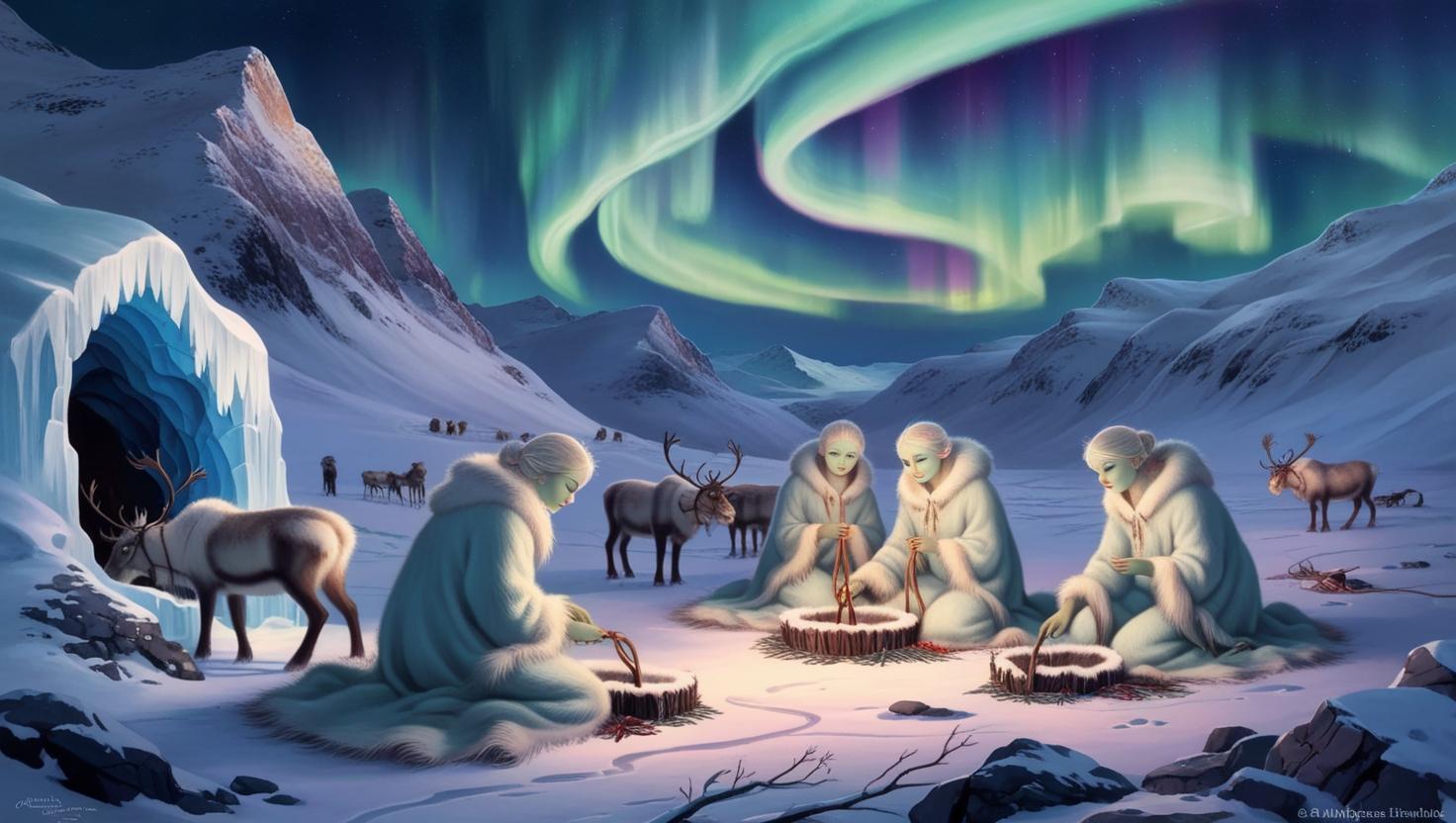
For generations the Sami have told of the Ulddat. They are not like us, but neither are they entirely different. Some say they look like humans, but that their skin is pale, almost translucent, and that their eyes can glow in the dark. They live in the mountains, in caves that no human can find, and sometimes you can hear their laughter when the northern lights dance across the sky. At other times they are silent, and only the sound of the wind across the plateau reminds us that they are there.
It is said that the Ulddat have their own societies, mirror images of human life. They have their own reindeer herds, their own homes and their own rules. But it all happens in the hidden, in a world behind our own. Sometimes, when the fog lies heavy over the rivers, the boundaries between the worlds can grow thin. Then it can happen that humans and Ulddat meet.
The stories that live on
There are many stories about the Ulddat. One of the most well-known concerns children who disappear. In a turf hut in Kautokeino, many years ago, a woman lay alone with her newborn child. She fell asleep, and when she awoke, the child was gone. Only a small scar on its belly bore witness that it had been there. People said that the Ulddat had taken the child, and left behind a changeling – a child that looked the same, but that would never be like the others.
Other tales concern trade and exchange. A man from Tana once caught an unusually large amount of fish. He told that he had met a stranger by the riverbank, and that they had made an agreement. The man was granted fishing luck, but had to promise his first child to the Ulddat. Such stories remind us that accepting gifts from the subterranean ones always comes at a price.
And then there are the stories of the white reindeer. Some say they have seen herds of white, unmarked reindeer on the mountain, and that these belong to the Ulddat. They are beautiful, but also dangerous – for anyone who tries to catch them may disappear forever.
Rituals and respect
For the Sami, the Ulddat have never been mere fairy tales. They have been a part of everyday life, a force that must be reckoned with. When someone was to make camp, they took care not to do so near places where the Ulddat dwelt. Mountains and stones known to be portals to the subterranean ones were respected. No one cut wood there, and no one hunted in these areas without first making an offering.
Often silver coins were buried at the foot of the mountain, or milk and blood were poured out as a gift. Sometimes the shaman, the noaidi, used his drum to communicate with the Ulddat. He could travel in trance to their world, negotiate to recover an abducted child, or ask for help in curing illness.
When the world becomes unsafe
In times of illness and hardship, people often turned to the Ulddat. When cholera came to Finnmark in the 19th century, people gathered to sacrifice reindeer to the subterranean ones. Perhaps, they thought, this would appease the Ulddat and bring health back to the village.
Women also had their place in the encounter with the Ulddat. In some areas they danced naked under the full moon to pray for fertility, hoping that the female Ulddat would hear their prayers.
The Ulddat and the Christian era
When Christianity came to Sápmi, the missionaries tried to eradicate the belief in the Ulddat. They called them demons, and warned against having anything to do with them. But the belief in the subterranean ones did not disappear. It lived on in secret, in stories told around the fire, and in small rituals performed in hiding.
The Ulddat today
Today the Ulddat live on in Sami art and literature. In novels and poems they are used as symbols of the hidden and the resilient – a reminder that not everything can be seen, and that some forces will always live beneath the surface. The white reindeer, the invisible societies, and the old rituals remind us of a time when the world was greater, and the boundaries between the visible and the invisible were thinner. Who knows, perhaps one may still meet the Ulddat out on the plateau.
A legacy of respect
The stories of the Ulddat have always been about respect. Respect for nature, for the unknown, and for the forces we cannot control. They have taught the Sami to live in balance with their surroundings, to take no more than they need, and to remember that we are only guests in a greater world.
Today, when people walk across the plateau, they can still feel a chill from beneath the earth. Perhaps it is only the wind. Or perhaps it is the Ulddat, watching over us – as they always have.
Sources:
Mebius, Hans (2007) Bissie, studier i samisk religionshistoria. Östersund: Jengel förlag.
Pentikäinen, Juha (1996) Shamanism and Northern Ecology. Berlin: De Gruyter.
Spangen, Marte (2020) "Sámi Myths and Medieval Heritage" in Myths and Magic in the Medieval High North. Turnhout: Brepols.
Sara, Máret Ánne (2016) Mellom verdener. Guovdageaidnu: DAT.
Oskal, Nils (2000) Traditional Sámi Reindeer Husbandry. Karasjok: Davvi Girji.
Kusmenko, Juri (2008) The Sami and Scandinavians. Berlin: Humboldt-Universität.