It often begins with a boundary. A farm at dusk. A fringe of forest that darkens before the rest of the landscape. A person who is no longer quite human. In Nordic tradition, the werewolf is precisely such a figure: not merely a monster, but a being who slips between forms, and who thereby reveals just how fragile humanity really is. He does not enter the story as a clearly defined animal, but as a question: what happens when that which is tame returns to the wild?
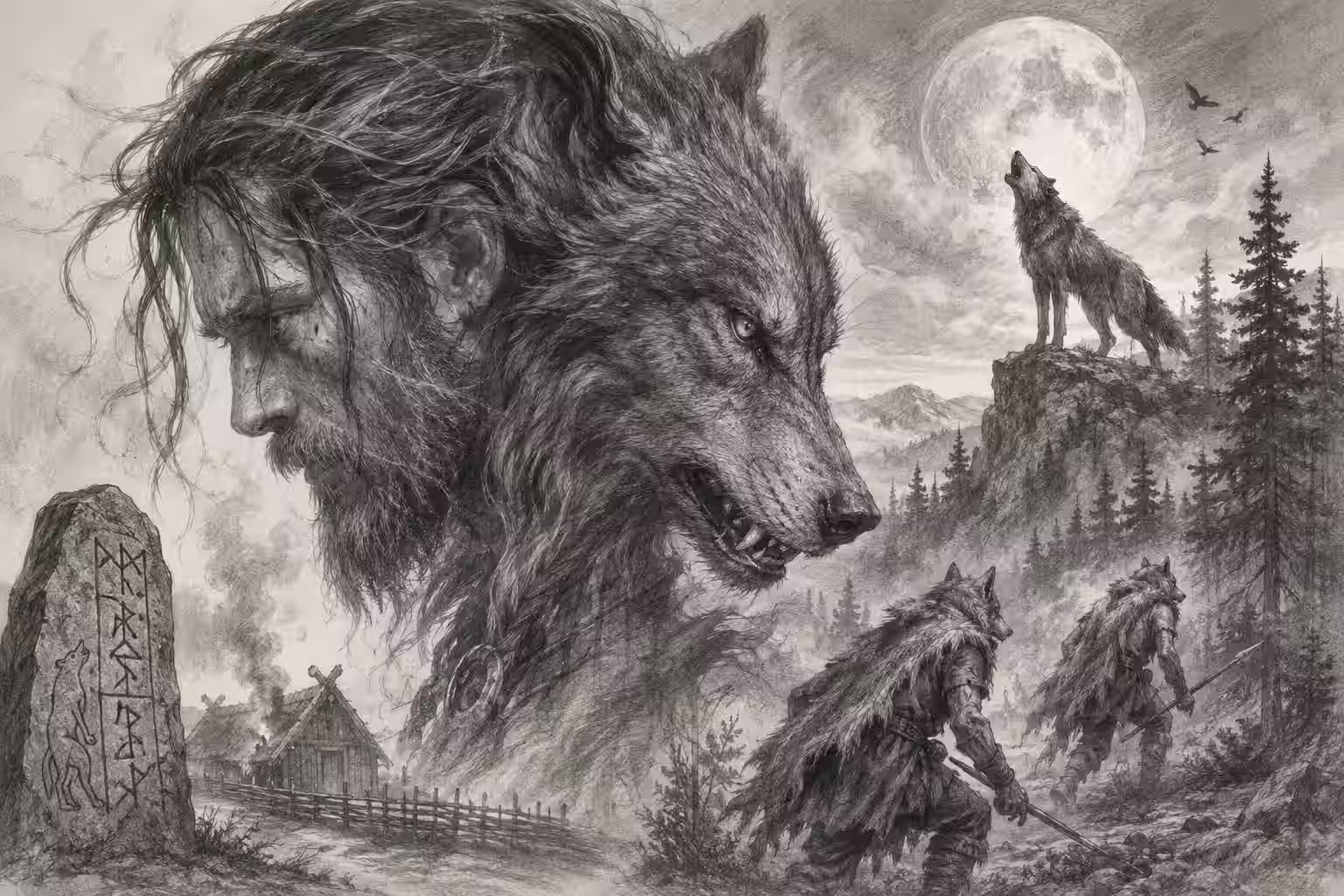
There is something disturbingly beautiful about this old notion. The werewolf is not made of fear alone; he is made of transition. Research points out that Old Norse texts often let the transformation occur through hide, hamr, clothing or magical external markers, rather than through the modern idea of a curse under the full moon. Thus, in Nordic mythology, the werewolf becomes not simply a man turning into a wolf, but a person who loses or exchanges form, and who in that very moment also loses part of his social identity. It is this duality that makes him so alive in the text: he is both hunter and hunted, both the one who stands within the community and the one driven out of it.
He was born in a leap year, a winter's night hour,
with shroud-clad hills and closed sounds,
while the driving snow lashed at wall and window,
and the wolf howled at the gate out there
(Werewolf! Werewolf!)
The poem Werewolf by Per Sivle
The wolf's shadow
The wolf has always held a special place in the Nordic imagination. It is at once feared and respected, a predator carrying the law of the wilderness in its body. In werewolf tales, this shadow of the wolf is cast over the human being, and the result is a figure bearing an almost painful tension between control and instinct. Minjie Su describes how the Old Norse tales work precisely in this in-between space, between human and monster, between the ordered world and what lies beyond it.
It is no coincidence that the werewolf in the Old Norse texts often appears in liminal zones: at border farms, in forests, in the space of night, or in landscapes already marked by distance from law and kin. He belongs at the margins. And the margin, in Old Norse poetry, is never merely geography; it is also psychology. He who goes out into the outlying land simultaneously leaves the protected human space. When the werewolf steps forth there, it is as if the landscape itself begins to think with the predator's gaze.
The hide that falls
One of the most gripping episodes in Old Norse tradition is found in the Völsunga saga. There, Sigmund and Sinfjötli put on wolf skins, and as they do so, they are transformed. They begin to live as wolves, hunt as wolves, and to some extent also be wolves. But they are not entirely gone as human beings. Precisely for this reason the scene feels so uncanny: the human does not disappear. It remains within the beast as an inner unrest.
This type of tale shows that the werewolf in Nordic tradition is not primarily a biological metamorphosis, but an existential one. The hide is more than a garment; it is a threshold. When it is laid over the body, it is also laid over the identity. In such moments, the person becomes something else, but not in a simple way. He becomes more restless, more violent, more unresolved. Research highlights precisely that Old Norse werewolf figures cannot be reduced to one fixed model, because they often express an unfinished struggle between form and being.
And perhaps this is why these tales still capture us. They are not just about becoming an animal. They are about discovering that the animal already lies close beneath the skin.
The dual nature
In the werewolf myth there is always a double movement. On the one hand, there is a descent: the human slides towards wildness, blood, the hunt and the night. On the other hand, there is a kind of strange clarity. For in the moment the human loses form, it also becomes visible what form actually is. The werewolf reveals boundaries by breaking them.
This makes him more than a figure of horror. He becomes an image of inner division, of anger that cannot be tamed, of identities that do not quite fit within the language of community. Minjie Su shows that the Old Norse werewolf texts often exist "between the monster and the man", and it is precisely in this in-between space that their power arises. It is not a quiet space; it is a space where body, will and social order collide.
In some tales, the connection to warrior culture is also evident. The wolf-hame stands close to the ecstatic and the violent, and research has often placed werewolf material in relation to figures such as berserkers and wolf-warriors, although these are not the same. Here the wolf becomes an image of the masculinity that has been loosed from ordinary bonds, and which is therefore also dangerous. It is not merely a creature that tears others apart; it tears apart the idea of what a man should be.
At the forest's edge
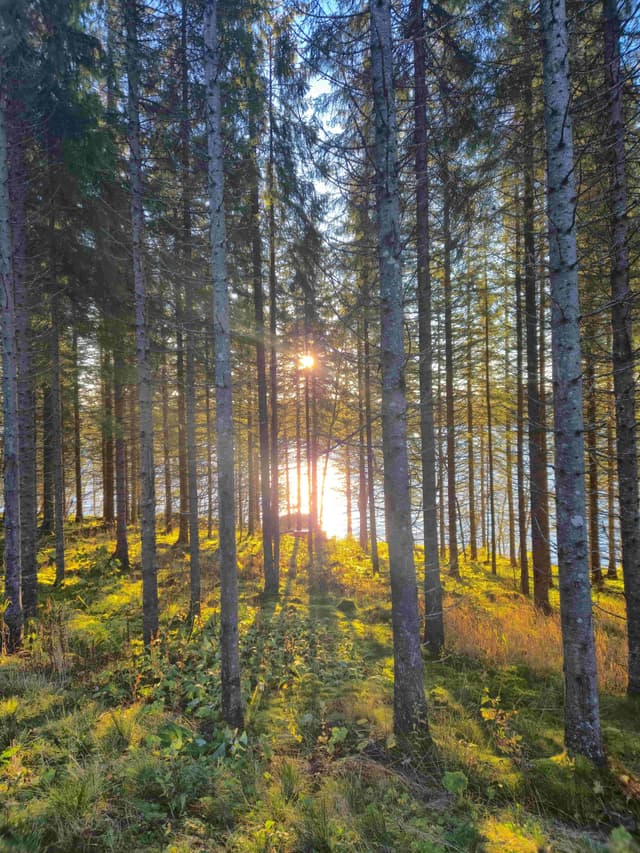
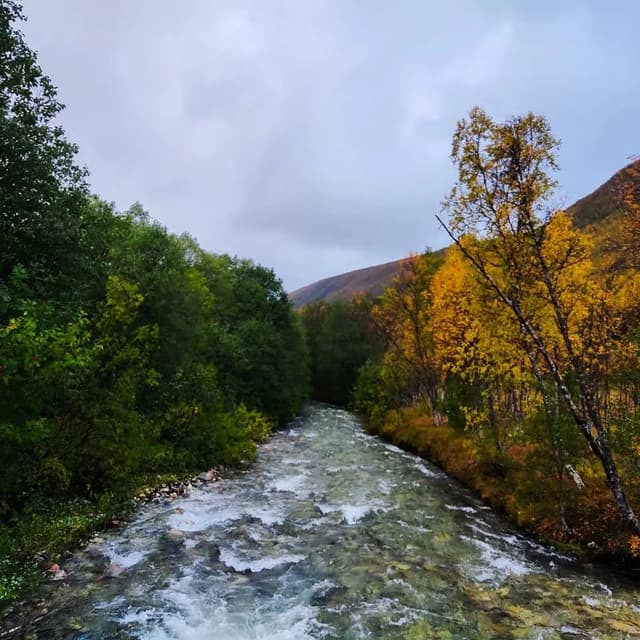
There is something particularly Nordic about the way the werewolf moves. He does not come from an abstract darkness, but from a specific landscape: the forest, the mountain, the night-field, the boundary between farm and outlying land. These places are never merely backdrop. They are active spaces where order loosens and old forces slip free.
When the werewolf appears in such surroundings, he becomes part of nature's own story. He is not a foreign being who merely happens to be there; he is an expression of what the landscape can do to a person. In Nordic tradition this is especially important, because nature is rarely neutral. It is by no means only a place one passes through. It is something one can lose oneself in, both physically and spiritually. The werewolf is the one who has gone so far that the boundary between inside and outside has collapsed.
This is also mirrored in the tales' language of food and body. Su points to how werewolf texts can work with notions of blood, raw meat and gradual steps away from human ethics. It is as if the tales let the reader feel the transition in the mouth. To become a werewolf is not merely to look different; it is to taste differently, desire differently, to swallow the world in a new and more brutal way.
From riddle to horror
There is a particular power in that which cannot be fully explained. The werewolf in Old Norse tradition lives precisely on this ambiguity. Research shows that the Old Norse texts do not give us one unified teaching about werewolves, but several variants of transformation, skin-changing and human dissolution. Therefore, the werewolf can be at once cursed, ritual, socially marginalised and symbolically charged.
In later Nordic folk belief, the image often becomes more straightforward: the werewolf is a person transformed into a wolf, bear or dog, often through sorcery or a curse. But the older Old Norse tradition is more open, more literary, more ambiguous. There, it is not always clear whether the person has become an animal, or whether the animal has simply awoken within the person. And it is precisely this uncertainty that makes the figure so powerful. The werewolf is not merely an answer; he is a question that growls in the dark.
A figure that mirrors us
When we read the werewolf in Nordic mythology today, it is easy to think that he belongs to a distant and barbaric past. But in fact he is surprisingly modern. He contains everything we still struggle to understand: the fluidity of identity, the body that does not always obey the will, the social role that can collapse, and the dark freedom that comes with releasing control. This is why the werewolf still feels so powerful in literature and culture. He is not merely old. He is recognisable.
Research emphasises that werewolf tales are precisely about transitions, boundaries and the unresolved. Within this lies something deeply human as well. For every generation needs its own images of monsters, and the most enduring are often those that not only frighten, but also explain something about ourselves. The werewolf does exactly that. He shows that the human being is not a closed entity. Beneath the skin, there is always something listening towards the forest.
The last wolf skin
So he stands there at last, not as a simple figure of horror, but as one of the most complex figures in the Old Norse imagination. A man in wolf-hame. A body that can no longer be held fast in a single form. A tale of what happens when culture's thin layer cracks and wildness slips in through the fissures. In the sagas and in research, he lives on as a sign that identity is never entirely safe, never entirely finished, never entirely human in the simple sense.
And perhaps this is why the werewolf still recurs in Nordic culture: because he reminds us that the wild is never entirely gone. It merely stands outside the light, waiting. When evening falls, and the forest begins to grow deeper than the map, something may come through the darkness that was once a human being.
Sources
Minjie Su, Werewolves in Old Norse-Icelandic Literature: Between the Monster and the Man.
The article Varulven i fornnordisk tradition.
Store norske leksikon
Norsk Ordbok / NAOB
Institutet för språk och folkminnen
Varulv – Wikipedia