We are not the only ones doing this
There is something that happens in a ceremony, where the boundary between the one drumming and what the drum calls forth becomes thin. The light dizziness. The feeling that something opens up which has always been there, we just don't usually see it. It's in that moment I remember that we are not alone in this. Everywhere, in every direction, people have found their way to the same cracks in reality. Just with other words, other tools.
This article is about some of the other paths, the broad field often called Western esotericism: alchemy, astrology, hermeticism, kabbalah, mesmerism, spiritualism, theosophy and the whole messy retinue of New Age. I look at them as a shamanist. Not to measure ourselves against each other, but because I believe we recognise more than we think.
No one really knows what this is
When the religious scholars Henrik Bogdan and Olav Hammer were to write the introduction to Western Esotericism in Scandinavia (Brill, 2016), they actually began by admitting that no one has managed to agree on what "Western esotericism" really is. A bit like it is with the word shamanism. Alchemy from the 1500s and UFO movements from more recent times end up in the same book, and no one can quite explain why. What they do agree on is which currents belong there: a list they mostly borrow from the great work Dictionary of Gnosis and Western Esotericism (Hanegraaff et al., 2005), which lists around 300 currents and figures across more than 1200 pages.
I recognise myself in that. I've been asked "but what IS shamanism really" countless times, and each time the answer slips a little between my fingers. Perhaps that's not a problem to be solved. Perhaps that's just what spiritual life is like: it can't be pressed down into a single definition. Bogdan and Hammer use a fine expression, air de famille: a family air that hangs over all of this without any single trait being common to all of them. It's how you recognise a cousin you've never met. Not because he's like you, but because there's something in the look that says you come from the same root.
Bureus and the runes: when the foreign became familiar
There is an example I particularly like. The sociologist Roland Robertson called it globalisation: how global ideas travel in and become something local and new. The Swedish 1500-century scholar Johannes Bureus had thoroughly studied the Jewish kabbalah's idea that the Hebrew alphabet carried hidden, cosmic powers. Instead of simply importing it, he did something else: he built up a corresponding system around the Nordic runes. Signs that had been carved into wood and stone for generations suddenly took on the same weighty, secret meaning as the Hebrew letters.
We recognise that. No spiritual tradition arises in a vacuum. Shamanism has always done exactly this: taken in what already existed around it and made it its own. When a longing meets symbols it doesn't already know, it often reaches for what is already sacred at home (runes, mountains, rivers) and lets the foreign wisdom speak through it. That's not cheating. That's simply how transmission works.
The alchemists were searching for something more than gold
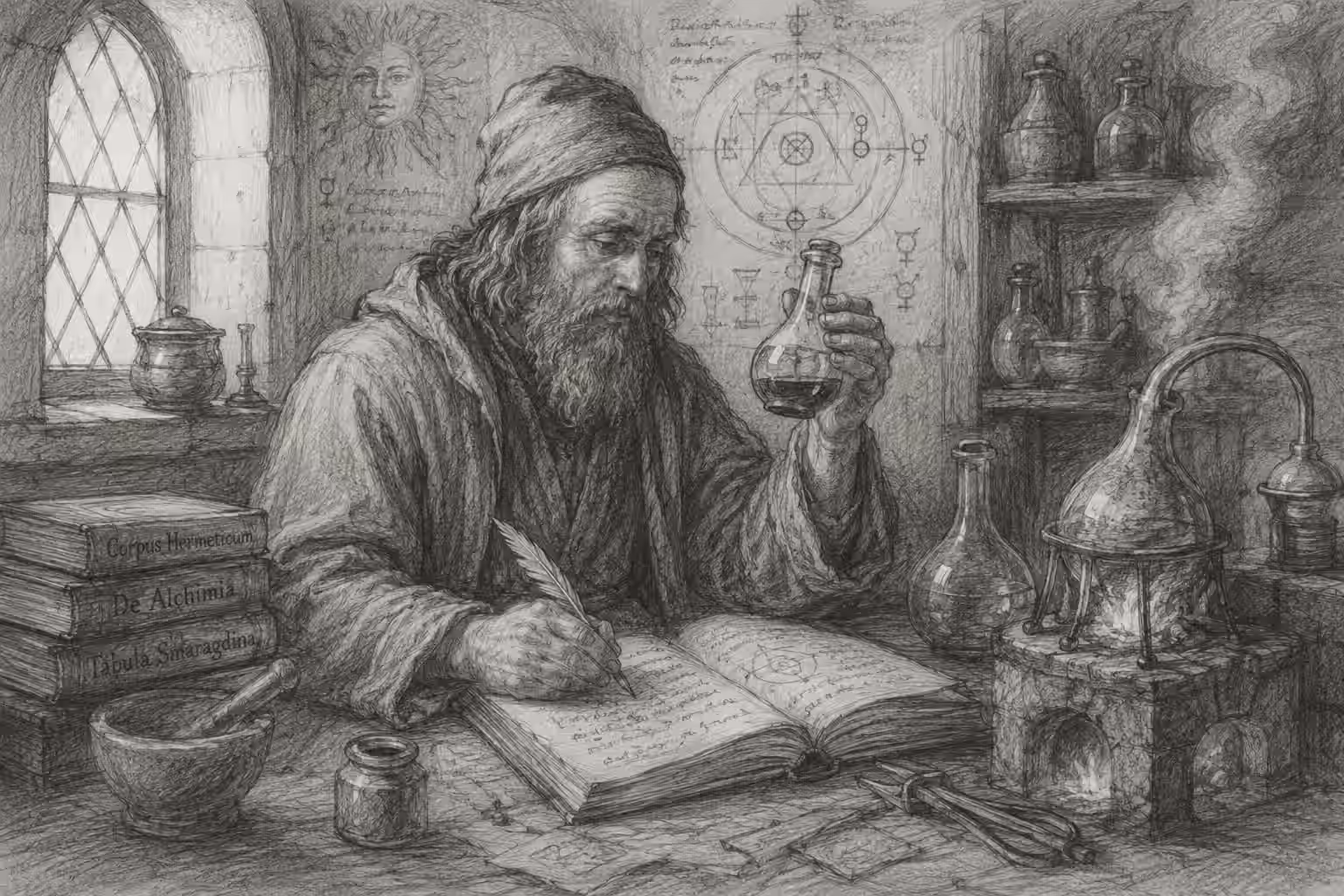
Before chemistry and magic were clinically separated, the alchemists sat by their furnaces searching for the Philosopher's Stone, not just to make gold, but because they understood, perhaps without saying it aloud, that what happens on the outside is connected to what happens within. There's an almost comical story about the Norwegian priest Hans Egede, missionary to Greenland in the 1700s, who sent for alchemical writings and tried to make the Philosopher's Stone up there. A man sent out to preach one thing, quietly hunting for something else entirely.
Alchemy is a distant cousin of what we do. We seek transformation through drum, journey and contact with helping spirits. The alchemist sought the same thing through fire and metal and patient work. Different tools, the same longing to understand that the visible is connected to something invisible.
The stars and the ban on reading them
Astrology had a strange journey in Scandinavia. In the 1500s it was part of the actual curriculum at the University of Copenhagen, and the astronomer Tycho Brahe delivered predictions directly to the Danish king. But the wind turned: the theologians believed it threatened belief in human free will, and in 1633 King Christian IV banned specific predictions in almanacs, because it apparently could provoke God's wrath.
That fear, that reading signs in the sky would challenge a judging God, is distant to me. In shamanistic thinking there is no such opposition between reading nature's signs and respecting the greater powers. To read IS to listen. The astrologer who studied the stars did, at bottom, the same thing as the noaidi who read the reindeer's tracks or the flames in the fire: both were looking for patterns that bind the small human to the great. The difference is that astrology ended up as tables and calculation, while our reading has always been a conversation: the spirits answer back. The stars are silent. The spirits speak.
Secret knowledge as salvation
Hermeticism and kabbalah share the belief that salvation, or at least insight, comes through knowledge, gnosis, a wisdom that lifts you above the sleeping, ordinary human being. Here perhaps lies the clearest kinship: both are initiatory traditions. No one becomes a shaman or noaidi by reading a book. It requires an inner death and rebirth, a journey through the darkness before you can carry something back to the community. The hermeticist sought it through text and numerology. We seek it through pain, fasting, drumming. But the goal is similar: to become the one who has seen behind the veil and can be a bridge for the others.
There was a secret order, Metatron, probably founded in the 1720s, which believed Freemasonry had revealed too much of "the arcane sciences" and which secretly tried to contact angels and higher beings. I recognise that logic: that not all knowledge can withstand daylight, that some things can only be carried by those who have prepared themselves. We guard our initiation rituals and the drum's patterns for the same reason.
Swedenborg: perhaps the closest thing to a shaman Scandinavia has had
No figure in this history resembles a shaman more than the Swedish natural scientist Emanuel Swedenborg. In his last thirty years he wrote book after book about conversations he had with angels and spirits in other worlds. It's tempting to call him a North European shaman in a scientist's clothing: he moved between the material and the spiritual as if it were as natural as walking out the door.
His ideas first took root abroad, not at home. But in the 1770s Duke Karl, later king, gathered a small circle at the castle to contact the spirits of the dead, practise ritual magic and conduct alchemical experiments. It's not unlike a ceremonial circle: a group of people trusting that the spirit world is accessible to more than just one chosen person.
Mesmerism and the invisible current
Towards the end of the 1700s, mesmerism came to Scandinavia: the idea of an invisible life force that could be directed to heal. In Denmark, several cultural figures called it one of humanity's great discoveries. This is perhaps the clearest meeting point with shamanistic healing: the belief that there is a force flowing through all living things, which a trained person can direct to where it has stopped. The mesmerist used his hands. We use the drum and the breath and the helping spirits. But the basic idea is the same: illness is often about something that has stagnated.
Table-rapping and theosophical world brotherhood
In the 1850s, news of spiritualist séances (spirits rapping out answers through furniture) reached Denmark, and it quickly became the talk of intellectuals and artists. A Swedish spiritualist society was founded in 1877. A little later came theosophy, with lodges in all the major cities: there were even plans to build a world centre on the island of Visingsö, plans that fell apart after the leader's death.
Spiritualism's séances and our spirit rituals share a fundamental belief: that the dead are not gone, only somewhere else. But here we part ways too. The spiritualist is often passive: a medium the spirit speaks THROUGH. Our journey is something else. We ourselves travel to the realm of the dead, negotiate, ask for help, give something back. The table doesn't rap on its own with us. It is the drummer's preparation that opens the gate.
New Age: messy, but sincerely meant
The last decade of the previous century was, as Bogdan and Hammer write, a time of "massive religious experimentation". Anthroposophy gained a strong foothold in Norway. Occult orders, Rosicrucian groups, and not least New Age, which still fascinates large parts of the population up here.
New Age is probably the current I encounter most closely, because that's where people tend to meet us: in the festival tent, on retreat, on the alternative shelf of the bookshop. And yes, it deserves the criticism it gets, with its tendency to pick crystals from one tradition and chakras from another without always taking on the responsibility that belongs with them. But I won't dismiss it for that reason. New Age has, with all its shortcomings, done something important: told an entire generation that there is a spiritual reality outside the church walls, accessible to anyone, not just the priest or the initiated elite. That is actually something shamanism has always practised: with us, the healer and the seer can turn up from any corner of the village, not just from a particular priesthood.
The alchemist's furnace, the astrologer's star chart, the hermeticist's texts, Swedenborg's conversations with angels, the mesmerist's hands, the spiritualist's rapping table, the New Age seeker's messy search: all of it is an attempt to answer the same question the shaman has asked since the beginning. Is the world only what we can touch and feel, or are there doors we haven't yet learned to open?
I am not saying shamanism is the same as any of this. We have our own burden and gift: the connection to the landscape, to the ancestors, to the spirits that belong to precisely our mountain and our river. But when I meet the alchemist, the astrologer, the hermeticist and the theosophist along the way, I feel the kinship. We are all people who have refused to believe that reality stops where the eyes stop seeing. That is worth honouring, whatever guise it comes in.
Sources:
Bogdan, Henrik and Olav Hammer, «Introduction», in Western Esotericism in Scandinavia, ed. Henrik Bogdan and Olav Hammer, Leiden/Boston: Brill, 2016.
Bogdan, Henrik and Olav Hammer, «Research on Esotericism in Scandinavia», in Tore Ahlbäck (ed.), Western Esotericism, Åbo/Turku: Donner Institute, 2008, pp. 38–49.
Hammer, Olav, «Old New Religions in Scandinavia», in James R. Lewis and Inga Bårdsen Tøllefsen (eds.), Nordic New Religions, Leiden: Brill, 2015.
Hanegraaff, Wouter J. et al. (eds.), Dictionary of Gnosis and Western Esotericism, Leiden: Brill, 2005.
Robertson, Roland, Globalization: Social Theory and Global Culture, London: Sage, 1992.