Shamanism is a spiritual practice found all over the world that dates back thousands of years. At the core of the shaman's work is communication with the spirit world, often by means of spirit journeys, visions, and contact with spirit guides. These techniques are used both for personal insight and guidance, and to help others understand and solve complex problems. Spirit guides, which can take the form of animals, ancestors, or other spiritual beings, play a key role in the shaman's work. We look at how shamans use visions and spirit guides as tools for gaining insight, with examples of modern practice, including the founding of Sjamanistisk Forbund, which illustrates how visions are still a living part of shamanic reality.
Visions as portals to insight Visions are a central part of the shaman's world and serve as an important tool for gaining access to hidden knowledge and understanding. For a shaman, a vision is not merely a subjective experience, but a real communication with the spirit world. Visions can arise through a range of techniques, such as drum journeys, meditation, or fasting. By entering a trance or altered state of consciousness, the shaman can gain access to deeper insight about life's challenges, healing, or future events.
In many cultures, visions are an integral part of the shaman's mission. For example, among the North American indigenous peoples, young men often seek visions through a so-called vision quest in order to gain insight into their life's direction or tasks. In this process, they isolate themselves in nature, without food or drink, and seek contact with the spirit world through dreams and visions. This process can take several days and involves deep self-reflection and communication with spirit guides.
Spirit helpers as guides A spirit guide is a spiritual guide who helps the shaman navigate the spiritual world and understand the visions or insights that are received. These spirits can take the form of animals, ancestors, elemental forces, or other beings from the spirit world. In many traditions, it is common to have a personal spirit guide who accompanies the shaman throughout life, helping them interpret visions, find answers to questions, or perform healing rituals.
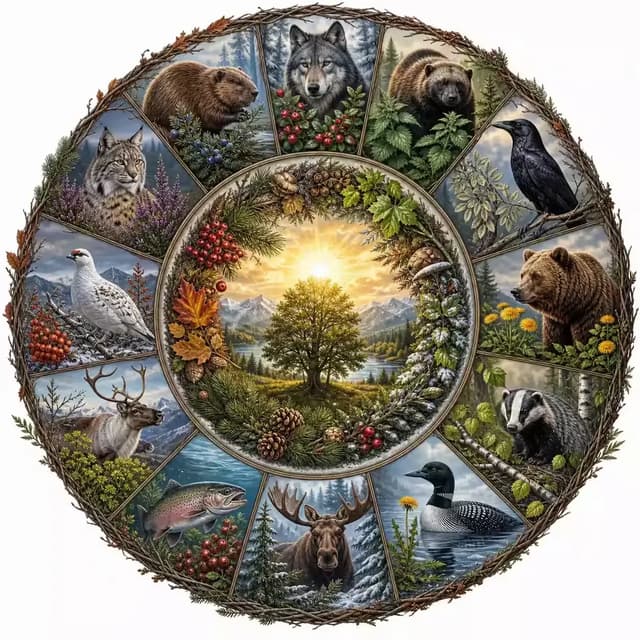
Animal spirits, or power animals, are especially important in shamanism. They represent specific qualities and forces that the shaman can draw on in their work. For example, a bear may symbolize strength and protection, while a wolf may symbolize wisdom and togetherness. Spirit guides can appear during a drum journey, in dreams, or spontaneously during meditation or everyday activities. For shamans, these spirits are as real as people, and they serve as teachers, protectors, and helpers in the shaman's daily work.
The relationship between the shaman and their spirit guides is deeply reciprocal. The shaman shows respect and honor to their spirit guides through rituals, offerings, and gratitude, while the guides provide wisdom and protection in return. This relationship is an important part of the shaman's success in their spiritual work.
The drum journey, the bridge to the spirit world A spirit journey is a technique shamans use to leave the physical world and travel to the spiritual world to receive guidance or healing. During a spirit journey, the shaman enters a trance, often with the help of drumming, chanting, or meditation. In this altered state, the shaman can travel to different "worlds" – often described as the lower world, the middle world, and the upper world – to meet spirit guides and gain insight.
Spirit journeys can be used for many purposes, including healing, soul journeys, and retrieving power. To carry out a spirit journey, the shaman must have a clear intention, for example to find the answer to a question, restore a person's balance, or retrieve power from a specific spirit or power animal. In this state, the shaman can see visions, meet spiritual beings, or receive direct guidance from the spirits.
In shamanic traditions, the drum journey is regarded as a bridge between the physical and spiritual world. It is a direct way to make contact with the spirits and gain insight that can help both the shaman themselves and the people they help. This ritual is universal in shamanic practice, although the details may vary between cultures.
Dreams as guidance Dreams also play an important role in shamanic insight. In many cultures, dreams are regarded as a realm in which the spirit world can easily communicate with the shaman, since the soul is thought to be more open and receptive during sleep. Shamans use dreams to receive omens of future events, solve personal or collective challenges, and receive messages from spirit guides.
Dream work is closely connected to shamanic wisdom and insight, and many shamans place great emphasis on interpreting their dreams in order to understand what the spirits are trying to convey. In some cases, special dreams may be considered so important that they trigger a ritual, a healing, or spiritual work to ensure that the message of the dream is understood and acted upon.
The founding of Sjamanistisk Forbund A modern example of how visions still play an important role in shamanic practice is the founding of Sjamanistisk Forbund. This federation was created as a response to a vision from the founder about the need to bring together and promote shamanic traditions in modern times.
The vision underlying its founding was to create a community in which shamanic practitioners could share experiences, practice spiritual practices, and preserve traditions in a world that is becoming increasingly urbanized and distanced from nature. The founder of the federation tells of visions that gave them clarity about how they could bring together people with a shared shamanic interest and strengthen the spiritual community. This event illustrates how visions are still an integral part of shamans' reality, and how spiritual insight can lead to concrete actions and organizations that serve the community. Visions and communication with spirit guides are essential parts of the shaman's toolkit for attaining insight, guidance, and healing.
Sources:
Harner, M. (1990). The way of the shaman. Harper & Row. Paine, R. (2003). Reclaiming the drum: Noaidi and the rebirth of Sami spirituality. Nordic Folklore Studies. Tedlock, B. (2005). The woman in the shaman's body: Reclaiming the feminine in religion and medicine. Bantam Books. Vitebsky, P. (1995). The shaman: Voyages of the soul, trance, ecstasy, and healing from Siberia to the Amazon. Duncan Baird Publishers.