Rock carvings in Norway give us a unique insight into the belief systems and rituals of prehistoric societies. From a shamanic perspective, many of these rock carvings can be interpreted as visual representations of ritual scenes and spiritual practices. This analysis will focus on some of the most prominent rock carving sites in Norway and their shamanic significance.
Alta, Finnmark
The Alta complex, a UNESCO World Heritage Site, contains over 6,000 rock carvings spanning a period of nearly 5,000 years. Many of these images can be interpreted as shamanic in nature.
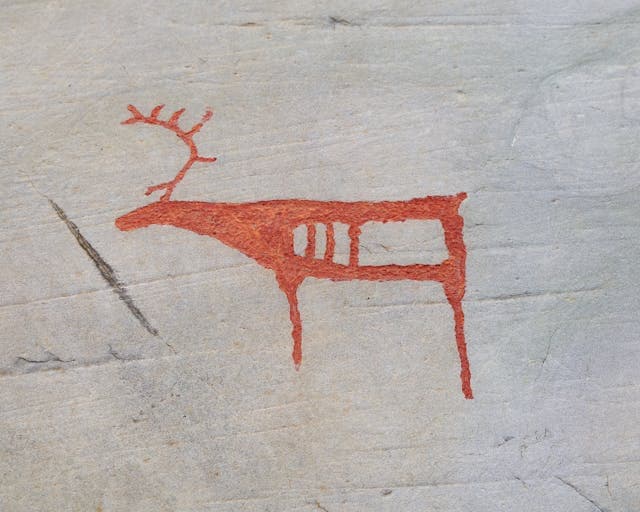
Reindeer scenes: Reindeer are a recurring motif in the Alta rock carvings. From a shamanic perspective, these may represent more than just hunting scenes. Reindeer were often seen as spiritual guides in many Arctic cultures. Images of people who appear to be transforming into reindeer can be interpreted as the shaman's spirit journey or ability to take animal form.
Boat scenes: Many rock carvings in Alta show boats, often with figures aboard. These may represent the shaman's journey to the underworld or the spirit world. In many shamanic traditions, boats are seen as vessels for spiritual journeys.
Human figures with animal features: Several carvings show human figures with animal-like characteristics, such as horns or bird heads. This can be interpreted as the shaman's transformation or communication with animal spirits, a central practice in many shamanic traditions.
Vingen, Sogn og Fjordane
Vingen is known for its many rock carvings of deer, but it also contains other fascinating motifs that can be interpreted shamanically.
Dance scenes: Several carvings show figures that appear to be dancing. Dance is often an integral part of shamanic rituals, used to achieve trance states.
Abstract patterns: Vingen also contains abstract patterns and lines that may represent lines of energy or visions seen during trance. Such abstract patterns are common in shamanic art all over the world.
Ausevik, Sogn og Fjordane
The Ausevik field contains some of the most enigmatic rock carvings in Norway, with motifs that can readily be interpreted in a shamanic context.
Labyrinth patterns: Ausevik is known for its complex labyrinth patterns. In a shamanic context, the labyrinth may represent the journey to and from the spirit world, or the inner journey the shaman undertakes during trance.
Anthropomorphic figures: Several of the figures in Ausevik have unusual forms, with elongated limbs or heads. This can be interpreted as representations of spiritual beings or shamans in a transformed state.
Amtmannsnes, Finnmark
The Amtmannsnes field contains several scenes that can be interpreted as ritual or shamanic.
Bear scenes: Several carvings show bears or people interacting with bears. In many Arctic cultures, the bear was seen as a sacred animal with a strong connection to shamanic practices. Scenes showing people "becoming" bears may represent the shaman's transformation.
Fishing scenes: Amtmannsnes also has several scenes showing fishing. In a shamanic context, fishing may represent more than just an everyday activity - it can symbolise "fishing" for visions or knowledge from the underworld, often represented by water.
General themes and interpretations
When we look at rock carvings across Norway, some recurring themes emerge that can be interpreted shamanically:
Transformation: Many rock carvings show figures that appear to be in a state of transformation between human and animal. This may represent the shaman's ability to take animal form or communicate with animal spirits.
Cosmological symbols: Circles, spirals, and other geometric forms may represent various aspects of shamanic cosmology, such as the different worlds the shaman travels through.
Ritual scenes: Images showing groups of people engaged in apparently ritual activities can provide insight into prehistoric shamanic practices.
Spiritual journeys: Scenes involving boats, birds, or figures that appear to "fly" can be interpreted as representations of the shaman's spiritual journeys.
Sacred animals: Repeated depictions of specific animals, such as reindeer, elk, bear, or birds, may indicate their special status in the spiritual worldview.
It is important to note that while these interpretations are fascinating and often convincing, we must be careful about projecting modern understandings of shamanism onto prehistoric societies. The rock carvings were created over a long period of time by various cultures, and their meaning may have changed over time. Moreover, many of the scenes may have had multiple meanings, both practical and spiritual.
Nevertheless, a shamanic perspective on Norwegian rock carvings provides valuable insight into the rich spiritual traditions of our prehistoric ancestors. It helps us see these works of art not merely as decorative or documentary, but as deep expressions of a complex and living spiritual worldview.
Sources:
Helskog, K. (1999). The Shore Connection. Cognitive Landscape and Communication with Rock Carvings in Northernmost Europe. Norwegian Archaeological Review, 32(2), 73-94.
Lahelma, A. (2005). Between the Worlds: Rock Art, Landscape and Shamanism in Subneolithic Finland. Norwegian Archaeological Review, 38(1), 29-47.
Price, N. (2001). The Archaeology of Shamanism. Routledge.
Lewis-Williams, J.D. (2002). The Mind in the Cave: Consciousness and the Origins of Art. Thames & Hudson.
Whitley, D.S. (2000). The Art of the Shaman: Rock Art of California. University of Utah Press.
Goldhahn, J. (2002). Roaring Rocks: An Audio-Visual Perspective on Hunter-Gatherer Engravings in Northern Sweden and Scandinavia. Norwegian Archaeological Review, 35(1), 29-61.
Tilley, C. (1991). Material Culture and Text: The Art of Ambiguity. Routledge.
Pentikäinen, J. (2007). Golden King of the Forest: The Lore of the Northern Bear. Etnika.
Jordan, P. (2003). Material Culture and Sacred Landscape: The Anthropology of the Siberian Khanty. AltaMira Press.